翻訳対象のテキストが見つかりません。
Comet ATLAS and the Mighty Galaxies
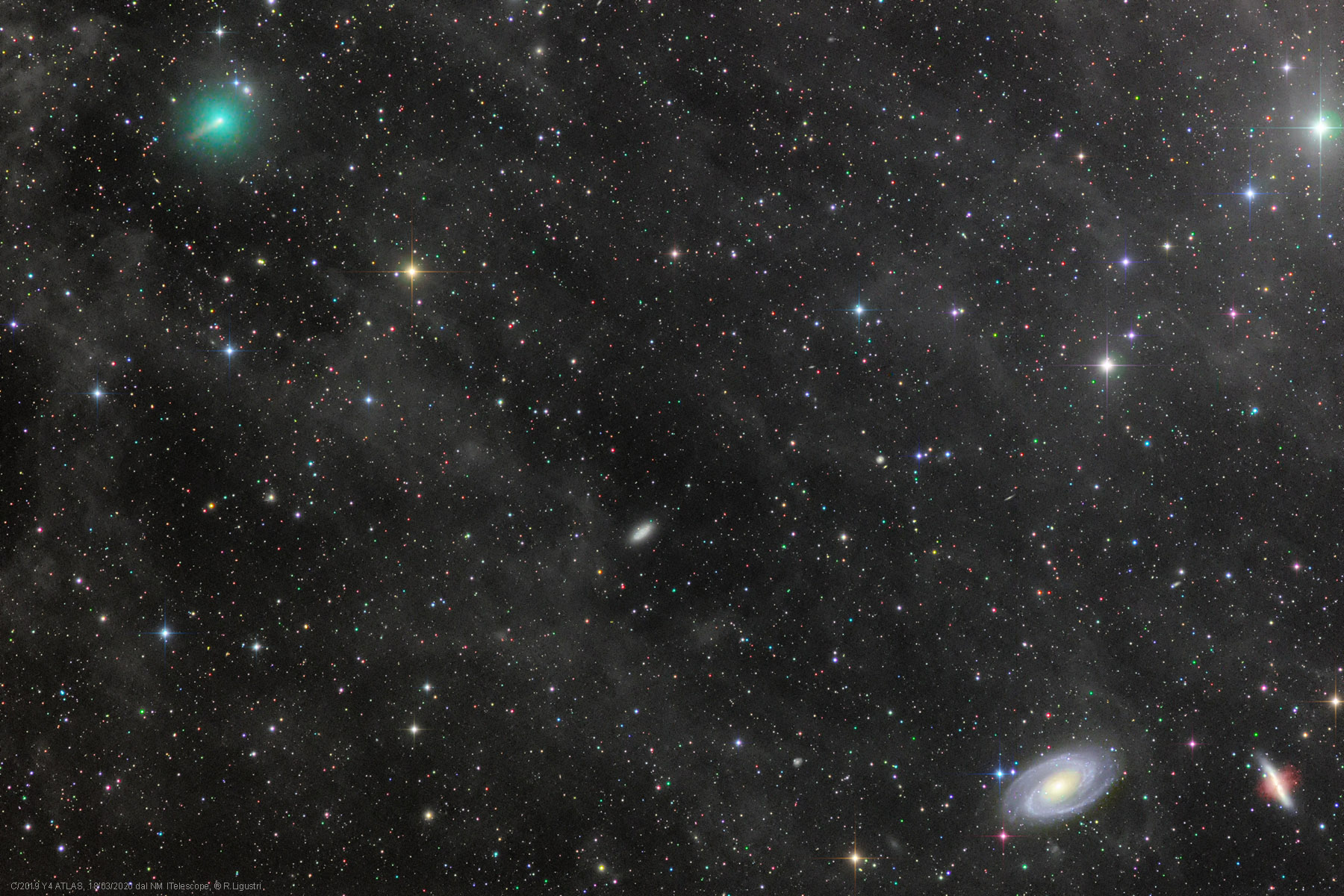
彗星 ATLAS C/2019 Y4 は、NASA の資金提供を受けた小惑星地球衝突最終警報システムによって発見され、2019 年に報告された最後の彗星発見です。現在、北の夜空で明るさを増しているこの彗星の美しい緑色のコマは、3 月 18 日にニューメキシコの遠隔操作天文台から撮影されたこの望遠鏡の空の写真の左上にあります。右下には、重力的に相互作用する大きな銀河としてよく知られている M81 と M82 があります。天の川の上空のかすかな塵の雲を通して見えるこの銀河ペアは、おおぐま座の方向に約 1200 万光年離れています。接近中の彗星 ATLAS は、まだ火星の軌道の外側で、地球から約 9 光分の距離にあります。この彗星の細長い軌道は、1844年の大彗星の軌道と似ており、約6000年後には太陽系内側に戻ってくる軌道を描いています。アトラス彗星は5月31日に水星の軌道の内側で近日点(太陽に最も接近する点)に達し、数日後には肉眼で見える彗星になる可能性があります。
原文(English)
Comet ATLAS C/2019 Y4 was discovered by the NASA funded Asteroid Terrestrial-impact Last Alert System, the last comet discovery reported in 2019. Now growing brighter in northern night skies, the comet's pretty greenish coma is at the upper left of this telescopic skyview captured from a remotely operated observatory in New Mexico on March 18. At lower right are M81 and M82, well-known as large, gravitationally interacting galaxies. Seen through faint dust clouds above the Milky Way, the galaxy pair lies about 12 million light-years distant, toward the constellation Ursa Major. In bound Comet ATLAS is about 9 light-minutes from Earth, still beyond the orbit of Mars. The comet's elongated orbit is similar to orbit of the Great Comet of 1844 though, a trajectory that will return this comet to the inner Solar System in about 6,000 years. Comet ATLAS will reach a perihelion or closest approach to the Sun on May 31 inside the orbit of Mercury and may become a naked-eye comet in the coming days.
\ この感動を宇宙仲間にシェア /
宇宙をXでシェア
© CARA Project / APOD