JWST打ち上げ時の噴煙の背後にレナード彗星が現れる
Comet Leonard behind JWST Launch Plume
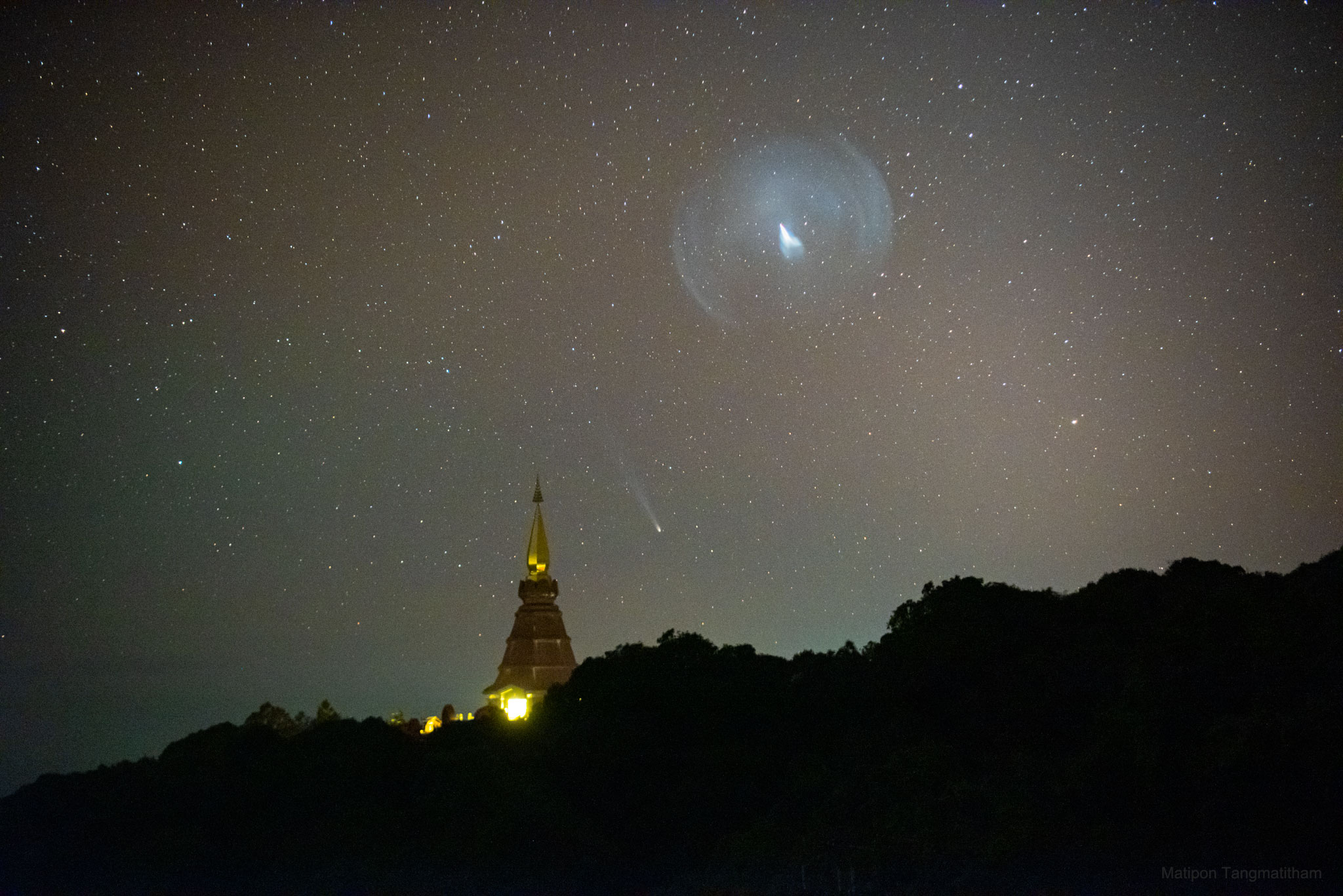
この2つの筋のうち、どちらが彗星でしょうか?どちらも彗星のような特徴を持っていますが、下側の筋だけが本物の彗星です。この下側の筋は、太陽の周りをループ軌道で周回しながら太陽系内を通過している、都市ほどの大きさの岩石質の氷の塊であるレナード彗星のコマと尾を示しています。レナード彗星は最近、地球と金星に最も接近し、来週には太陽の周りを回ります。肉眼でも見えるこの彗星は、ここ数週間で長く変化する尾を形成しています。一方、上側の筋は、2日前にジェームズ・ウェッブ宇宙望遠鏡(JWST)を地球から打ち上げたアリアンVロケットの噴射煙です。この単一露光画像はタイで撮影されたもので、手前の尖塔はドイ・インタノン国立公園の仏塔の頂上にあります。 NASAがこれまでに開発した中で最大かつ最も強力な宇宙望遠鏡であるJWSTは、地球と太陽のL2点付近を周回し、2022年夏に科学観測を開始する予定です。ギャラリー:レナード彗星2021 ギャラリー:ウェッブ宇宙望遠鏡 打ち上げ:2021年12月25日
原文(English)
Which one of these two streaks is a comet? Although they both have comet-like features, the lower streak is the only real comet. This lower streak shows the coma and tail of Comet Leonard, a city-sized block of rocky ice that is passing through the inner Solar System as it continues its looping orbit around the Sun. Comet Leonard has recently passed its closest to both the Earth and Venus and will round the Sun next week. The comet, still visible to the unaided eye, has developed a long and changing tail in recent weeks. In contrast, the upper streak is the launch plume of the Ariane V rocket that lifted the James Webb Space Telescope (JWST) off the Earth two days ago. The featured single-exposure image was taken from Thailand, and the foreground spire is atop a pagoda in Doi Inthanon National Park. JWST, NASA's largest and most powerful space telescope so far, will orbit the Sun near the Earth-Sun L2 point and is scheduled to start science observations in the summer of 2022. Gallery: Comet Leonard 2021 Gallery: Webb Space Telescope Launch: 2021 December 25
\ この感動を宇宙仲間にシェア /
宇宙をXでシェア
© Matipon Tangmatitham
(NARIT) / APOD