レナード彗星のさらに先の尾
The Further Tail of Comet Leonard
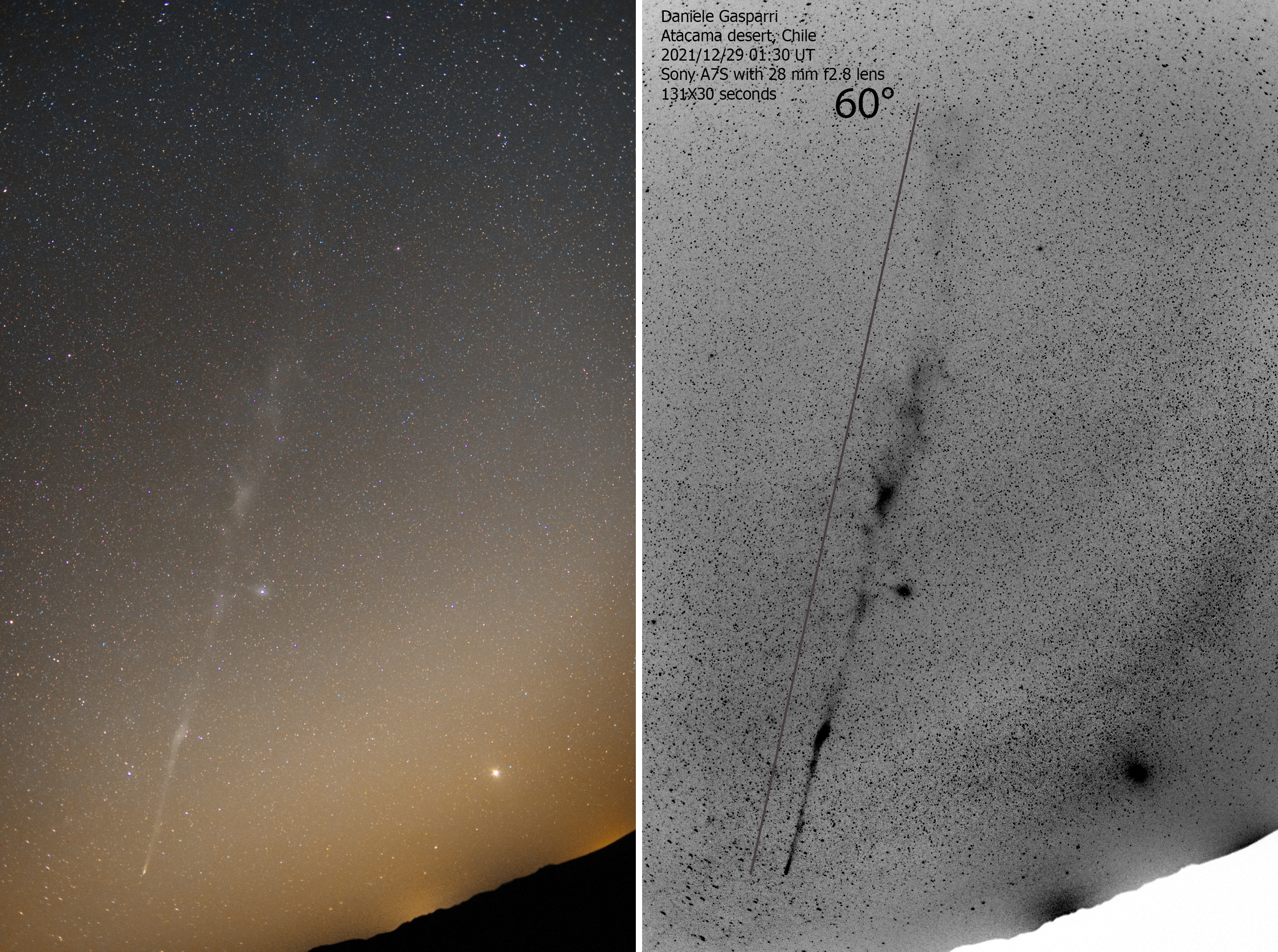
2021年で最も明るい彗星であるレナード彗星は、12月29日に暗いアタカマ砂漠の空で撮影されたこの2枚のパネルの左下に位置しています。1月3日に近日点に向かうレナード彗星の目に見える尾は伸びています。広角レンズで重ね合わせた露光画像(コントラストをつけるために白黒反転表示もされています)は、複雑なイオンの尾を驚くべき60度にわたって追跡しており、右下の地平線近くには明るい木星が輝いています。直径約1キロメートルの塵、岩石、氷の塊であるレナード彗星の核から蒸発した物質が、太陽光で蛍光を発する電離ガスの長い尾を作り出しています。ここ数週間の彗星の核でのフレアと磁場や太陽風による揺さぶりにより、尾は不規則に縮んでねじれたような外観になっています。太陽に最も接近するまでまだ数日あるため、レナード彗星の活動は続くと考えられます。この彗星は、南天の星座である顕微鏡座を通過する際に、太陽系の黄道面の南側に位置しています。
原文(English)
Comet Leonard, brightest comet of 2021, is at the lower left of these two panels captured on December 29 in dark Atacama desert skies. Heading for its perihelion on January 3 Comet Leonard's visible tail has grown. Stacked exposures with a wide angle lens (also displayed in a reversed B/W scheme for contrast), trace the complicated ion tail for an amazing 60 degrees, with bright Jupiter shining near the horizon at lower right. Material vaporizing from Comet Leonard's nucleus, a mass of dust, rock, and ices about 1 kilometer across, has produced the long tail of ionized gas fluorescing in the sunlight. Likely flares on the comet's nucleus and buffeting by magnetic fields and the solar wind in recent weeks have resulted in the tail's irregular pinched and twisted appearance. Still days from its closest approach to the Sun, Comet Leonard's activity should continue. The comet is south of the Solar System's ecliptic plane as it sweeps through the southern constellation Microscopium.
\ この感動を宇宙仲間にシェア /
宇宙をXでシェア
© Daniele Gasparri / APOD