ケフェウス座のNGC 7822
NGC 7822 in Cepheus
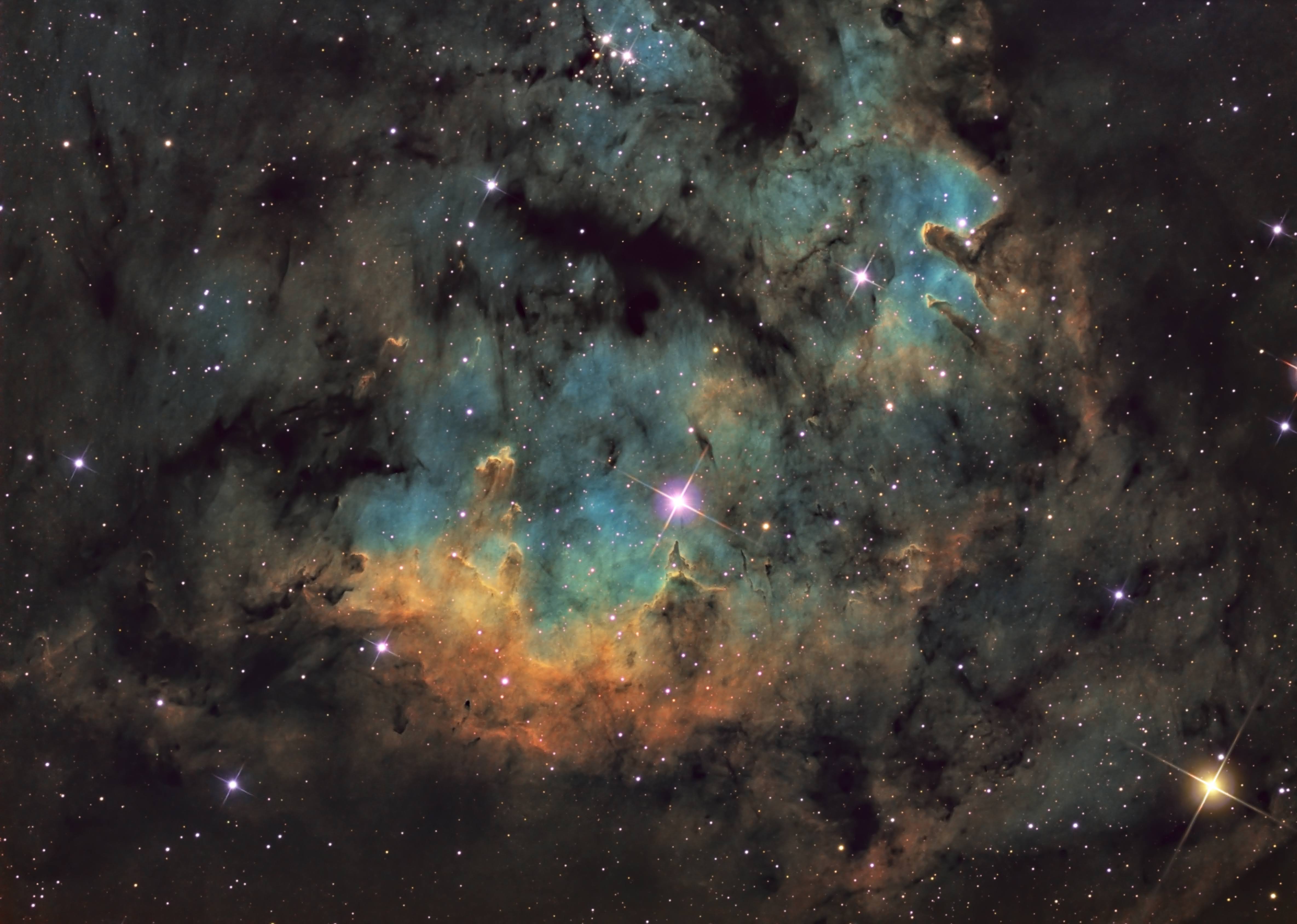
高温の若い星々とガスと塵の宇宙の柱がNGC 7822に密集しているように見える。北天の星座ケフェウス座に向かう巨大分子雲の端にあるこの輝く星形成領域は、約3,000光年離れたところにある。この星雲の中では、明るい縁と暗い形が、この色鮮やかな望遠鏡の空に際立っている。この画像には、原子状酸素、水素、硫黄からの放射を青、緑、赤の色調にマッピングする狭帯域フィルターのデータが含まれている。この放射線と色の組み合わせは、ハッブルパレットとしてよく知られている。原子放射は、中心の高温の星からの高エネルギー放射によって駆動されている。それらの強力な風と放射は、より密度の高い柱の形状を形作り、侵食し、誕生雲の中心を数光年にわたって特徴的な空洞を空けている。星は重力崩壊によって柱の中でまだ形成されている可能性があるが、柱が侵食されるにつれて、形成中の星は最終的に星物質の貯蔵庫から切り離されることになる。この視野は、NGC 7822の推定距離で約40光年の範囲に及ぶ。
原文(English)
Hot, young stars and cosmic pillars of gas and dust seem to crowd into NGC 7822. At the edge of a giant molecular cloud toward the northern constellation Cepheus, the glowing star forming region lies about 3,000 light-years away. Within the nebula, bright edges and dark shapes stand out in this colorful telescopic skyscape. The image includes data from narrowband filters, mapping emission from atomic oxygen, hydrogen, and sulfur into blue, green, and red hues. The emission line and color combination has become well-known as the Hubble palette. The atomic emission is powered by energetic radiation from the central hot stars. Their powerful winds and radiation sculpt and erode the denser pillar shapes and clear out a characteristic cavity light-years across the center of the natal cloud. Stars could still be forming inside the pillars by gravitational collapse but as the pillars are eroded away, any forming stars will ultimately be cutoff from their reservoir of star stuff. This field of view spans about 40 light-years at the estimated distance of NGC 7822.
\ この感動を宇宙仲間にシェア /
宇宙をXでシェア
© Mark Carter / APOD