水銀のナトリウム尾
Mercury's Sodium Tail
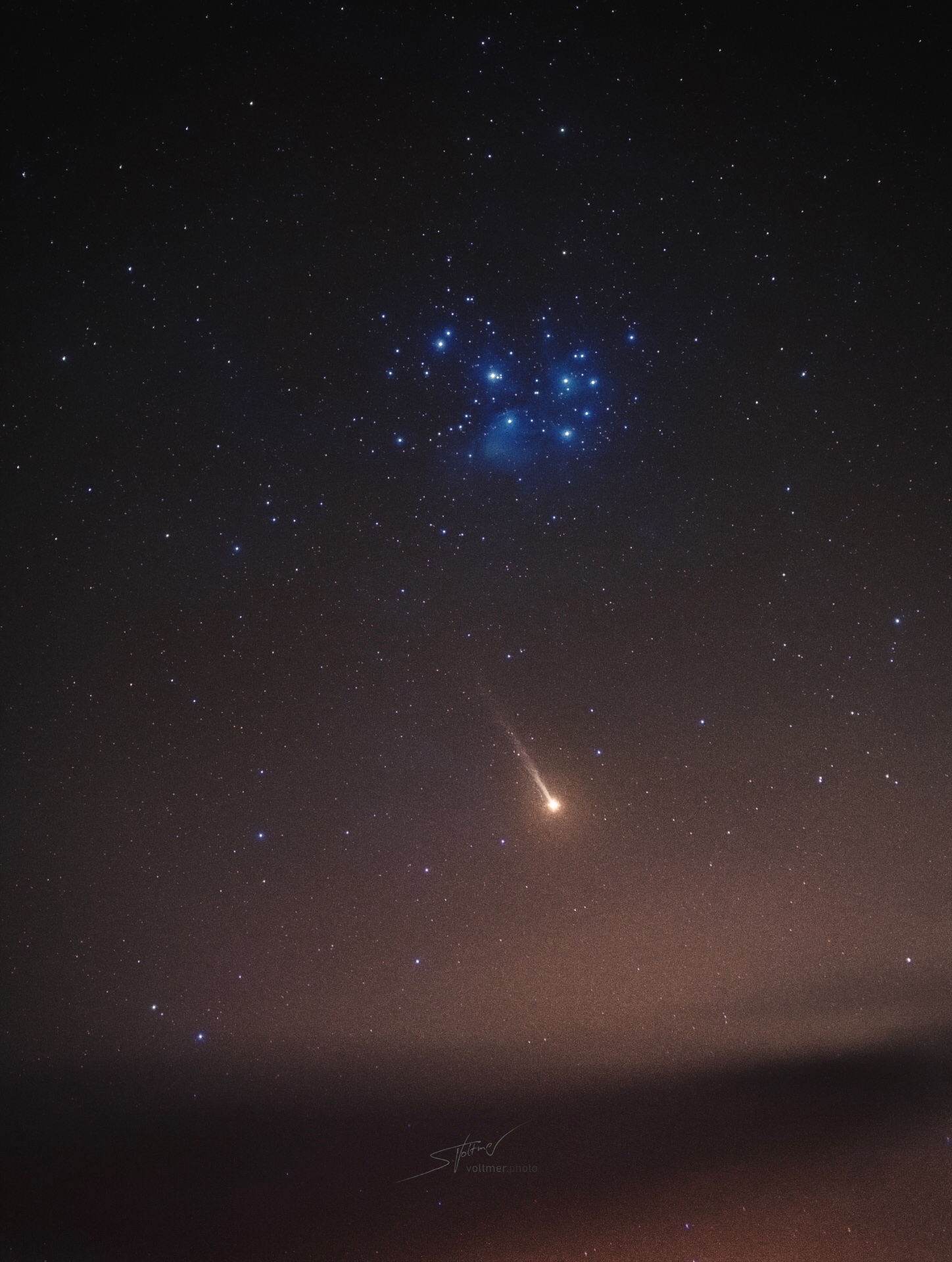
あれは彗星ではありません。プレアデス星団の下には、実は惑星、水星があります。太陽系最内惑星である水星を長時間露光すると、予想外のものが見えることがあります。それは尾です。水星の薄い大気には、太陽光によって励起されると光る少量のナトリウムが含まれています。太陽光はまた、これらの原子を水星の表面から放出し、遠ざけます。特にナトリウムの黄色い光は比較的明るいです。写真に写っているのは、先週スペインのラ・パルマ島から、主にナトリウムから放出される黄色い光を透過するフィルターを通して撮影された深宇宙画像で、水星とそのナトリウムの尾が見えるものです。1980年代に初めて予測された水星の尾は、2001年に初めて発見されました。尾の多くの詳細は、2011年から2015年にかけて水星を周回したNASAのロボット探査機MESSENGERによる複数の観測で明らかになりました。尾は、もちろん、通常は彗星に関連付けられています。
原文(English)
That's no comet. Below the Pleiades star cluster is actually a planet: Mercury. Long exposures of our Solar System's innermost planet may reveal something unexpected: a tail. Mercury's thin atmosphere contains small amounts of sodium that glow when excited by light from the Sun. Sunlight also liberates these atoms from Mercury's surface and pushes them away. The yellow glow from sodium, in particular, is relatively bright. Pictured, Mercury and its sodium tail are visible in a deep image taken last week from La Palma, Spain through a filter that primarily transmits yellow light emitted by sodium. First predicted in the 1980s, Mercury's tail was first discovered in 2001. Many tail details were revealed in multiple observations by NASA's robotic MESSENGER spacecraft that orbited Mercury between 2011 and 2015. Tails, of course, are usually associated with comets.
\ この感動を宇宙仲間にシェア /
宇宙をXでシェア
© Sebastian Voltmer / APOD