天の川銀河のブラックホール
The Milky Way's Black Hole
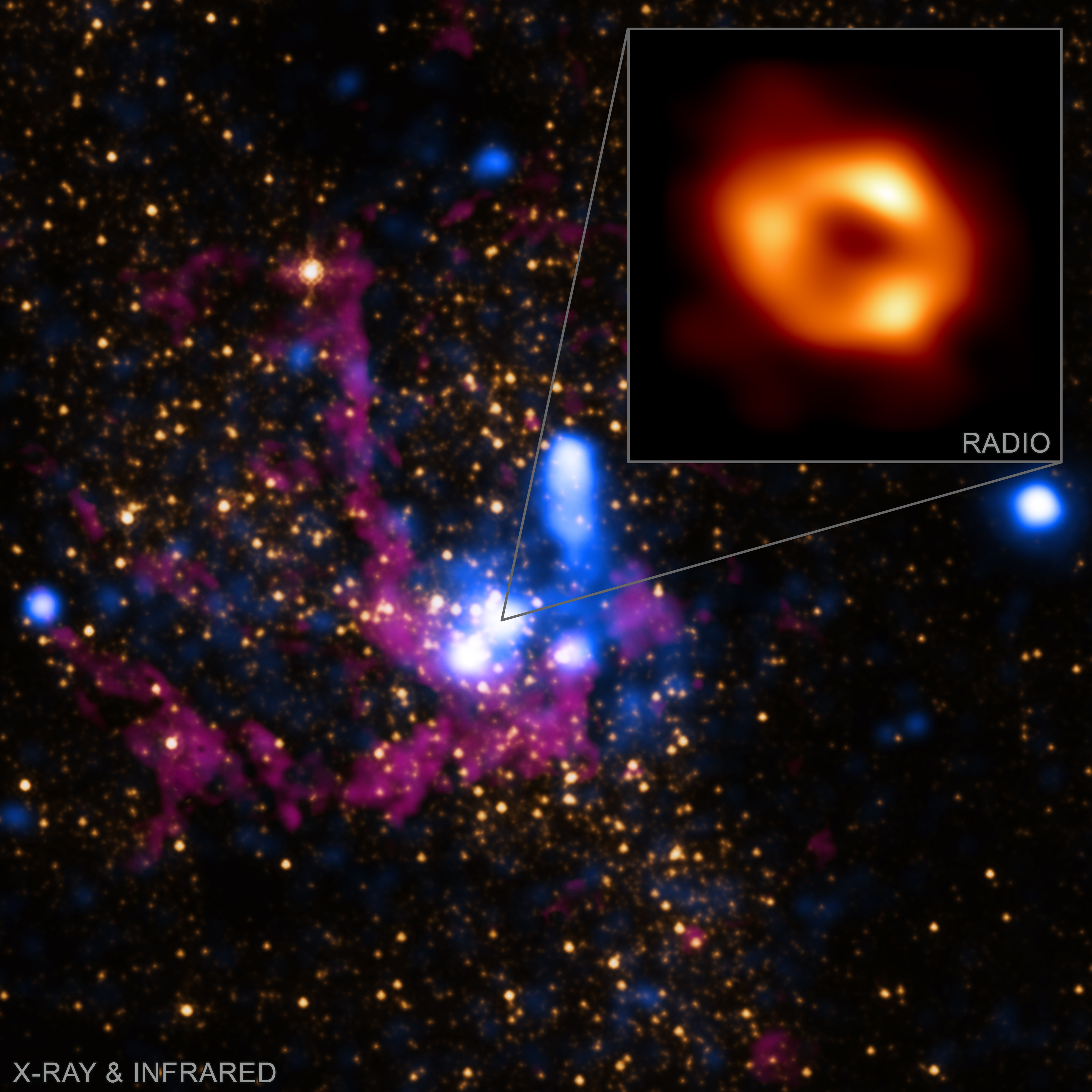
天の川銀河の中心にはブラックホールが存在します。星々は、Sgr A*(「サッジエイスター」と発音)として知られる、非常に質量が大きくコンパクトな天体の周りを公転していることが観測されています。しかし、地球のイベントホライズンテレスコープから最近公開されたこの電波画像(挿入図)は、天の川銀河の中心にあるブラックホールの直接的な証拠としては初めてのものです。アインシュタインの一般相対性理論で予測されたように、太陽質量の400万倍のブラックホールの強い重力は光を曲げ、明るいリング状の構造に囲まれた影のような暗い中心領域を作り出しています。宇宙望遠鏡や地上観測所による観測は、銀河中心の動的な環境をより広く把握することを可能にし、イベントホライズンテレスコープのブラックホール画像の重要な背景を提供します。メインパネルの画像は、チャンドラX線データとハッブル宇宙望遠鏡の赤外線データを示しています。メインパネルの直径は約7光年だが、イベントホライズンテレスコープの挿入画像自体は、約2万7000光年離れた銀河の中心でわずか10光分の範囲にしか広がっていない。
原文(English)
There's a black hole at the center of the Milky Way. Stars are observed to orbit a very massive and compact object there known as Sgr A* (say "sadge-ay-star"). But this just released radio image (inset) from planet Earth's Event Horizon Telescope is the first direct evidence of the Milky Way's central black hole. As predicted by Einstein's Theory of General Relativity, the four million solar mass black hole's strong gravity is bending light and creating a shadow-like dark central region surrounded by a bright ring-like structure. Supporting observations made by space-based telescopes and ground-based observatories provide a wider view of the galactic center's dynamic environment and an important context for the Event Horizon Telescope's black hole image. The main panel image shows the X-ray data from Chandra and infrared data from Hubble. While the main panel is about 7 light-years across, the Event Horizon Telescope inset image itself spans a mere 10 light-minutes at the center of our galaxy, some 27,000 light-years away.
\ この感動を宇宙仲間にシェア /
宇宙をXでシェア
© NASA / APOD