アンドロメダのかつての星と未来の星
The Once and Future Stars of Andromeda
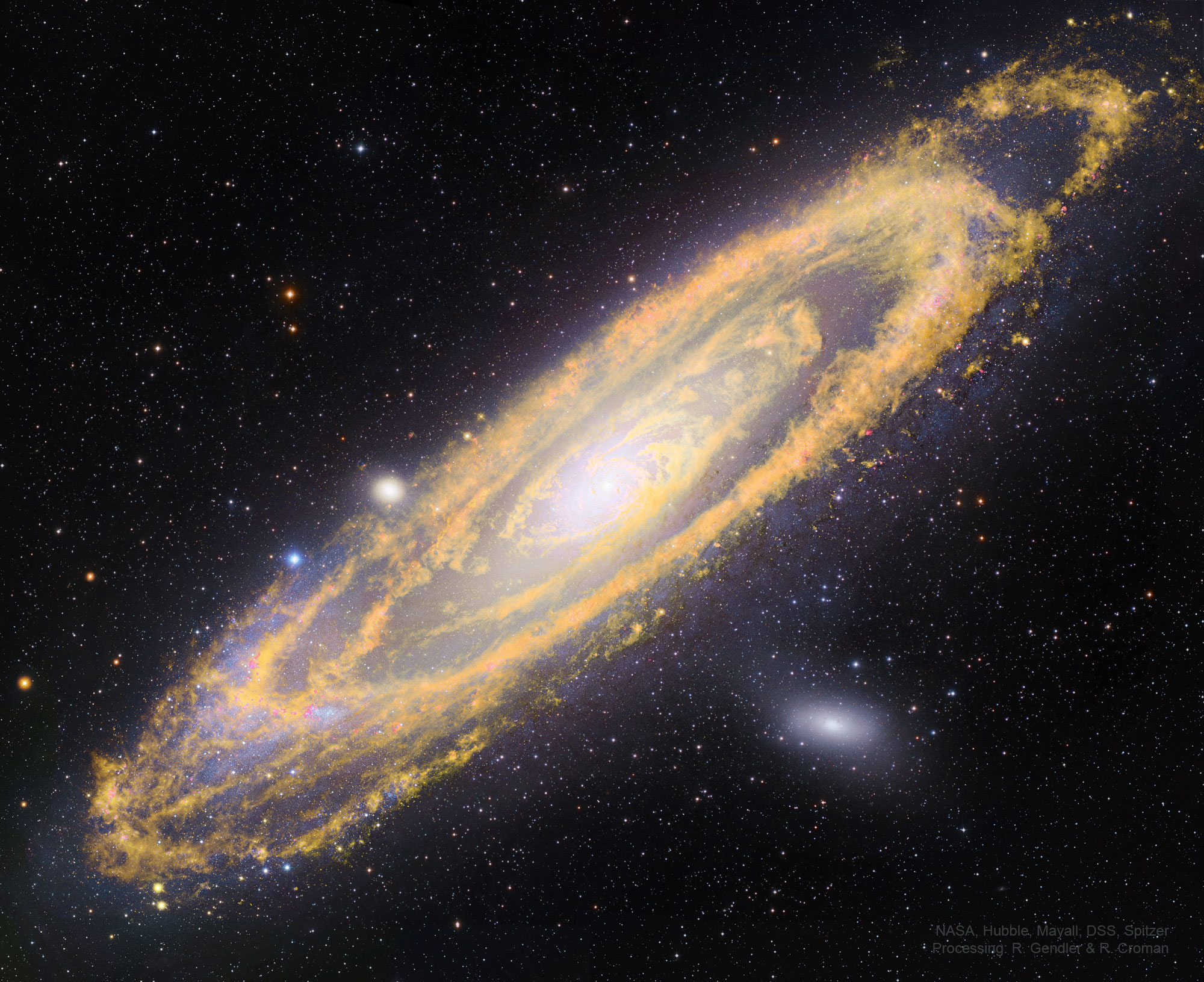
このアンドロメダ銀河の画像は、星が現在どこにあるかだけでなく、星がまもなくどこになるかも示しています。もちろん、大きくて美しいアンドロメダ銀河(M31)は渦巻銀河で、わずか250万光年しか離れていません。宇宙望遠鏡と地上望遠鏡の両方が協力して、通常の可視光の内外の波長で、この興味深いアンドロメダ銀河の合成画像を作成しました。可視光は、ハッブル宇宙望遠鏡、すばる望遠鏡、メイオール望遠鏡によって撮影され、白と青の色調で強調されているように、M31の星が現在どこにあるかを示しています。赤外線は、NASAのスピッツァー宇宙望遠鏡によって撮影され、オレンジ色で強調されているように、M31の将来の星がまもなく形成される場所を示しています。赤外線は、星によって温められた巨大な塵の帯がアンドロメダの渦状腕に沿って掃引している様子を追跡しています。この塵は、銀河の広大な星間ガス、つまり将来の星形成の原材料のトレーサーです。これらの新しい星は、おそらく今後1億年の間に形成されるだろう。それは、アンドロメダ銀河が約50億年後に私たちの天の川銀河と合体するずっと前のことだろう。
原文(English)
This picture of Andromeda shows not only where stars are now, but where stars will soon be. Of course, the big, beautiful Andromeda Galaxy, M31, is a spiral galaxy -- and a mere 2.5 million light-years away. Both space-based and ground-based observatories have been here combined to produce this intriguing composite image of Andromeda, at wavelengths both inside and outside normally visible light. The visible light shows where M31's stars are now -- as highlighted in white and blue hues and imaged by the Hubble, Subaru, and Mayall telescopes. The infrared light shows where M31's future stars will soon form -- as highlighted in orange hues and imaged by NASA's Spitzer Space Telescope. The infrared light tracks enormous lanes of dust, warmed by stars, sweeping along Andromeda's spiral arms. This dust is a tracer of the galaxy's vast interstellar gas -- the raw material for future star formation. These new stars will likely form over the next hundred million years, surely well before Andromeda merges with our Milky Way Galaxy in about 5 billion years.
\ この感動を宇宙仲間にシェア /
宇宙をXでシェア
© NASA / APOD