天の川銀河は破滅の危機に瀕している:アンドロメダ銀河との衝突が迫っている
Milky Way Galaxy Doomed: Collision with Andromeda Pending
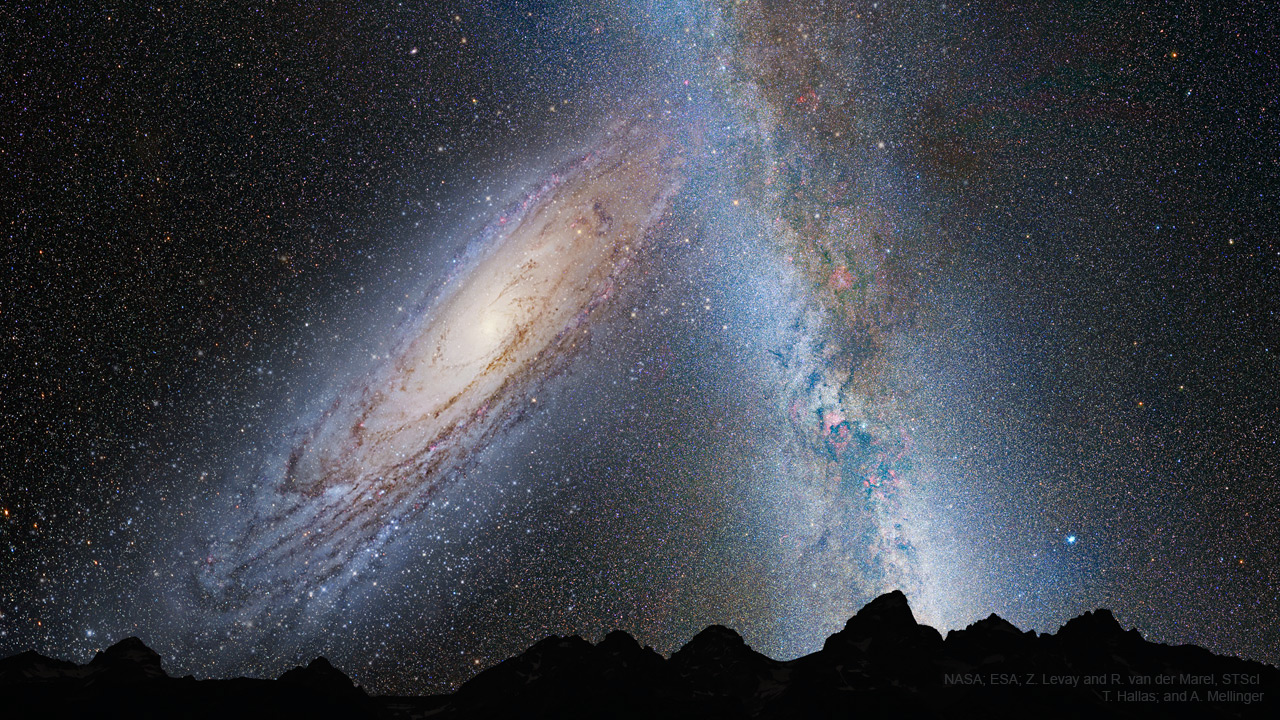
私たちの天の川銀河は、いつか隣のより大きなアンドロメダ銀河と衝突するのでしょうか?おそらくそうでしょう。ハッブル宇宙望遠鏡の最近の画像で、M31の星々が背景の銀河に対してわずかにずれていることを注意深くプロットすると、M31の中心が私たちの銀河の中心と直接衝突するコースにある可能性があることが示されています。しかし、横方向の速度の誤差は十分に大きいため、2つの銀河の中心部がわずかに衝突を免れる可能性は高いものの、外側のハローが重力的に絡み合うほど接近するでしょう。そうなると、2つの銀河は束縛され、周囲を回り、最終的には合体して1つの大きな楕円銀河になります。これは今後数十億年かけて起こります。ここに示されているのは、それぞれの銀河の外縁部が衝突し始める遠い未来の世界(地球?)の空を描いた画像の組み合わせです。私たちの銀河系、そしてその周辺の局所銀河群全体の正確な未来は、今後何年にもわたって活発な研究テーマであり続けるだろう。
原文(English)
Will our Milky Way Galaxy collide one day with its larger neighbor, the Andromeda Galaxy? Most likely, yes. Careful plotting of slight displacements of M31's stars relative to background galaxies on recent Hubble Space Telescope images indicate that the center of M31 could be on a direct collision course with the center of our home galaxy. Still, the errors in sideways velocity appear sufficiently large to admit a good chance that the central parts of the two galaxies will miss, slightly, but will become close enough for their outer halos to become gravitationally entangled. Once that happens, the two galaxies will become bound, dance around, and eventually merge to become one large elliptical galaxy -- over the next few billion years. Pictured here is a combination of images depicting the sky of a world (Earth?) in the distant future when the outer parts of each galaxy begin to collide. The exact future of our Milky Way and the entire surrounding Local Group of Galaxies is likely to remain an active topic of research for years to come.
\ この感動を宇宙仲間にシェア /
宇宙をXでシェア
© NASA / APOD