成層圏から見たオーロラ
Northern Lights from the Stratosphere
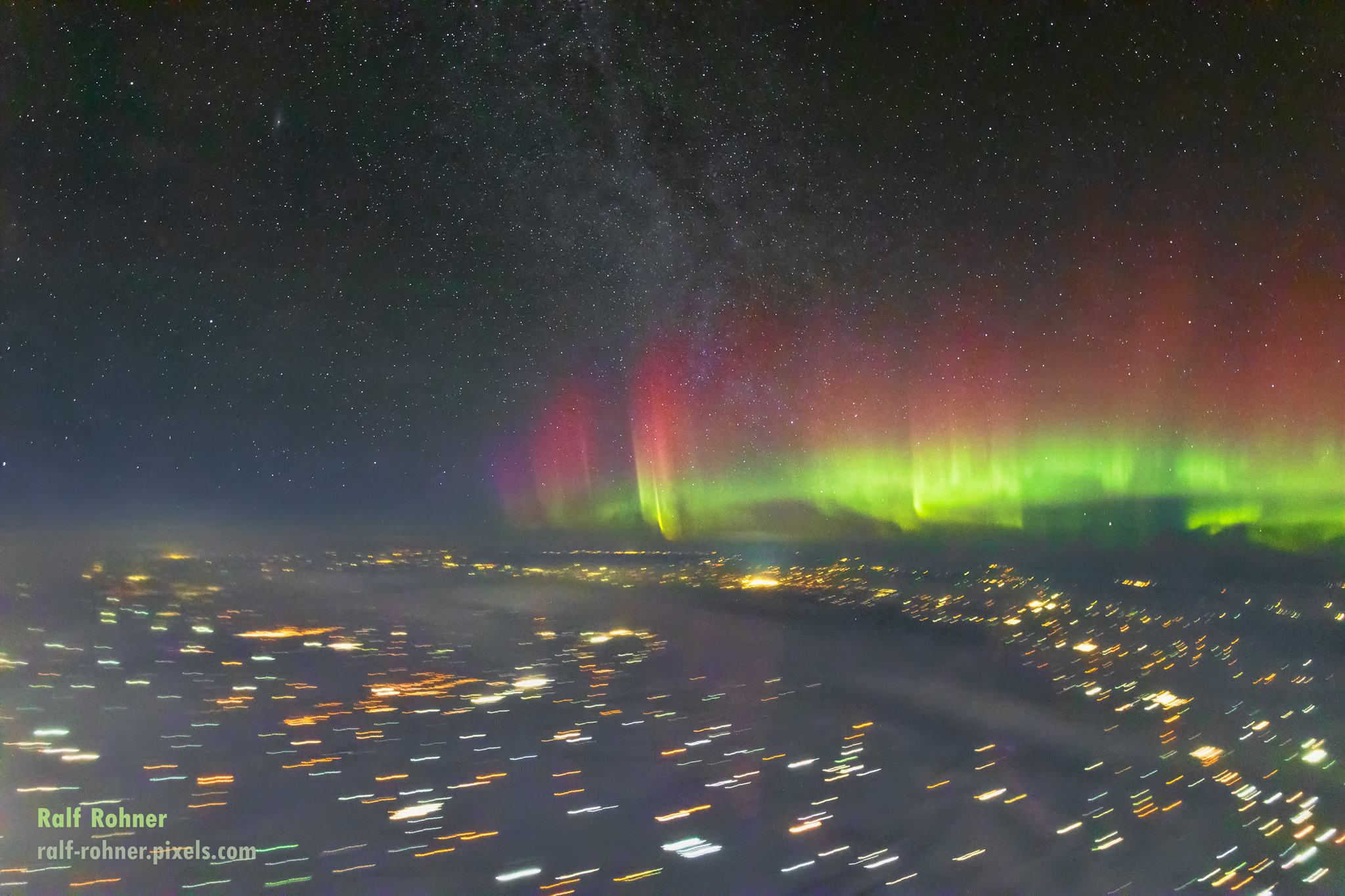
1月15日に撮影された、地球の成層圏から見た夜空の眺めには、オーロラが輝いています。この5秒間の単一露光写真は、カナダのウィニペグ上空を飛行する航空機に搭載された手持ちカメラで撮影されました。露光中、地上の明かりが、高速で飛行する航空機の進行方向に沿って色鮮やかな軌跡を残します。さらに遠くの地平線上では、地球の極域で地球の磁場に沿って加速された高エネルギー粒子が原子状酸素を励起し、オーロラのきらめく光景を作り出します。オーロラの特徴的な緑色は高度100~300キロメートルで発生し、さらに高い高度や低い大気密度では赤色になります。天の川銀河の平面に沿って微かな星々の光が夜空を弧を描いて広がり、アンドロメダ銀河はこの北の空の眺めを銀河系外の宇宙空間へと広げています。天の川銀河に最も近い大きな渦巻銀河であるアンドロメダ銀河のぼんやりとした痕跡が、左上にかろうじて見えます。
原文(English)
Northern lights shine in this night skyview from planet Earth's stratosphere, captured on January 15. The single, 5 second exposure was made with a hand-held camera on board an aircraft above Winnipeg, Canada. During the exposure, terrestrial lights below leave colorful trails along the direction of motion of the speeding aircraft. Above the more distant horizon, energetic particles accelerated along Earth's magnetic field at the planet's polar regions excite atomic oxygen to create the shimmering display of Aurora Borealis. The aurora's characteristic greenish hue is generated at altitudes of 100-300 kilometers and red at even higher altitudes and lower atmospheric densities. The luminous glow of faint stars along the plane of our Milky Way galaxy arcs through the night, while the Andromeda galaxy extends this northern skyview to extragalactic space. A diffuse hint of Andromeda, the closest large spiral to the Milky Way, can just be seen to the upper left.
\ この感動を宇宙仲間にシェア /
宇宙をXでシェア
© Ralf Rohner / APOD