HFG1とアベル6:惑星状星雲
HFG1 & Abell 6: Planetary Nebulae
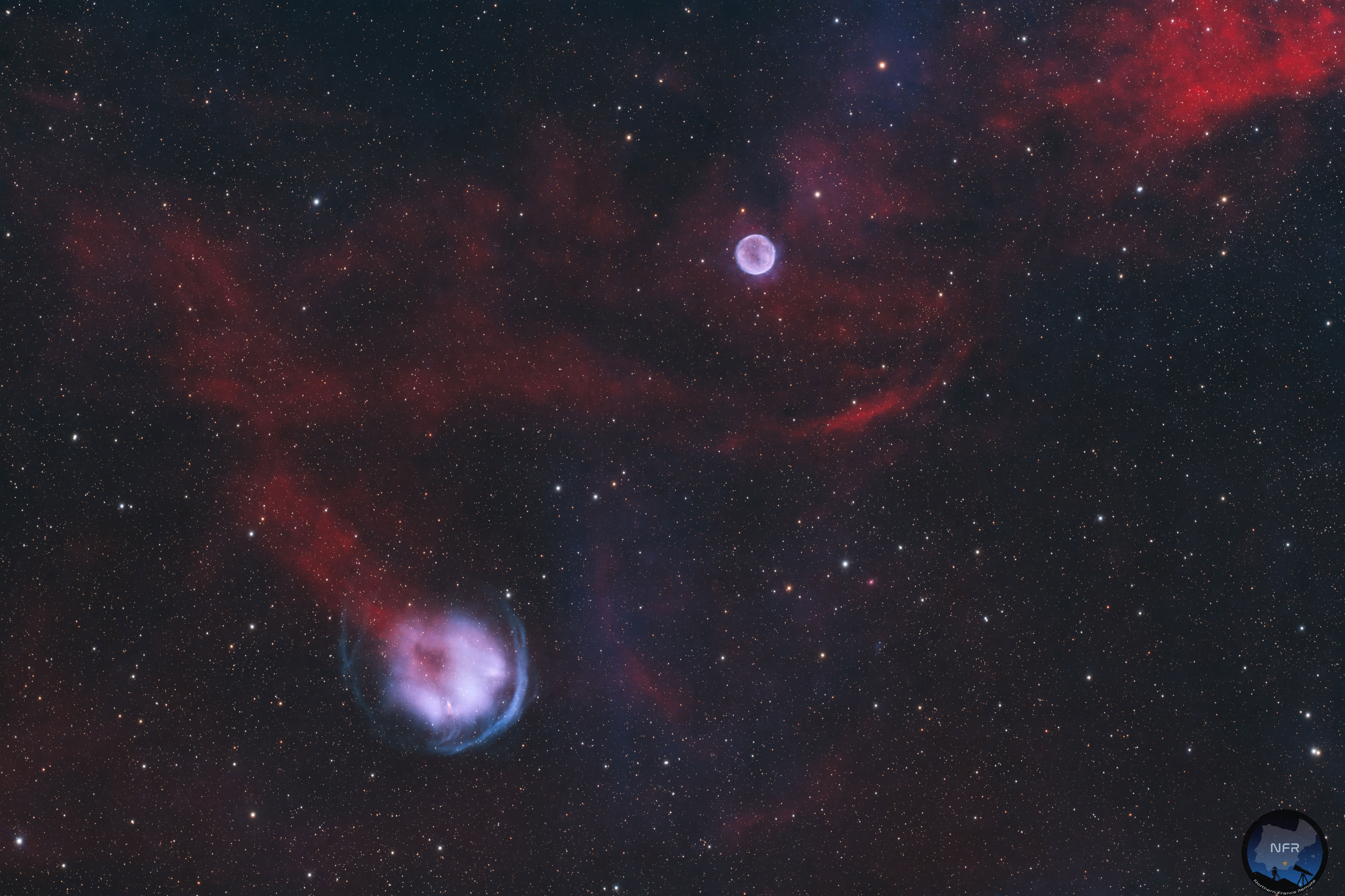
カシオペヤ座のヘッカソーン・フェセン・ガル1(HFG1)やアベル6のような惑星状星雲は、太陽のような中型星の最終段階の残骸です。その形状にもかかわらず、惑星状星雲は実際の惑星とは何の関係もありません。掲載写真の左下部分に位置するHFG1は、白色矮星と赤色巨星からなる連星系V664 Casによって形成されました。両方の星は、地球の約半日で重心の周りを公転しています。V664 Casは、地球上で最も速い列車の約300倍の速度で星雲全体を移動し、青みがかった弧状の衝撃波を発生させます。この衝撃波は、弧が最も明るい領域で周囲の星間物質と最も強く相互作用します。約1万年後、惑星状星雲は、それを形成する星から紫外線が放出されなくなるため、見えなくなります。美しい形状と構造を持つ惑星状星雲は、天体写真家にとって非常に魅力的な被写体である。
原文(English)
Planetary nebulae like Heckathorn-Fesen-Gull 1 (HFG1) and Abell 6 in the constellation Cassiopeia are remnants from the last phase of a medium sized star like our Sun. In spite of their shapes, planetary nebulae have nothing in common with actual planets. Located in the bottom left part of the featured photo, HFG1 was created by the binary star system V664 Cas, which consists of a white dwarf star and a red giant star. Both stars orbit their center of mass over about half an Earth day. Traveling with the entire nebula at a speed about 300 times faster than the fastest train on Earth, V664 Cas generates a bluish arc shaped shock wave. The wave interacts most strongly with the surrounding interstellar medium in the areas where the arc is brightest. After roughly 10,000 years, planetary nebulae become invisible due to a lack of ultraviolet light being emitted by the stars that create them. Displaying beautiful shapes and structures, planetary nebulae are highly desired objects for astrophotographers.
\ この感動を宇宙仲間にシェア /
宇宙をXでシェア
© Julien Cadena &
Mickael Coulon;
Text: Natalia Lewandowska
(SUNY Oswego) / APOD