AM1054:銀河の衝突によって星が形成される
AM1054: Stars Form as Galaxies Collide
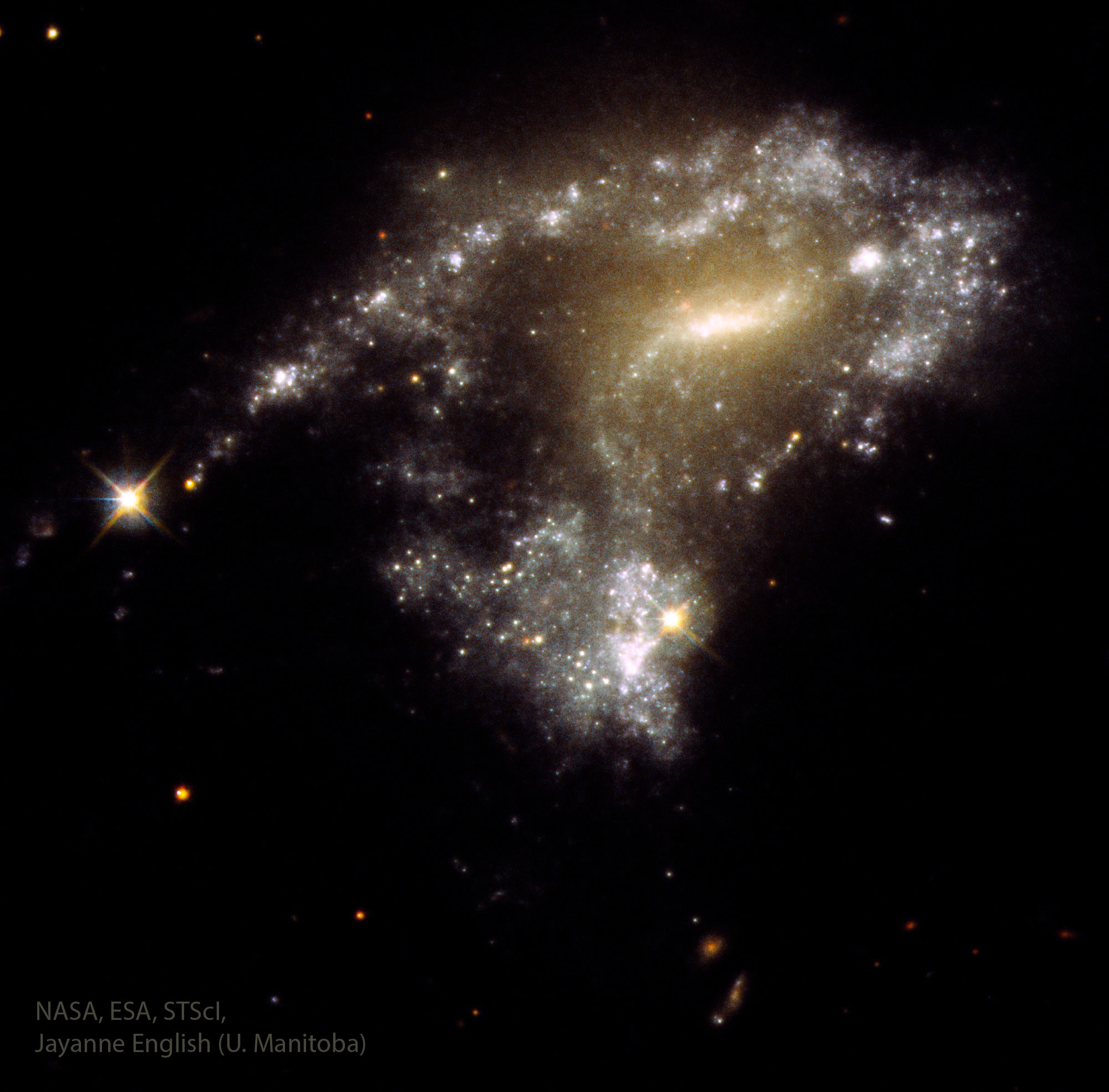
銀河が衝突すると、いくつの星が生まれるのでしょうか?ハッブル宇宙望遠鏡が最近公開した画像に写っているAM1054-325の場合、答えは数百万です。銀河AM1054-325と近くの銀河が互いの周りを回る際に星が破壊されるのではなく、その重力と運動によって星の誕生が引き起こされました。星形成は、もう一方の銀河の重力によってAM1054-325の黄色い本体から伸びるガス状の残骸の中で急速に起こります。生まれたばかりの星を取り囲む水素ガスはピンク色に輝きます。明るい生まれたばかりの星は青く輝き、数千から数百万個の星が密集した星団を形成します。AM1054-325には、真珠のネックレスのように見えるものも含め、このような鮮やかな青色の点状の星団が100個以上存在します。紫外線の分析により、これらの星のほとんどが1000万歳未満であることが判明しました。まさに星の赤ちゃんです。これらの星形成領域の多くは球状星団に成長する可能性があり、底部の先端にある若い星の束は分離して小さな銀河を形成する可能性さえある。
原文(English)
When galaxies collide, how many stars are born? For AM1054-325, featured here in a recently released image by the Hubble Space Telescope, the answer is millions. Instead of stars being destroyed as galaxy AM1054-325 and a nearby galaxy circle each other, their gravity and motion has ignited stellar creation. Star formation occurs rapidly in the gaseous debris stretching from AM1054-325’s yellowish body due to the other galaxy’s gravitational pull. Hydrogen gas surrounding newborn stars glows pink. Bright infant stars shine blue and cluster together in compact nurseries of thousands to millions of stars. AM1054-325 possesses over 100 of these intense-blue, dot-like star clusters, some appearing like a string of pearls. Analyzing ultraviolet light helped determine that most of these stars are less than 10 million years old: stellar babies. Many of these nurseries may grow up to be globular star clusters, while the bundle of young stars at the bottom tip may even detach and form a small galaxy.
\ この感動を宇宙仲間にシェア /
宇宙をXでシェア
© NASA / APOD