地球の最南端より下での皆既日食
Total Solar Eclipse Below the Bottom of the World
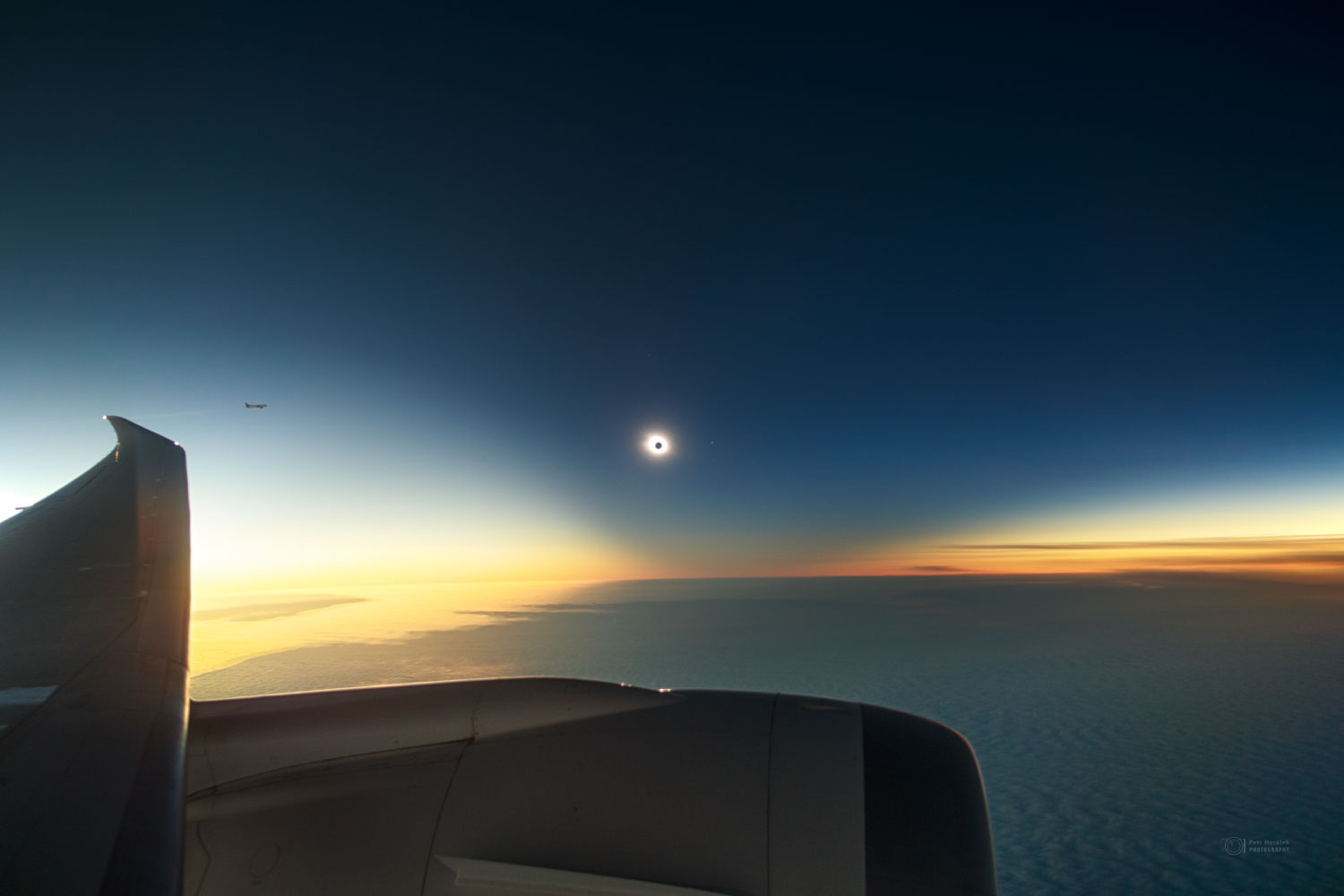
2021年末、地球の果てでのみ観測可能な皆既日食がありました。この珍しい現象を捉えるため、飛行機が南氷洋の雲に覆われた海面の下を飛行しました。掲載されている画像は、比較的見事な撮影例の一つで、明るい点が太陽の外側のコロナ、中央の暗い点が月食の様子を示しています。画像の左下には飛行機の翼とエンジンが見え、左端には日食を観測している別の飛行機が見えます。日食中の太陽を取り囲む空の暗い部分は、影円錐と呼ばれます。これは、月によって影になった長い空気の回廊を見下ろしているため、暗く見えるのです。日食中の太陽を注意深く観察すると、すぐ右に水星が見えます。次の皆既日食を見るために地球の果てまで行く必要はありません。皆既日食の経路は、今日からちょうど1週間後の2024年4月8日に北アメリカを横断します。 NASAの報道:2024年4月8日の皆既日食
原文(English)
In late 2021 there was a total solar eclipse visible only at the end of the Earth. To capture the unusual phenomenon, airplanes took flight below the clouded seascape of Southern Ocean. The featured image shows one relatively spectacular capture where the bright spot is the outer corona of the Sun and the eclipsing Moon is seen as the dark spot in the center. A wing and engine of the airplane are visible across the left and bottom of the image, while another airplane observing the eclipse is visible on the far left. The dark area of the sky surrounding the eclipsed Sun is called a shadow cone. It is dark because you are looking down a long corridor of air shadowed by the Moon. A careful inspection of the eclipsed Sun will reveal the planet Mercury just to the right. You won't have to travel to the end of the Earth to see the next total solar eclipse. The total eclipse path will cross North America on 2024 April 8, just over one week from today. NASA Coverage: Total Solar Eclipse of 2024 April 8
\ この感動を宇宙仲間にシェア /
宇宙をXでシェア
© Petr Horálek
(ESO
Photo Ambassador,
Inst. of Physics in Opava) ;
Acknowledgement:
Xavier Jubier / APOD