M51の巻き戻し
Unwinding M51
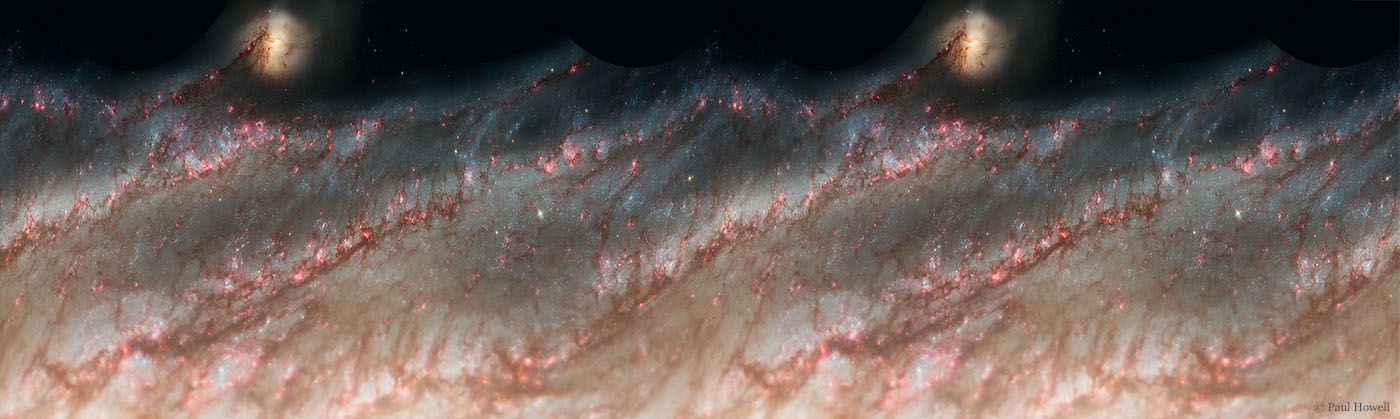
2005年にハッブル宇宙望遠鏡が撮影した壮大なM51銀河の画像をデジタル変換すると、直径6万光年の巨大な渦巻銀河の腕がほどけていく様子がわかる。実際、M51は原始的な渦巻星雲の一つで、その渦巻く腕は対数螺旋と呼ばれる数学的な曲線で表され、中心からの距離が大きくなるにつれて螺旋の間隔が幾何級数的に広がっていく。ハッブル画像のピクセル座標をM51の中心に対して対数を用いてずらすと、銀河の渦巻腕は斜めの直線としてマッピングされる。変換された画像は、腕自体が星形成によって描かれ、ピンク色の星形成領域と若い青い星団が並んでいることを劇的に示している。伴銀河NGC 5195(上部)は、その手前の腕の軌跡を変えているように見えるが、M51のこの展開による影響は比較的受けていない。スピラ・ミラビリスとも呼ばれる対数螺旋は、あらゆるスケールで自然界に見られます。例えば、対数螺旋はハリケーン、バブルチャンバー内の素粒子の軌跡、そしてもちろんカリフラワーも表すことができます。NASA報道:2024年4月8日の皆既日食
原文(English)
The arms of a grand design spiral galaxy 60,000 light-years across are unwound in this digital transformation of the magnificent 2005 Hubble Space Telescope portrait of M51. In fact, M51 is one of the original spiral nebulae, its winding arms described by a mathematical curve known as a logarithmic spiral, a spiral whose separation grows in a geometric way with increasing distance from the center. Applying logarithms to shift the pixel coordinates in the Hubble image relative to the center of M51 maps the galaxy's spiral arms into diagonal straight lines. The transformed image dramatically shows the arms themselves are traced by star formation, lined with pinkish starforming regions and young blue star clusters. Companion galaxy NGC 5195 (top) seems to alter the track of the arm in front of it though, and itself remains relatively unaffected by this unwinding of M51. Also known as the spira mirabilis, logarthimic spirals can be found in nature on all scales. For example, logarithmic spirals can also describe hurricanes, the tracks of subatomic particles in a bubble chamber and, of course, cauliflower. NASA Coverage: Total Solar Eclipse of 2024 April 8
\ この感動を宇宙仲間にシェア /
宇宙をXでシェア
© Hubble Heritage Project / APOD