レグルスと矮小銀河
Regulus and the Dwarf Galaxy
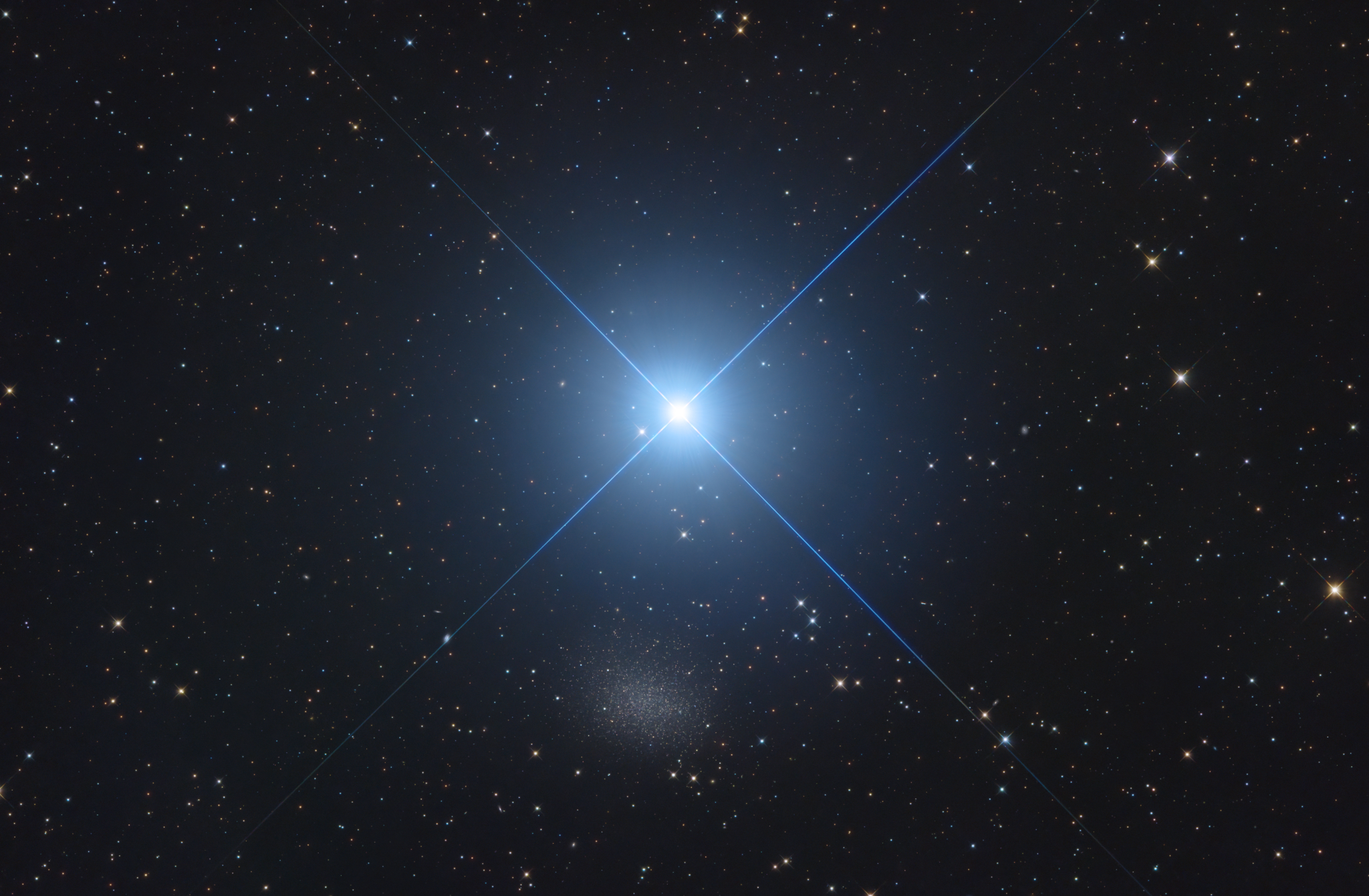
北半球の春には、明るい星レグルスが東の地平線上に簡単に見つけることができます。しし座のアルファ星であるレグルスは、この望遠鏡の視野の中心にある尖った星です。わずか79光年しか離れていないレグルスは、高温で高速回転する星で、多重星系の一部であることが知られています。レグルスのすぐ下にあるぼやけた部分は、そのまぶしさに完全に隠れてはいませんが、小さな銀河Leo Iからの拡散星光です。Leo Iは矮小楕円体銀河で、私たちの天の川銀河とアンドロメダ銀河(M31)が支配する局所銀河群のメンバーです。約80万光年離れているLeo Iは、天の川銀河を周回する既知の小さな伴銀河の中で最も遠いと考えられています。しかし、矮小銀河レオIは、その中心に天の川銀河の中心にあるブラックホールに匹敵する質量を持つ超大質量ブラックホールの存在を示す証拠を提示している。
原文(English)
In northern hemisphere spring, bright star Regulus is easy to spot above the eastern horizon. The alpha star of the constellation Leo, Regulus is the spiky star centered in this telescopic field of view. A mere 79 light-years distant, Regulus is a hot, rapidly spinning star that is known to be part of a multiple star system. Not quite lost in the glare, the fuzzy patch just below Regulus is diffuse starlight from small galaxy Leo I. Leo I is a dwarf spheroidal galaxy, a member of the Local Group of galaxies dominated by our Milky Way Galaxy and the Andromeda Galaxy (M31). About 800 thousand light-years away, Leo I is thought to be the most distant of the known small satellite galaxies orbiting the Milky Way. But dwarf galaxy Leo I has shown evidence of a supermassive black hole at its center, comparable in mass to the black hole at the center of the Milky Way.
\ この感動を宇宙仲間にシェア /
宇宙をXでシェア
© Markus Horn / APOD