太陽フィラメントが噴火する
A Solar Filament Erupts
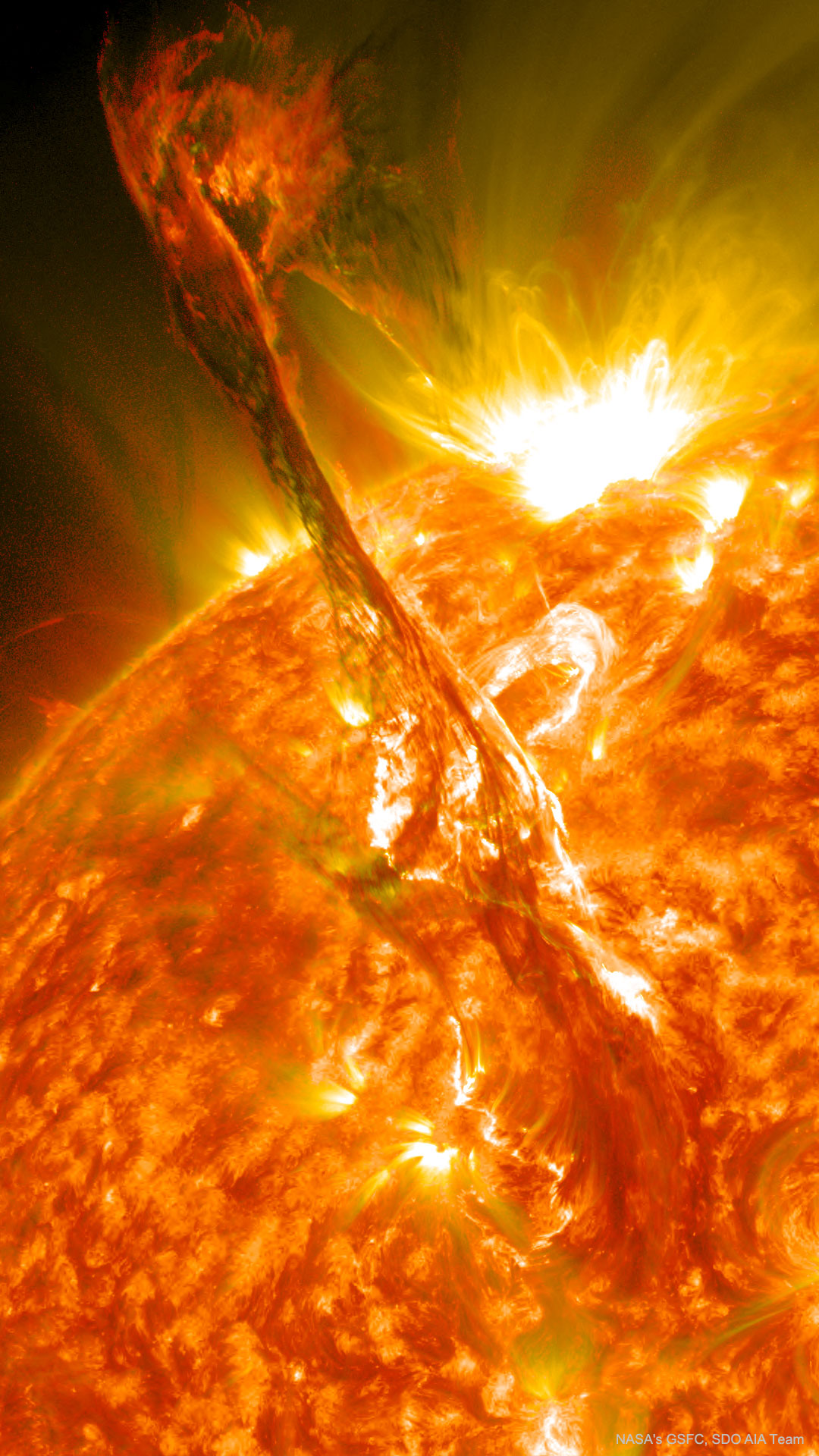
太陽に何が起こったのでしょうか?特に変わったことはなく、フィラメントが噴出しただけです。2012年半ば頃、長期間存在していた太陽のフィラメントが突然宇宙空間に噴出し、高エネルギーのコロナ質量放出(CME)を引き起こしました。フィラメントは太陽の絶えず変化する磁場によって数日間支えられており、噴出のタイミングは予想外でした。太陽を周回する太陽力学観測衛星(SDO)によって綿密に監視された結果、爆発によって電子とイオンが太陽系に放出され、その一部は3日後に地球に到達し、地球の磁気圏に衝突して目に見えるオーロラを引き起こしました。特集されている紫外線画像では、噴出するフィラメントの上に活動領域を取り囲むプラズマのループが見られます。太陽は11年周期で最も活動的な時期に近づいており、荷電粒子を宇宙空間に放出できるコロナホールが多数発生しています。これまでと同様に、これらの荷電粒子はオーロラを引き起こす可能性があります。あなたの空のサプライズ:あなたの誕生日にAPODで特集された写真は何ですか? (1995年以降)
原文(English)
What's happened to our Sun? Nothing very unusual -- it just threw a filament. Toward the middle of 2012, a long standing solar filament suddenly erupted into space, producing an energetic coronal mass ejection (CME). The filament had been held up for days by the Sun's ever changing magnetic field and the timing of the eruption was unexpected. Watched closely by the Sun-orbiting Solar Dynamics Observatory, the resulting explosion shot electrons and ions into the Solar System, some of which arrived at Earth three days later and impacted Earth's magnetosphere, causing visible auroras. Loops of plasma surrounding the active region can be seen above the erupting filament in the featured ultraviolet image. Our Sun is nearing the most active time in its 11-year cycle, creating many coronal holes that allow for the ejection of charged particles into space. As before, these charged particles can create auroras. Your Sky Surprise: What picture did APOD feature on your birthday? (post 1995)
\ この感動を宇宙仲間にシェア /
宇宙をXでシェア
© NASA / APOD