アゾレス諸島上空の虹色の夜光
Rainbow Airglow over the Azores
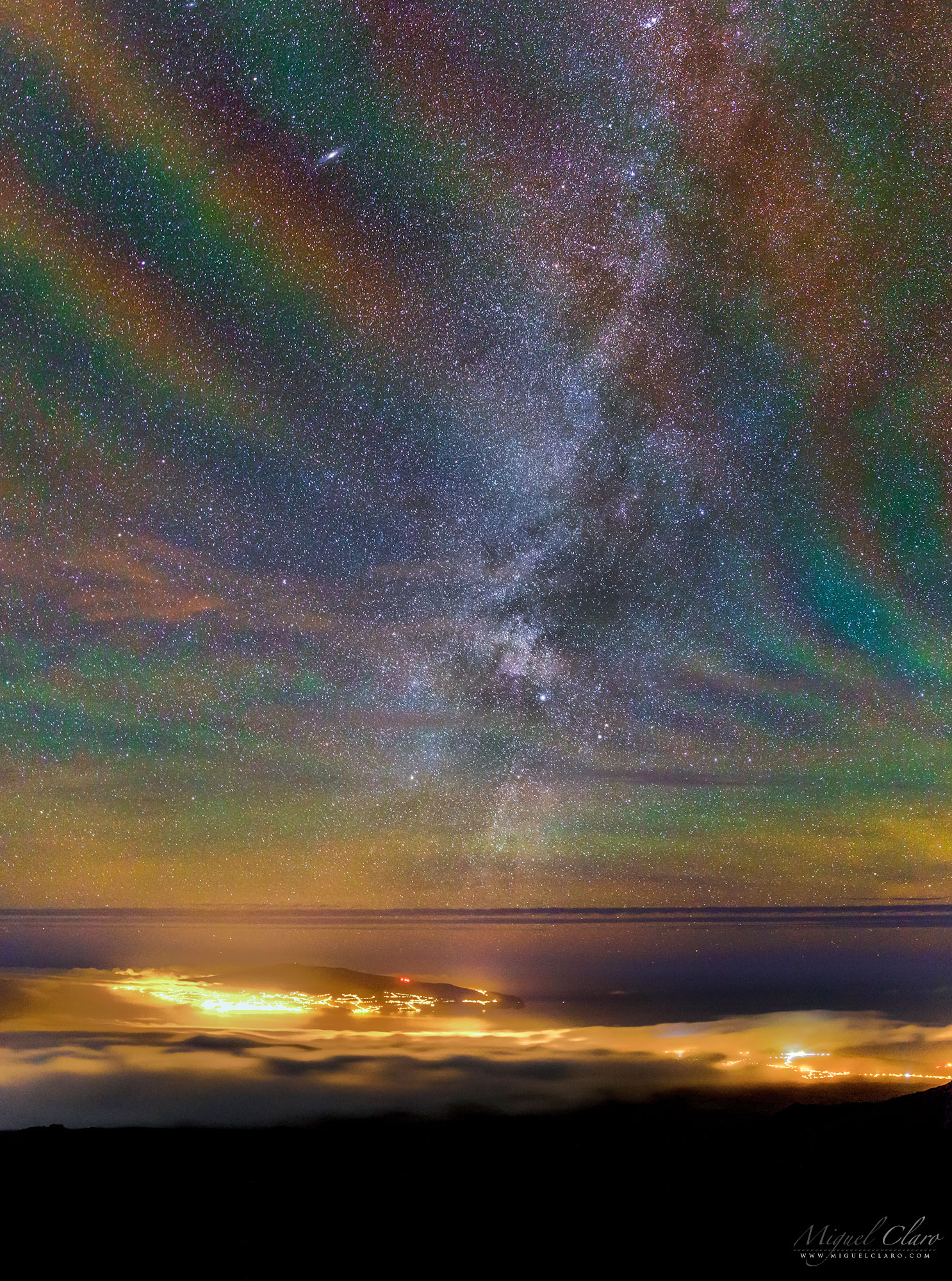
なぜ空が巨大な虹のように光るのでしょうか?それは大気光です。空気は常に光っていますが、通常は見えにくいものです。しかし、嵐が近づくなどの擾乱によって、地球の大気に目に見える波紋が生じることがあります。これらの重力波は、静かな水面に石を投げたときに生じる振動に似た空気の振動です。大気光の垂直な壁に沿って長時間露光することで、波打つ構造が特に見やすくなったと考えられます。では、これらの色はどこから来るのでしょうか?濃い赤色の光は、太陽からの紫外線によって励起された高度約87キロメートルのOH分子から発生していると考えられます。オレンジ色と緑色の大気光は、それより少し高い位置にあるナトリウム原子と酸素原子から発生していると考えられます。この画像は、ポルトガルのアゾレス諸島にあるピコ山に登った際に撮影されました。地上の光は、大西洋のファイアル島から来ています。この縞模様の夜光を通して、壮大な夜空が見えます。画像の中心には天の川銀河の中央の帯が走り、左上付近にはアンドロメダ銀河(M31)が見えます。APOD30周年!:6月11日にアンカレッジで無料公開講座開催
原文(English)
Why would the sky glow like a giant repeating rainbow? Airglow. Now, air glows all of the time, but it is usually hard to see. A disturbance however -- like an approaching storm -- may cause noticeable rippling in the Earth's atmosphere. These gravity waves are oscillations in air analogous to those created when a rock is thrown in calm water. The long-duration exposure nearly along the vertical walls of airglow likely made the undulating structure particularly visible. OK, but where do the colors originate? The deep red glow likely originates from OH molecules about 87 kilometers high, excited by ultraviolet light from the Sun. The orange and green airglow is likely caused by sodium and oxygen atoms slightly higher up. The featured image was captured during a climb up Mount Pico in the Azores of Portugal. Ground lights originate from the island of Faial in the Atlantic Ocean. A spectacular sky is visible through this banded airglow, with the central band of our Milky Way Galaxy running up the image center, and M31, the Andromeda Galaxy, visible near the top left. APOD Turns 30!: Free Public Lecture in Anchorage on June 11
\ この感動を宇宙仲間にシェア /
宇宙をXでシェア
© Miguel Claro
(TWAN);
Rollover Annotation:
Judy Schmidt / APOD