オリオンのゆりかご
Orion's Cradle
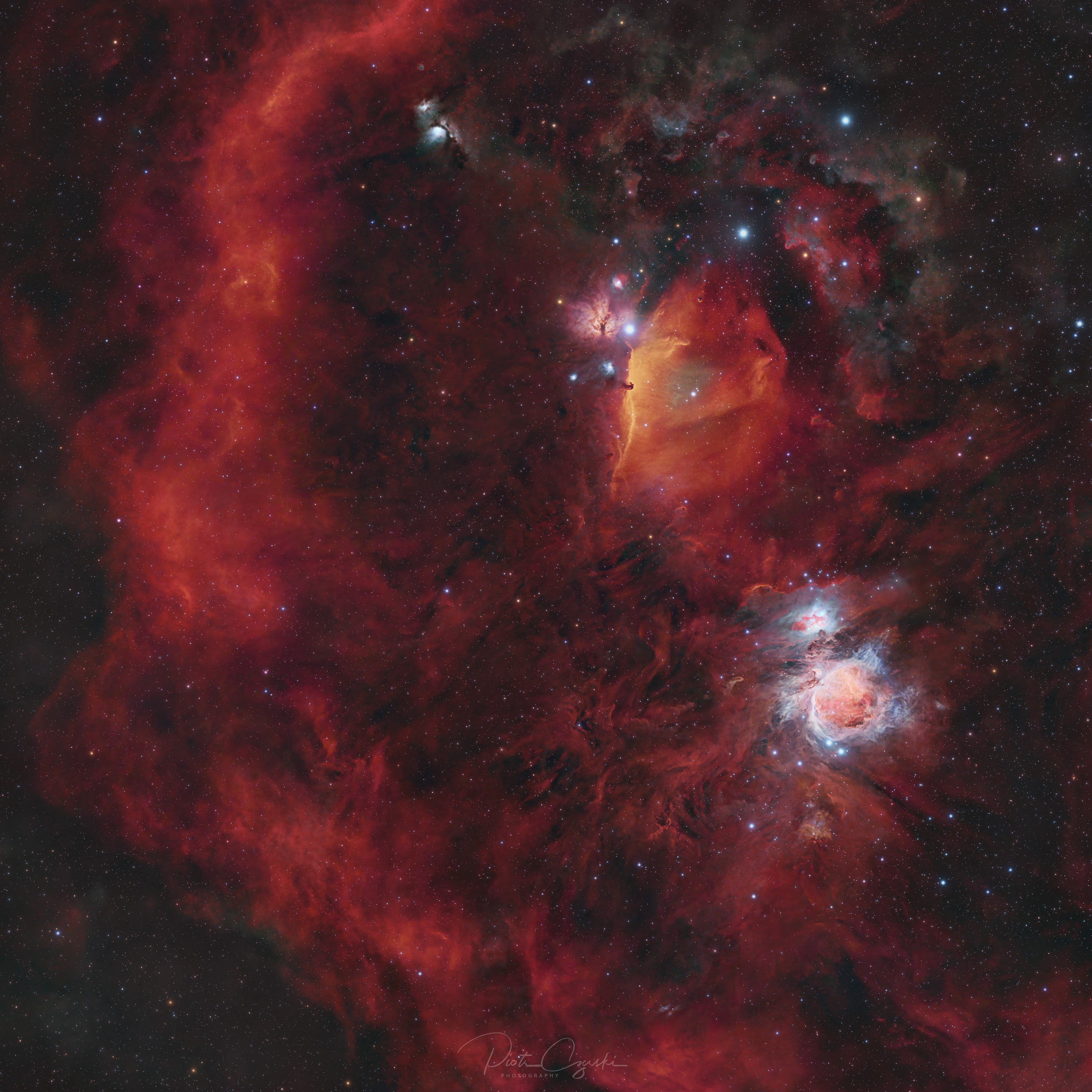
赤く輝く水素ガスに包まれて、オリオン座では星が生まれています。これらの星の育成場は、約 1,500 光年離れた巨大なオリオン分子雲複合体の端にあります。この詳細な画像は、よく知られた星座の中心を横切って約 12 度にわたっており、最も近い大きな星形成領域であるオリオン大星雲が右下に見えます。この深いモザイクには、上部中央近くに、炎星雲と馬頭星雲も含まれています。水素アルファ フィルターを使用して取得された画像データにより、この広角の宇宙の眺めに、エネルギーを帯びた原子状水素ガスの蔓とそれを取り囲むバーナード ループの一部という、他の注目すべき特徴が加わります。オリオン大星雲とオリオン座の多くの星は肉眼で簡単に見ることができますが、広大な星間ガスからの放射は微弱で、星雲の多い複合体を望遠鏡で見たとしても、記録するのは非常に困難です。スカイサプライズ: あなたの誕生日に APOD が特集した写真は何ですか? (1995 年以降)
原文(English)
Cradled in red-glowing hydrogen gas, stars are being born in Orion. These stellar nurseries lie at the edge of the giant Orion molecular cloud complex, some 1,500 light-years away. This detailed view spans about 12 degrees across the center of the well-known constellation, with the Great Orion Nebula, the closest large star-forming region, visible toward the lower right. The deep mosaic also includes, near the top center, the Flame Nebula and the Horsehead Nebula. Image data acquired with a hydrogen-alpha filter adds other remarkable features to this wide-angle cosmic vista: pervasive tendrils of energized atomic hydrogen gas and portions of the surrounding Barnard's Loop. While the Orion Nebula and many stars in Orion are easy to see with the unaided eye, emission from the extensive interstellar gas is faint and much harder to record, even in telescopic views of the nebula-rich complex. Sky Surprise: What picture did APOD feature on your birthday? (after 1995)
\ この感動を宇宙仲間にシェア /
宇宙をXでシェア
© Piotr Czerski / APOD