スペイン上空での皆既日食
Total Solar Eclipse Over Spain
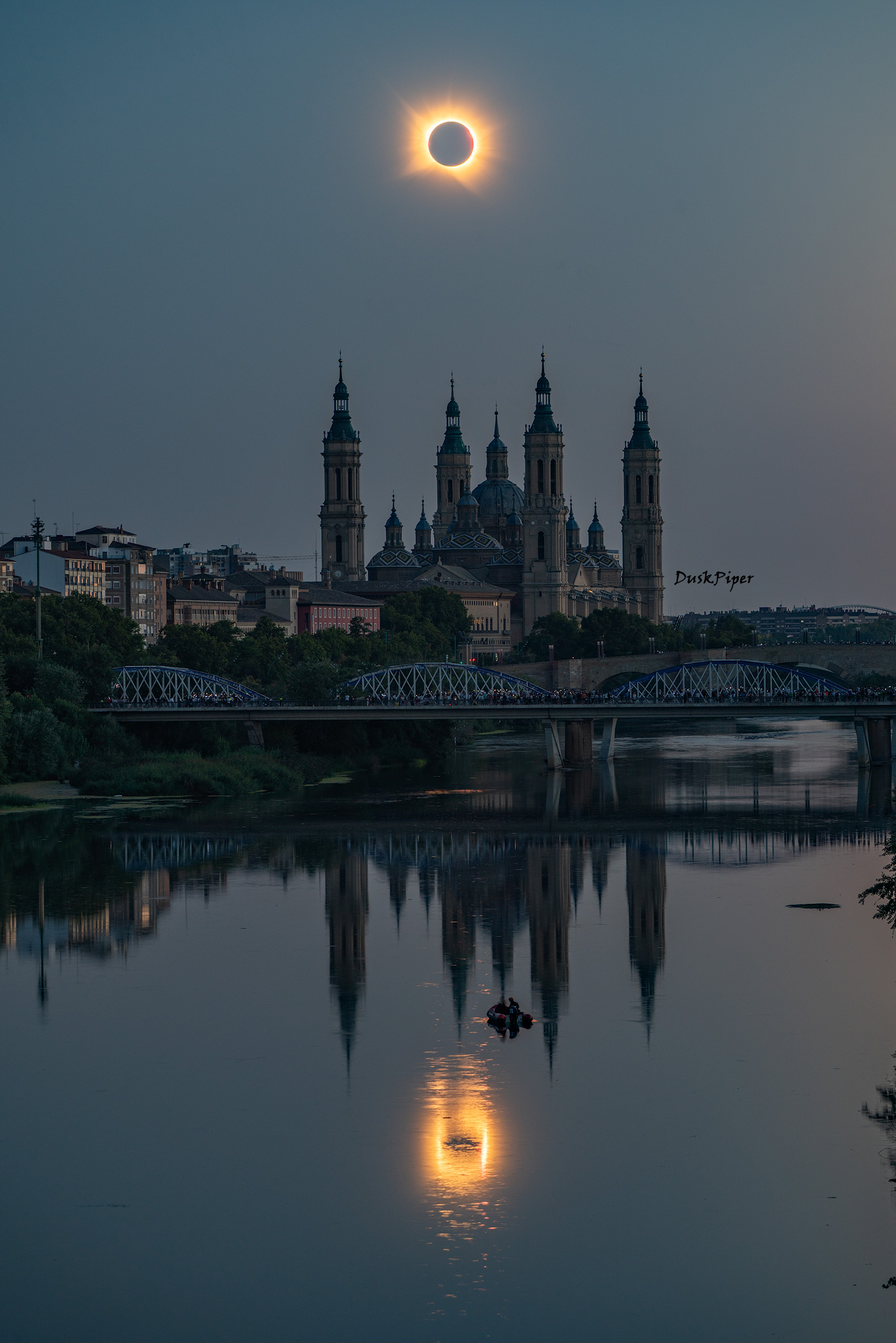
2026年8月12日、月が太陽を完全に覆い隠し、シベリア、グリーンランド、アイスランド、スペイン、ポルトガルに影を落としました。今日の画像は、スペインのサラゴサから観測された2つの皆既日食を捉えたもので、1つは聖母ピラール大聖堂の上空に、もう1つはエブロ川に映っています。ほんの数秒間、スペインでは1905年以来初めての大規模な皆既日食が見られました。皆既日食を目撃した人は、空気が冷たくなり、鳥の鳴き声が静まり、虫の鳴き声が混乱し、多くの人が畏敬の念を共有するかもしれません。太陽の明るい円盤が月によって遮られるため、コロナが輝く時です。日食を研究する他の理由の中でも、コロナが太陽の表面よりも数百万度も高温である理由を科学者が理解するのに役立ちます。熱心な市民は、野生生物の反応を記録したり、コロナを撮影したり、気温や雲を監視したりすることで、これらの研究に貢献できます。さらに壮大な日食画像:2026年8月12日の皆既日食
原文(English)
On August 12th, 2026, the Moon totally eclipsed the Sun and cast its shadow across Siberia, Greenland, Iceland, Spain, and Portugal. Today’s image features two total solar eclipses viewed from Zaragoza, Spain, one over the Cathedral-Basilica of Our Lady of the Pillar and the other reflecting in the Ebro River. For a few moments, Spain saw its first major total solar eclipse since 1905. Those witnessing totality may experience a chill in the air, the quieting of birds, the confused chirps of insects, and the shared awe of many. It’s the corona’s time to shine as the Sun’s bright disk is blocked by the Moon. Among other reasons to study eclipses, they help scientists understand why the corona is millions of degrees hotter than the Sun’s surface. Enthusiastic citizens can contribute to these studies by recording how wildlife responds, imaging the corona, and monitoring air temperature and clouds. More spectacular eclipse images: Solar Eclipse of 2026 August 12
\ この感動を宇宙仲間にシェア /
宇宙をXでシェア
© Ruiyu Zhang
Text:
Keighley Rockcliffe
(NASA
GSFC,
UMBC CSST,
CRESST II) / APOD