ステファンの五重奏曲からのX線写真
X-Rays from Stephan's Quintet
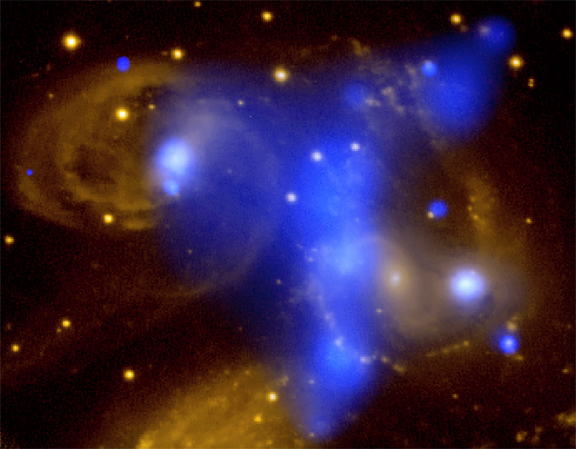
ステファンの五重星は、ペガスス座の方向、約3億光年離れたところに位置する、絵のように美しいが明らかに問題を抱えた銀河群です。この距離で20万光年以上に及ぶこの銀河群を合成した擬似カラー画像は、チャンドラX線観測衛星のX線データを青色で、光学データを黄色で重ね合わせ、この多重銀河衝突の強力さを示しています。画像中央を垂直に走る青い雲からのX線は、宇宙規模の高エネルギー衝撃によって数百万度まで加熱されたガスによって生成されています。この衝撃は、雲のすぐ右側に見える大きな渦巻銀河の星間ガスが、この銀河群の中心領域を通過する際に、五重星の希薄な銀河間ガスと衝突した結果であると考えられます。実際、数十億年もの間、銀河群が高温の銀河間ガスを繰り返し通過することで、銀河は徐々に星形成物質を失っていくはずである。この見方では、画面下端からわずかに顔を覗かせている大きな渦巻銀河は、わずか3500万光年離れた、銀河群とは無関係な前景銀河である。
原文(English)
Stephan's Quintet is a picturesque but clearly troubled grouping of galaxies about 300 million light-years away toward the high-flying constellation Pegasus. Spanning over 200,000 light-years at that distance, this composite false-color image illustrates the powerful nature of this multiple galaxy collision, showing x-ray data from the Chandra Observatory in blue superposed on optical data in yellow. The x-rays from the central blue cloud running vertically through the image are produced by gas heated to millions of degrees by an energetic shock on a cosmic scale. The shock was likely the result of the interstellar gas in the large spiral galaxy, seen immediately to the right of the cloud, colliding with the quintet's tenuous intergalactic gas as this galaxy plunged through group's central regions. In fact, over billions of years, repeated passages of the group galaxies through the hot intergalactic gas should progressively strip them of their own star forming material. In this view, the large spiral galaxy just seen peeking above the bottom edge is an unrelated foreground galaxy a mere 35 million light-years distant.
\ この感動を宇宙仲間にシェア /
宇宙をXでシェア
© NASA / APOD