タランチュラゾーン
The Tarantula Zone
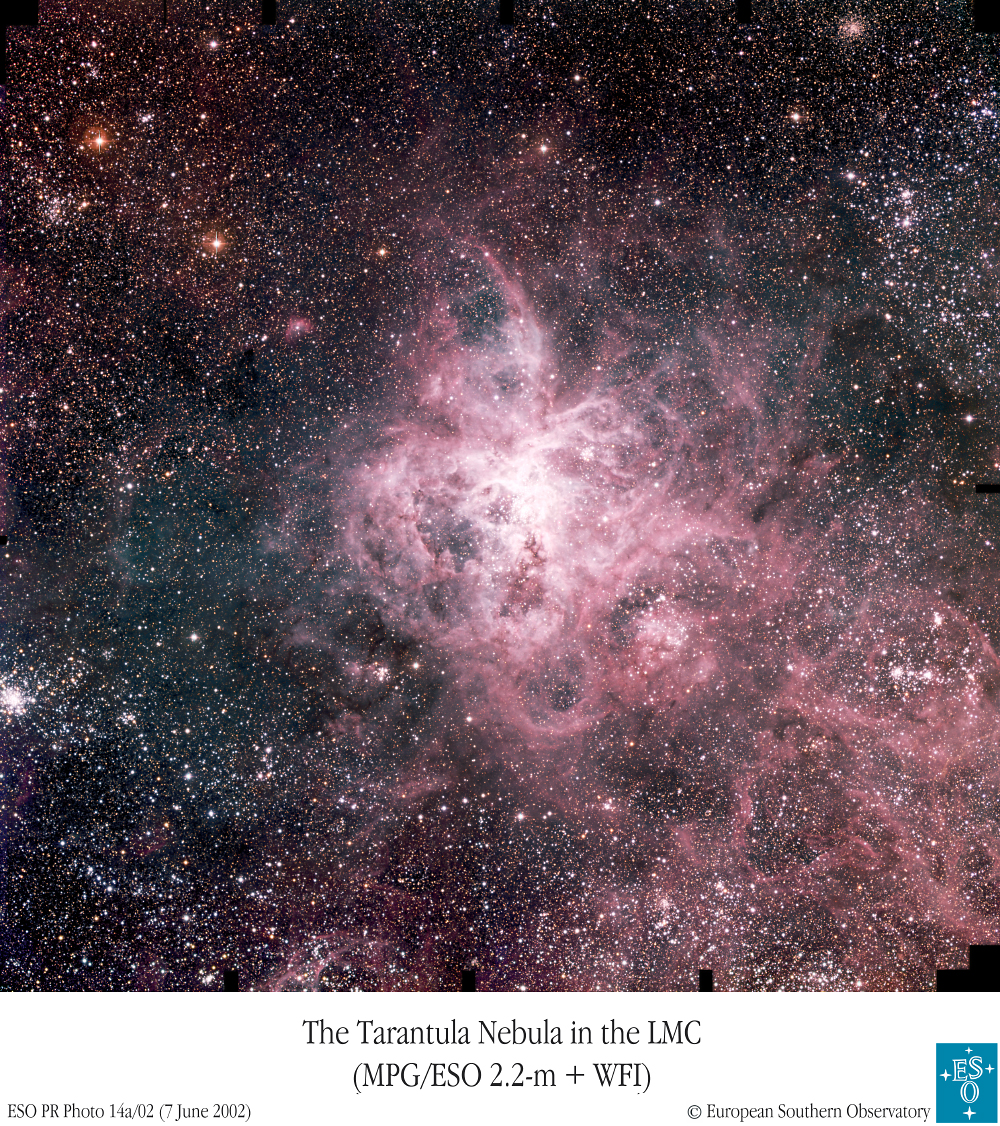
タランチュラ星雲は、直径1,000光年以上にも及ぶ巨大な輝線星雲で、私たちの隣の銀河である大マゼラン雲の中にあります。この宇宙のクモのような星雲の中心には、R136としてカタログ化されている若い大質量星団があり、その強烈な放射と強い恒星風が星雲の輝きを増幅させ、クモの巣状のフィラメントを形成しています。ラ・シヤ天文台にあるESOの2.2メートル望遠鏡の広視野撮像装置カメラで撮影されたこの印象的なカラーモザイク画像には、星雲の支配下にある他の若い星団も写っています。タランチュラ星雲の領域には、星雲の外縁に侵入するいくつかの暗黒星雲や、画像の左端にある高密度の星団NGC 2100も注目すべき存在です。現代史上最も近い超新星である1987a超新星の、小さくも膨張を続ける残骸は、この画像の右下隅付近に位置している。この鮮明なモザイク画像の視野は、南天の星座であるかじき座の満月ほどの大きさの空域を捉えている。
原文(English)
The Tarantula Nebula is more than 1,000 light-years across - a giant emission nebula within our neighboring galaxy the Large Magellanic Cloud. Inside this cosmic arachnid lies a central young cluster of massive stars, cataloged as R136, whose intense radiation and strong winds have helped energize the nebular glow and shape the spidery filaments. In this impressive color mosaic of images from the Wide-Field Imager camera on ESO's 2.2 meter telescope at La Silla Observatory, other young star clusters can be seen still within the nebula's grasp. Also notable among the denizens of the Tarantula zone are several dark clouds invading the nebula's outer limits as well as the dense cluster of stars NGC 2100 at the extreme left edge of the picture. The small but expanding remnant of supernova 1987a, the closest supernova in modern history, lies just off the lower right corner of the field. The rich mosaic's field of view covers an area on the sky about the size of the full moon in the southern constellation Dorado.
\ この感動を宇宙仲間にシェア /
宇宙をXでシェア
© NASA / APOD