SIRTF連勝記録
SIRTF Streak
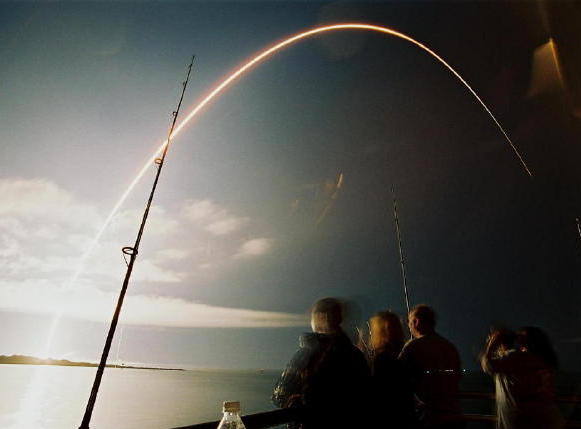
8月25日早朝、ボーイング・デルタ2ヘビーロケットがNASAの宇宙赤外線望遠鏡施設(SIRTF)を乗せて空高く舞い上がった。この劇的な光景は、フロリダ州ココアビーチ北端のジェッティパークの桟橋から長時間露光で撮影されたもので、ケープカナベラルの発射場から約2.5マイル(約4キロ)の距離にある。SIRTF(「サーティフ」と発音)は、NASAのグレート・オブザーバトリーズ・プログラムにおける4番目にして最後の衛星観測所として、赤外線で遠い宇宙を探査する。他の3つの大型天体物理衛星は、電磁スペクトルの高エネルギー領域向けに設計されており、ハッブル宇宙望遠鏡は可視光線付近で、コンプトンガンマ線観測所はガンマ線に感度のある機器で、チャンドラX線観測所は宇宙X線を検出している。SIRTFは、地球からの赤外線放射への被曝を減らすため、地球の太陽周回軌道に投入された。 SIRTFの赤外線検出器は、搭載された液体ヘリウムによって冷却され、ほぼ絶対零度に近い温度で動作します。現在、SIRTFのシステムは90日間の点検を受けています。
原文(English)
Streaking skyward, a Boeing Delta 2-Heavy rocket carries NASA's Space InfraRed Telescope Facility (SIRTF) aloft during the early morning hours of August 25th. The dramatic scene was recorded in a time exposure from the pier in Jetty Park at the northern end of Cocoa Beach, Florida, about 2.5 miles from the Cape Canaveral launch site. SIRTF (sounds like "sir tiff") will explore the distant Universe in infrared light as the fourth and final satellite observatory in NASA's Great Observatories Program. The three other large astrophysics satellites were designed for higher energies in the electromagnetic spectrum, with the Hubble Space Telescope operating near visible wavelengths, the Compton Gamma Ray Observatory instruments sensitive to gamma rays, and the Chandra Observatory detecting cosmic x-rays. SIRTF has been launched into an Earth-trailing solar orbit to reduce its exposure to infrared radiation from our fair planet. Cooled by an on board supply of liquid helium, SIRTF's infrared detectors will operate at near absolute zero temperatures. Presently, SIRTF's systems are undergoing a 90-day check out.
\ この感動を宇宙仲間にシェア /
宇宙をXでシェア
© Ben Cooper / APOD