ジュピター・アンピールド
Jupiter Unpeeled
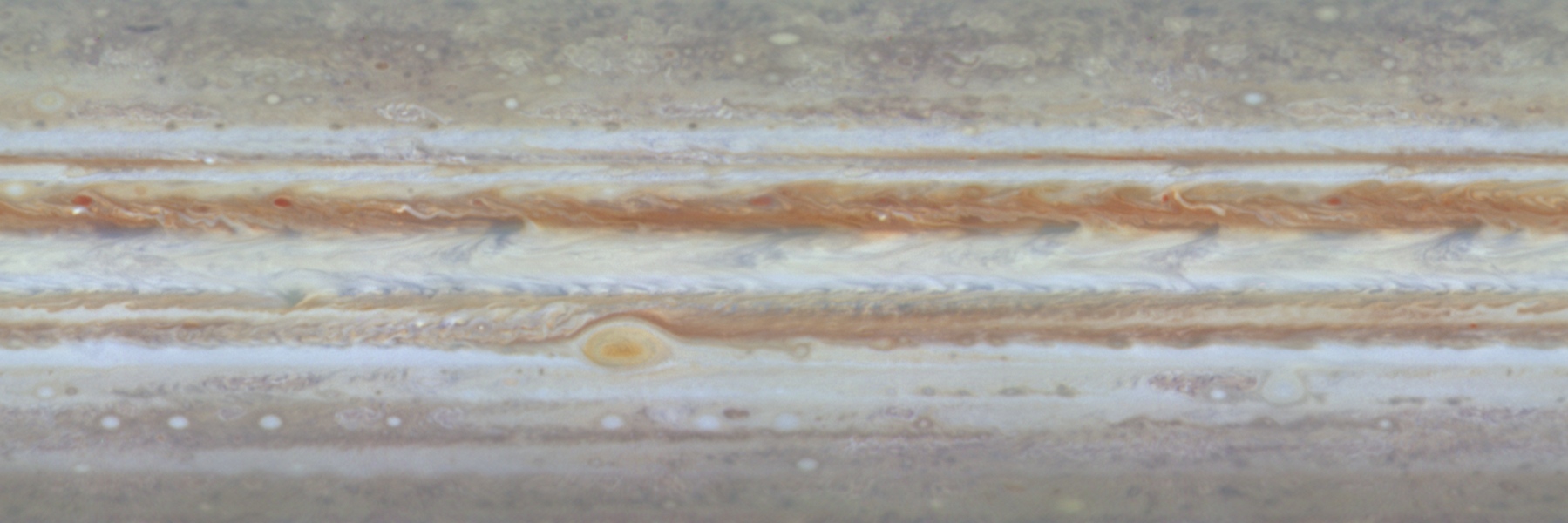
木星を極から極まで切り分け、外側の雲の層を剥がし、平らな面に伸ばすと…苦労の末に出来上がるのは、これとよく似たものになります。右にスクロールすると、カッシーニ探査機が撮影した木星のカラーモザイク画像全体が表示されます。このモザイク画像は、2000年後半にカッシーニが太陽系最大の惑星をゆっくりとフライバイした際に記録した画像データから作成された14フレームの動画のうちの1フレームです。この魅力的な動画は、木星の24回の自転にわたる雲の動きを近似的に表現しています。動画を作成するために、木星の赤道から南北60度の範囲をカバーする一連の観測データが、惑星の円筒形投影図のアニメーションに組み込まれました。地球の表面を描いたおなじみの長方形の壁掛け地図と同様に、赤道付近では地形の相対的な大きさや形は正確ですが、極域に近づくにつれて徐々に歪んでいきます。カッシーニ探査機が撮影した映像には、衛星イオとエウロパも登場するが、赤道付近で見られる最小の雲構造は直径約600キロメートルである。
原文(English)
Slice Jupiter from pole to pole, peel back its outer layers of clouds, stretch them onto a flat surface ... and for all your trouble you'd end up with something that looks a lot like this. Scrolling right will reveal the full picture, a color mosaic of Jupiter from the Cassini spacecraft. The mosaic is actually a single frame from a fourteen frame movie constructed from image data recorded by Cassini during its leisurely flyby of the solar system's largest planet in late 2000. The engaging movie approximates Jupiter's cloud motions over 24 jovian rotations. To make it, a series of observations covering Jupiter's complete circumference 60 degrees north and south of the equator were combined in an animated cylindrical projection map of the planet. As in the familiar rectangular-shaped wall maps of the Earth's surface, the relative sizes and shapes of features are correct near the equator but become progressively more distorted approaching the polar regions. In the Cassini movie, which also features guest appearances by moons Io and Europa, the smallest cloud structures visible at the equator are about 600 kilometers across.
\ この感動を宇宙仲間にシェア /
宇宙をXでシェア
© NASA / APOD