2MASS銀河の空
The 2MASS Galaxy Sky
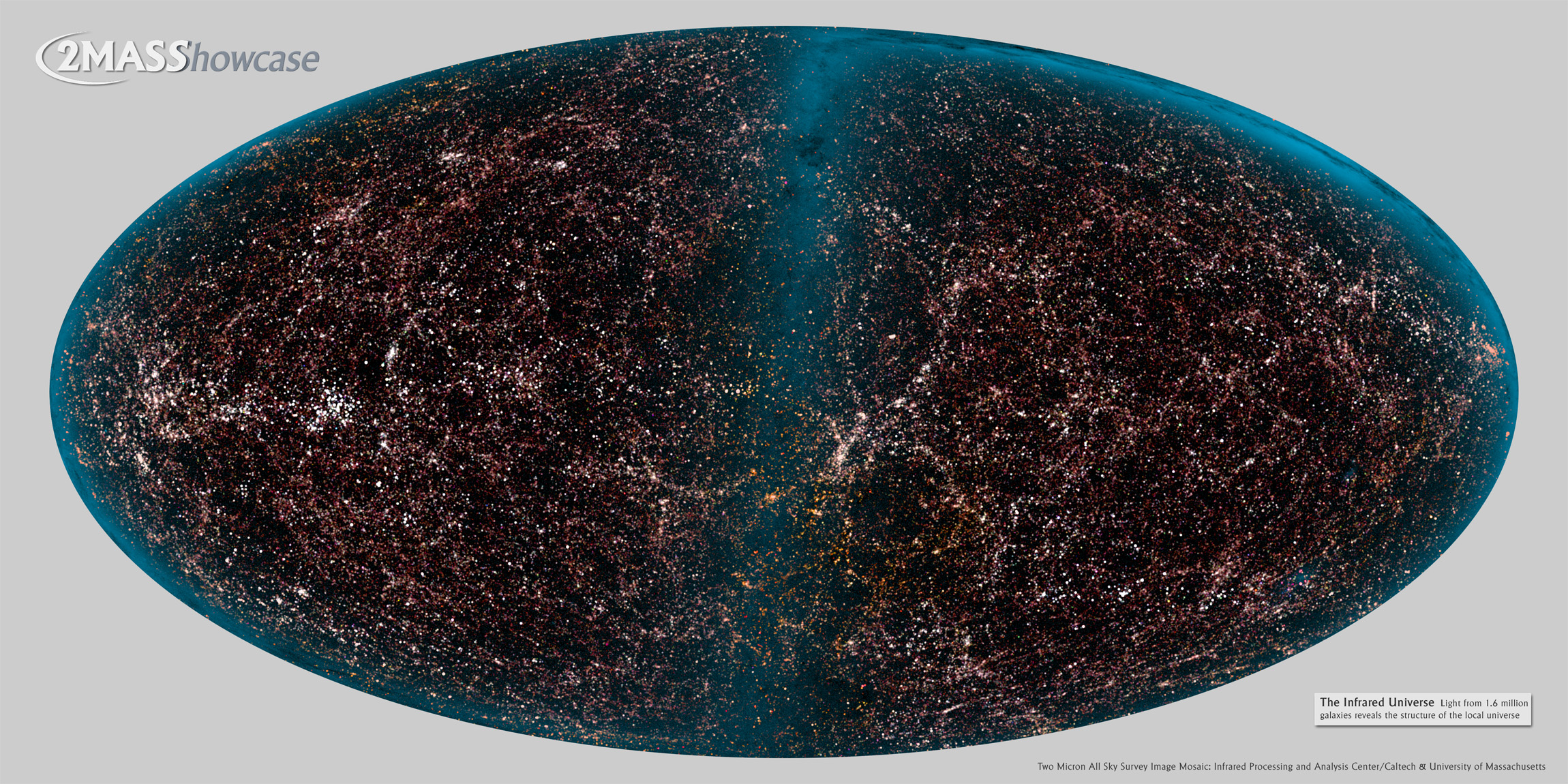
最も近い銀河はランダムに分布しているのでしょうか? Two Micron All Sky Survey (2MASS) によって検出された 100 万を超える最も明るい「広がりを持つ光源」のプロットを見ると、そうではないことがわかります。これらの赤外線広がりを持つ光源の大部分は銀河です。上に見えるのは、宇宙がどのように形成され進化してきたかを制限する、信じられないほど複雑な構造です。多くの銀河は重力によって結びついて銀河団を形成し、銀河団自体がゆるやかに結びついて超銀河団を形成し、さらに超銀河団は、より大きなスケールの構造の上に整列しているように見えることがあります。対照的に、私たちの天の川銀河内部の非常に明るい星が、垂直の青い帯を引き起こしています。
原文(English)
Are the nearest galaxies distributed randomly? A plot of over one million of the brightest "extended sources" detected by the Two Micron All Sky Survey (2MASS) shows that they are not. The vast majority of these infrared extended sources are galaxies. Visible above is an incredible tapestry of structure that provides limits on how the universe formed and evolved. Many galaxies are gravitationally bound together to form clusters, which themselves are loosely bound into superclusters, which in turn are sometimes seen to align over even larger scale structures. In contrast, very bright stars inside our own Milky Way Galaxy cause the vertical blue sash.
\ この感動を宇宙仲間にシェア /
宇宙をXでシェア
© 2MASS,
T. H. Jarrett, J. Carpenter, & R. Hurt / APOD