対数螺旋イザベルとM51
Logarithmic Spirals Isabel and M51
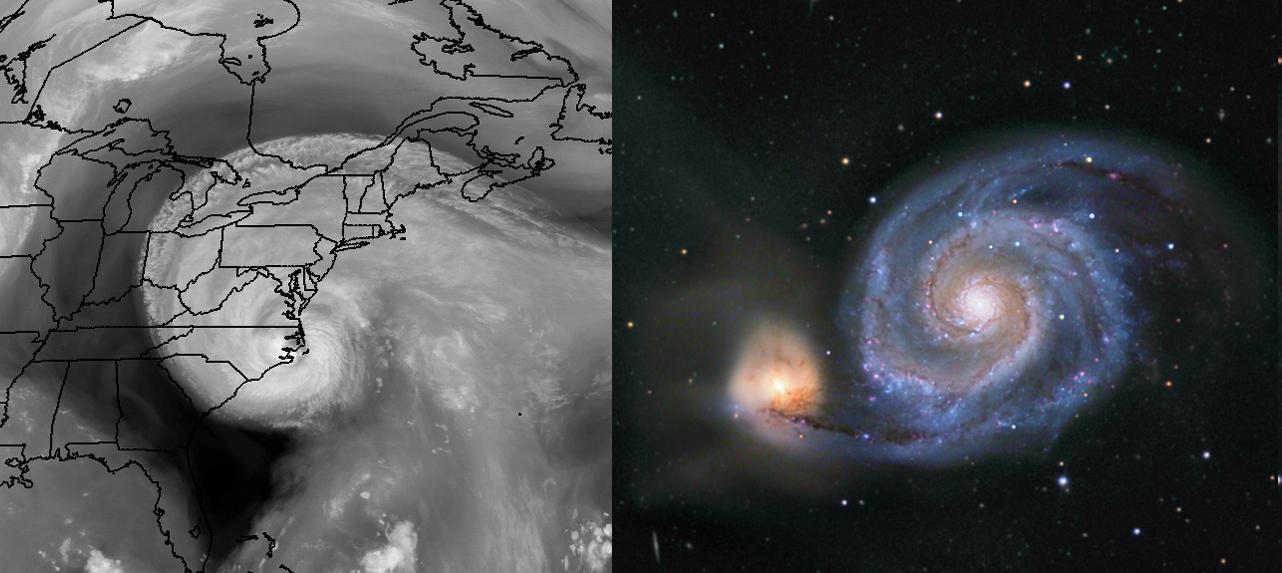
不快なほど接近しているハリケーン・イザベル(左)と、3000万光年離れた銀河M51は、実際には共通点がほとんどありません。まず、イザベルは数百マイルの直径でしたが、M51(渦巻銀河)は約5万光年にも及ぶため、規模が大きく異なります。さらに、その形成と進化を左右する物理的な相互作用も全く異なります。しかし、両者は驚くほどよく似ており、対数螺旋と呼ばれるシンプルで美しい数学的曲線の形をしています。対数螺旋とは、中心からの距離が大きくなるにつれて、螺旋の間隔が幾何級数的に大きくなる螺旋です。等角螺旋、成長螺旋、ベルヌーイ螺旋、または奇跡の螺旋とも呼ばれるこの曲線の豊かな特性は、17世紀の哲学者デカルトによる発見以来、数学者を魅了してきました。興味深いことに、この抽象的な形状は、上記の印象的な視覚的比較が示唆するよりもはるかに自然界に豊富に存在します。対数螺旋は、例えば、ヒマワリの種の配列、オウムガイの殻の形、そしてカリフラワーの形なども表す。
原文(English)
Uncomfortably close hurricane Isabel (left) and 30 million light-year distant galaxy M51 actually don't have much in common. For starters, Isabel was hundreds of miles across, while M51 (the Whirlpool Galaxy) spans about 50,000 light-years making them vastly dissimilar in scale, not to mention the extremely different physical interactions which control their formation and evolution. But they do look amazingly alike, both exhibiting the shape of a simple and beautiful mathematical curve known as a logarithmic spiral, a spiral whose separation grows in a geometric way with increasing distance from the center. Also known as the equiangular spiral, growth spiral, and Bernoulli's spiral or spira mirabilis, this curve's rich properties have fascinated mathematicians since its discovery by 17th century philosopher Descartes. Intriguingly, this abstract shape is much more abundant in nature than suggested by the striking visual comparison above. Logarithmic spirals also describe, for example, the arrangement of sunflower seeds, the shapes of nautilus shells, and ... cauliflower.
\ この感動を宇宙仲間にシェア /
宇宙をXでシェア
© NASA / APOD