冷たいハレー彗星
Cold Comet Halley
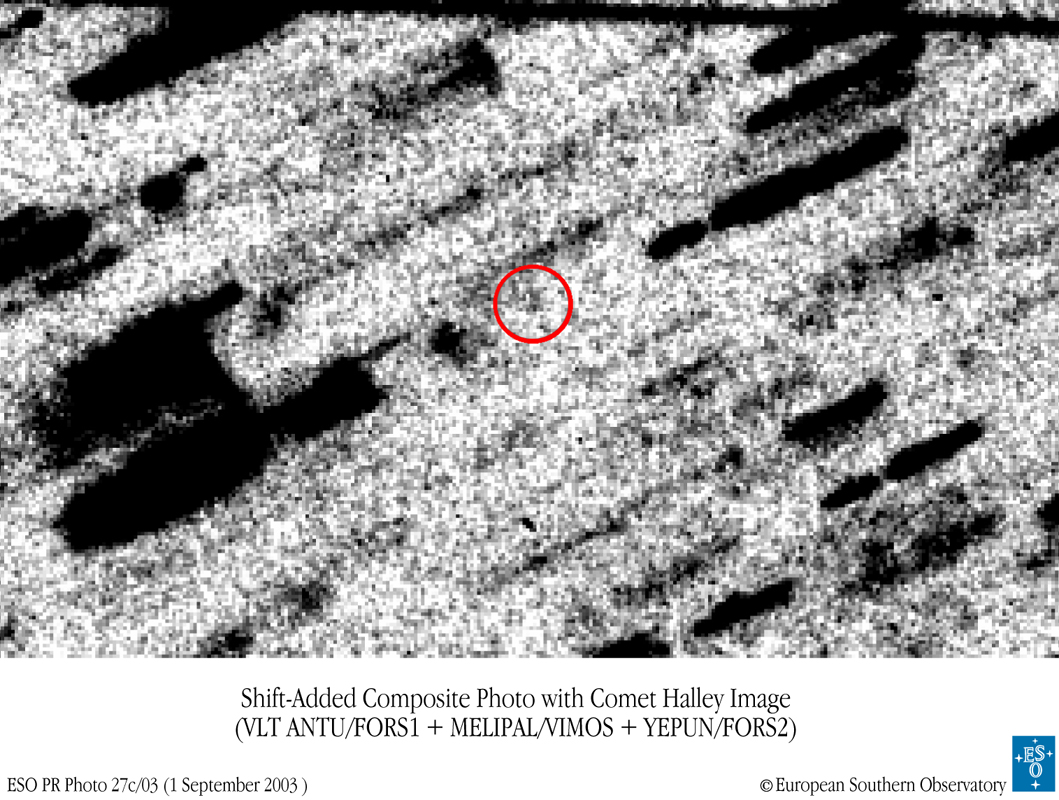
これは、これまで見た中で最も美しいハレー彗星の画像ではないかもしれませんが、おそらく最もユニークな画像でしょう。丸で囲まれた小さなピクセルの集まりは、太陽から40億キロメートル(4,000,000,000キロメートル)、つまり28天文単位以上離れた軌道上にある有名な彗星です。これは、彗星観測における記録的な距離です。1986年に地球の近傍を通過したハレー彗星は現在、太陽系の外縁部の薄暗い領域を航行しており、最外縁の巨大ガス惑星である海王星とほぼ同じ距離にあり、活動の兆候は見られません。3月に撮影されたこのネガ画像は、ESOの3台の超大型望遠鏡で撮影されたデジタル露光画像を合成したものです。露光は移動する彗星に位置合わせされているため、画像には背景の星や銀河が細長いぼやけた線として写っています。地球を周回する人工衛星が上部に暗い筋として写っています。ハレー彗星はここでは明らかに非常に暗く写っていますが、地上の大型望遠鏡を使えば、さらに暗くなり、2023年には軌道上で最も遠い地点、太陽から50億キロメートル(35天文単位)以上離れた地点に到達するまで、その様子を追跡することができます。
原文(English)
While this may not be the most esthetic image of Comet Halley that you have ever seen, it is likely the most unique. The tiny cluster of pixels circled is the famous comet along its orbit over 4 billion (4,000,000,000) kilometers or 28 AU from the Sun -- a record distance for a comet observation. Its last passage through our neck of the woods in 1986, Comet Halley presently cruises through the dim reaches of the outer solar system, almost as far away as outermost gas giant Neptune, and shows no sign of activity. Captured in March, this negative image is a composite of digital exposures made with three of ESO's Very Large Telescopes. The exposures are registered on the moving comet, so the picture shows background stars and galaxies as elongated smudges. An earth-orbiting satellite appears as a dark streak at the top. Comet Halley is clearly extremely faint here, but large earthbound telescopes will be able to follow it as it grows fainter still, reaching the most distant point in its orbit, more than 5 billion kilometers (35 AU) from the Sun, in 2023.
\ この感動を宇宙仲間にシェア /
宇宙をXでシェア
© NASA / APOD