X線月
X-Ray Moon
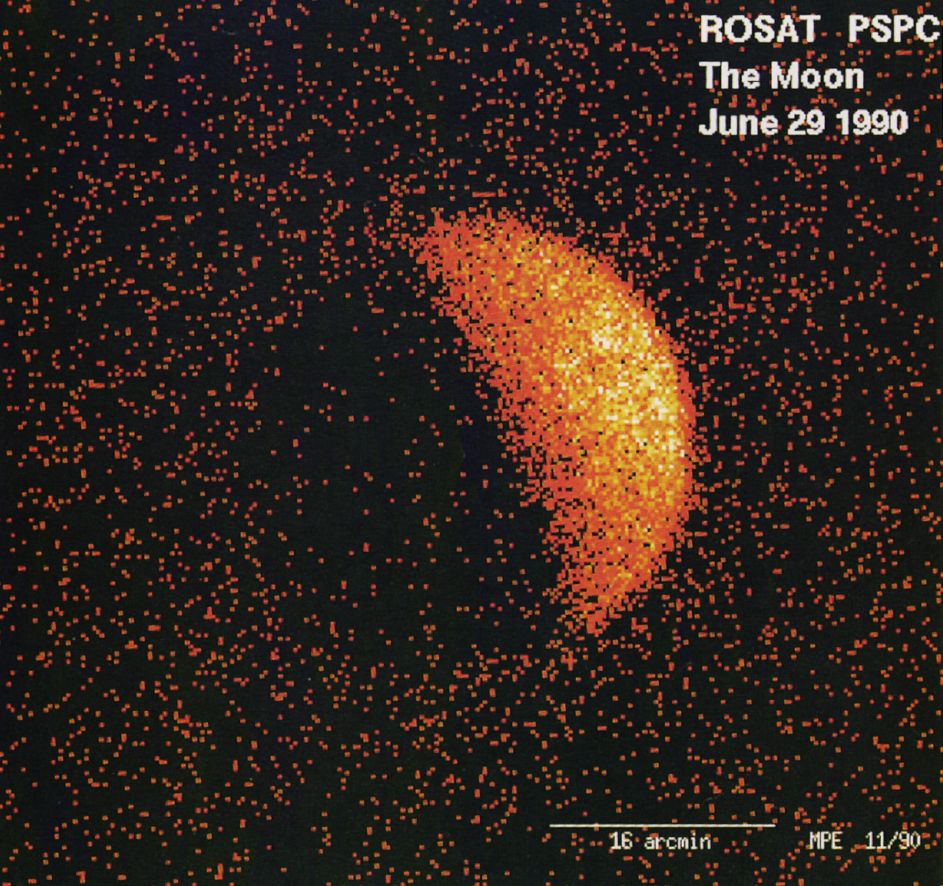
この月のX線画像は、1990年に軌道上のROSAT(レントゲン衛星)観測所によって撮影されました。このデジタル画像では、ピクセルの明るさがX線強度に対応しています。画像を3つの部分に分けて考えてみましょう。X線で明るく見える月の半球、暗い月の半分、そしてX線で見える空の背景です。明るい月の半球は、太陽から放出されたX線を散乱させるため、X線で輝いています。背景の空がX線で輝いているのは、ROSATの画像では解像されていませんが、最近チャンドラX線観測所のX線画像で検出された、遠くにある無数の強力な活動銀河が原因の一つです。しかし、なぜ月の暗い半分は完全に暗くないのでしょうか?チャンドラの新たな結果によると、X線の一部は影になっている月の半球からのみ来ているようです。実際には、それらは軌道上のX線観測所を取り囲む地球のジオコロナ、つまり拡張された大気から発生しています。
原文(English)
This x-ray image of the Moon was made by the orbiting ROSAT (Röntgensatellit) Observatory in 1990. In this digital picture, pixel brightness corresponds to x-ray intensity. Consider the image in three parts: the bright hemisphere of the x-ray moon, the darker half of the moon, and the x-ray sky background. The bright lunar hemisphere shines in x-rays because it scatters x-rays emitted by the sun. The background sky has an x-ray glow in part due to the myriad of distant, powerful active galaxies, unresolved in the ROSAT picture but recently detected in Chandra Observatory x-ray images. But why isn't the dark half of the moon completely dark? New Chandra results also suggest that a few x-rays only seem to come from the shadowed lunar hemisphere. Instead, they originate in Earth's geocorona or extended atmosphere which surrounds the orbiting x-ray observatories.
\ この感動を宇宙仲間にシェア /
宇宙をXでシェア
© NASA / APOD