木星のニューホライズンズ
New Horizons at Jupiter
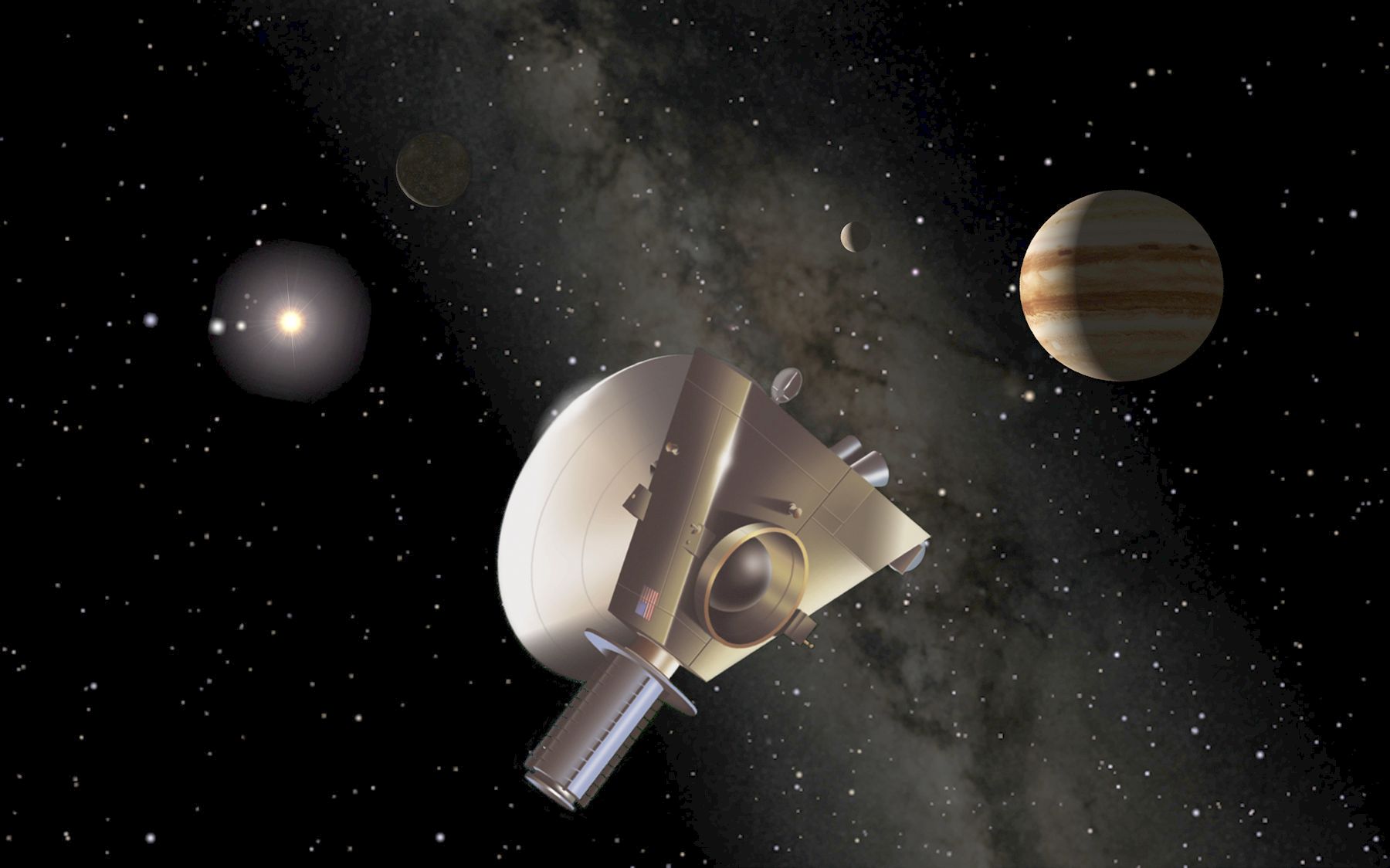
冥王星・カロン系とカイパーベルトの氷の住人たちを初めて間近で探査するNASAのニューホライズンズ探査機が、外向きに旅立つ姿を描いた想像図がここに掲載されている。この劇的なシーンは、ガス惑星木星のフライバイ後、2006年の打ち上げ予定から約1年後の465キログラムの探査機を描いている。木星フライバイは、燃料を節約し、太陽系の外縁部への移動時間を短縮するための重力アシスト操作として使用されるが、同時に、探査機器のテストや、巨大惑星、その衛星、磁場の研究の機会も提供する。太陽は8億キロメートル離れたところから見え、左側には内惑星の地球、金星、水星が並んでいる。探査機の軌道のすぐ内側を木星の周りを公転する、最も外側のガリレオ衛星カリストのかすかな三日月形が、薄れゆく太陽の右上に見えている。木星の左側にはエウロパがあり、遠くの背景には天の川のぼんやりとした星々や塵の雲が広がっている。ニュー・ホライズンズ探査機は2015年の夏に冥王星・カロンに到着する予定だ。
原文(English)
Headed for the first close-up exploration of the Pluto-Charon system and the icy denizens of the Kuiper belt, NASA's New Horizons spacecraft is pictured here in an artist's vision of the robot probe outward bound. The dramatic scene depicts the 465 kilogram spacecraft about one year after a planned 2006 launch, following a flyby of gas giant Jupiter. While the Jupiter flyby will be used as a gravity assist maneuver to save fuel and cut travel time to the outer reaches of the Solar System, it will also provide an opportunity to test instruments and study the giant planet, its moons, and magnetic fields. The Sun is seen from eight hundred million kilometers away, with inner planets Earth, Venus, and Mercury aligned on the left. A dim crescent of outermost Galilean moon Callisto, orbiting Jupiter just inside of the spacecraft's trajectory, appears to the upper right of the fading Sun. Left of Jupiter itself is Europa and in the distant background are the faint, unresolved stars and dust clouds of the Milky Way. New Horizons' planned arrival at Pluto-Charon is in the summer of 2015.
\ この感動を宇宙仲間にシェア /
宇宙をXでシェア
© Dan Durda
(SwRI) / APOD