アンテナ銀河からのX線
X-Rays From Antennae Galaxies
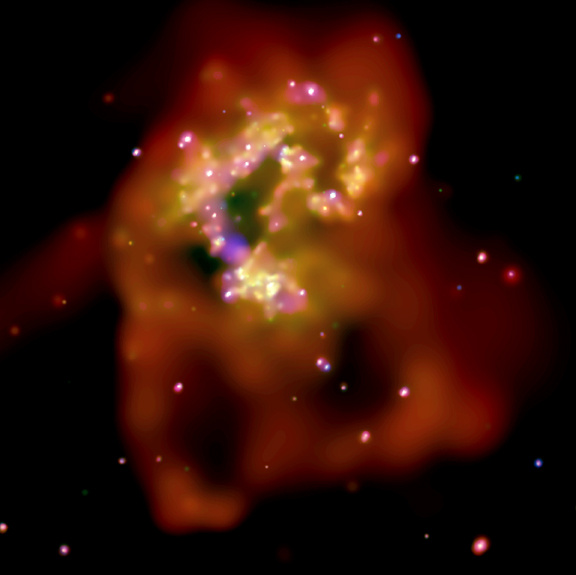
軌道上のチャンドラX線観測衛星によるこの擬似カラーX線画像では、数百万度のガスの泡を背景に、多数のブラックホールと中性子星が明るい点状の光源として輝いている。この印象的な画像は、からす座の約6000万光年離れた場所で巨大な衝突を起こしている2つの銀河、NGC 4038とNGC 4039の中心領域を約8万光年にわたって捉えている。可視光画像では、残骸から伸びる長く光り輝く触手のような構造が、この2つの銀河に「アンテナ銀河」という通称を与えている。銀河の衝突は現在ではかなり一般的であると考えられているが、衝突が起こると個々の星が衝突することはまれである。代わりに、ガスと塵の雲が合体して圧縮され、数千個の超新星爆発を伴う大規模な星形成の激しい爆発を引き起こす。爆発した星は、重元素が豊富な衝撃波ガスの泡と崩壊した恒星の核をこの光景に散らばらせる。この宇宙的な偶然に魅せられた天文学者たちは、銀河の衝突による進化を観察し、それが我々の銀河とよく似ていることに気づき始めている。
原文(English)
A bevy of black holes and neutron stars shine as bright, point-like sources against bubbles of million degree gas in this false-color x-ray image from the orbiting Chandra Observatory. The striking picture spans about 80 thousand light-years across the central regions of two galaxies, NGC 4038 and NGC 4039, locked in a titanic collision some 60 million light-years away in the constellation Corvus. In visible light images, long, luminous, tendril-like structures emanating from the wreckage lend the pair their popular moniker, the Antennae Galaxies. Galactic collisions are now thought to be fairly common, but when they happen individual stars rarely collide. Instead gas and dust clouds merge and compress, triggering furious bursts of massive star formation with thousands of resulting supernovae. The exploding stars litter the scene with bubbles of shocked gas enriched in heavy elements, and collapsed stellar cores. Transfixed by this cosmic accident astronomers watch and are beginning to appreciate the collision-driven evolution of galaxies, not unlike our own.
\ この感動を宇宙仲間にシェア /
宇宙をXでシェア
© NASA / APOD