地球の月から採取された球状粒子
A Spherule from the Earth's Moon
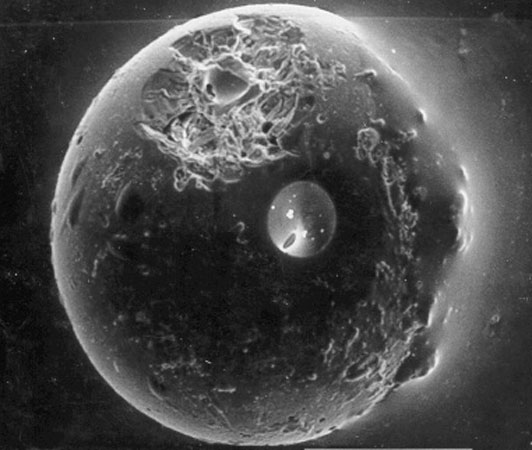
この球状粒子はどのようにして月面に現れたのでしょうか?隕石が月に衝突すると、その衝撃エネルギーによって飛び散った岩石の一部が溶け、その一部が冷えて小さなガラスのビーズになることがあります。アポロ計画で地球に持ち帰られた月の土壌サンプルには、こうしたガラスのビーズが数多く含まれていました。上の写真は、直径わずか0.25ミリメートルのガラス球状粒子です。この球状粒子は、さらに小さな衝突の被害を受けているため、特に興味深いものです。左上には、小さな衝突の衝撃波によって生じた破片に囲まれた、小さなクレーターが見えます。こうした衝突の年代を数多く特定することで、一部の天文学者は、月のクレーター形成が約5億年前に増加し、現在も続いていると推定しています。
原文(English)
How did this spherule come to be on the Moon? When a meteorite strikes the Moon, the energy of the impact melts some of the splattering rock, a fraction of which might cool into tiny glass beads. Many of these glass beads were present in lunar soil samples returned to Earth by the Apollo missions. Pictured above is one such glass spherule that measures only a quarter of a millimeter across. This spherule is particularly interesting because it has been victim to an even smaller impact. A miniature crater is visible on the upper left, surrounded by a fragmented area caused by the shockwaves of the small impact. By dating many of these impacts, some astronomers estimate that cratering on our Moon increased roughly 500 million years ago and continues even today.
\ この感動を宇宙仲間にシェア /
宇宙をXでシェア
© NASA / APOD