フェルミの最初の光
Fermi's First Light
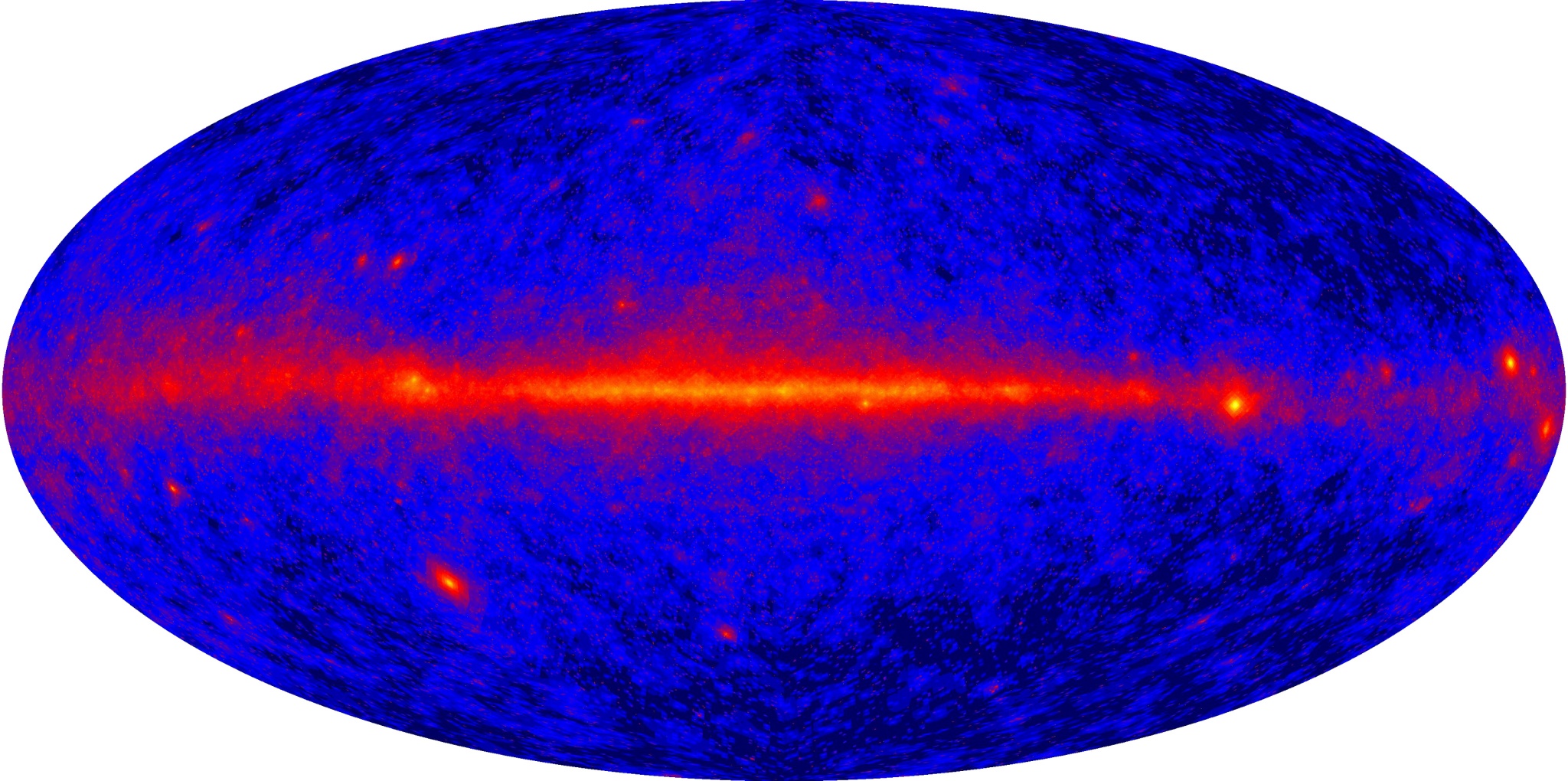
6 月 11 日に打ち上げられ、極限エネルギーの宇宙を探査するガンマ線大面積宇宙望遠鏡は、高エネルギー物理学の先駆者であるノーベル賞受賞者エンリコ・フェルミ (1901-1954) にちなんで、正式にフェルミ ガンマ線宇宙望遠鏡と改名されました。テスト後、フェルミの 2 つの機器、ガンマ線バーストモニター (GBM) と大面積望遠鏡 (LAT) は現在、定期的にデータを送信しています。この擬似カラー画像には、LAT によるフェルミ初のガンマ線空の地図が表示されています。これは、銀河面が中央に投影された、天の川銀河の中心方向を向いた全天ビューです。ガンマ線空では何が輝いているのでしょうか? 銀河面に沿って、高エネルギー宇宙線がガスや塵と衝突して拡散ガンマ線の光を生成します。カーソルを地図上に置くと、回転する中性子星やパルサー、ブレーザーと呼ばれる遠方の活動銀河からの強い放射を識別できます。将来の発見への序章となるこの注目すべき成果は、わずか4日間の観測(1年間の観測に相当)と1990年代のコンプトンガンマ線観測衛星のミッションを組み合わせたものです。ガンマ線バーストを監視できるだけでなく、大幅に向上した感度により、フェルミ衛星は高エネルギー宇宙のより深い領域を観測できるようになります。
原文(English)
Launched on June 11 to explore the universe at extreme energies, the Gamma-ray Large Area Space Telescope has been officially renamed the Fermi Gamma-ray Space Telescope, in honor of Nobel Laureate Enrico Fermi (1901-1954), pioneer in high-energy physics. After testing, Fermi's two instruments, the Gamma-ray Burst Monitor (GBM) and the Large Area Telescope (LAT), are now regularly returning data. Fermi's first map of the gamma-ray sky from the LAT is shown in this false-color image, an all-sky view that looks toward the center of our Milky Way Galaxy with the galactic plane projected across the middle. What shines in the gamma-ray sky? Along the galactic plane, energetic cosmic rays collide with gas and dust to produce the diffuse gamma-ray glow. Strong emission from spinning neutron stars or pulsars, and distant active galaxies known as blazars, can be identified by placing your cursor over the map. A prelude to future discoveries, the remarkable result combines only 4 days of observations, equivalent to a year of observations with the Compton Gamma-ray Observatory mission of the 1990s. In addition to the ability to monitor gamma-ray bursts, the greatly improved sensitivity will allow Fermi to look deeper into the high-energy Universe.
\ この感動を宇宙仲間にシェア /
宇宙をXでシェア
© NASA / APOD