MACSJ0025:2つの巨大銀河団が衝突
MACSJ0025: Two Giant Galaxy Clusters Collide
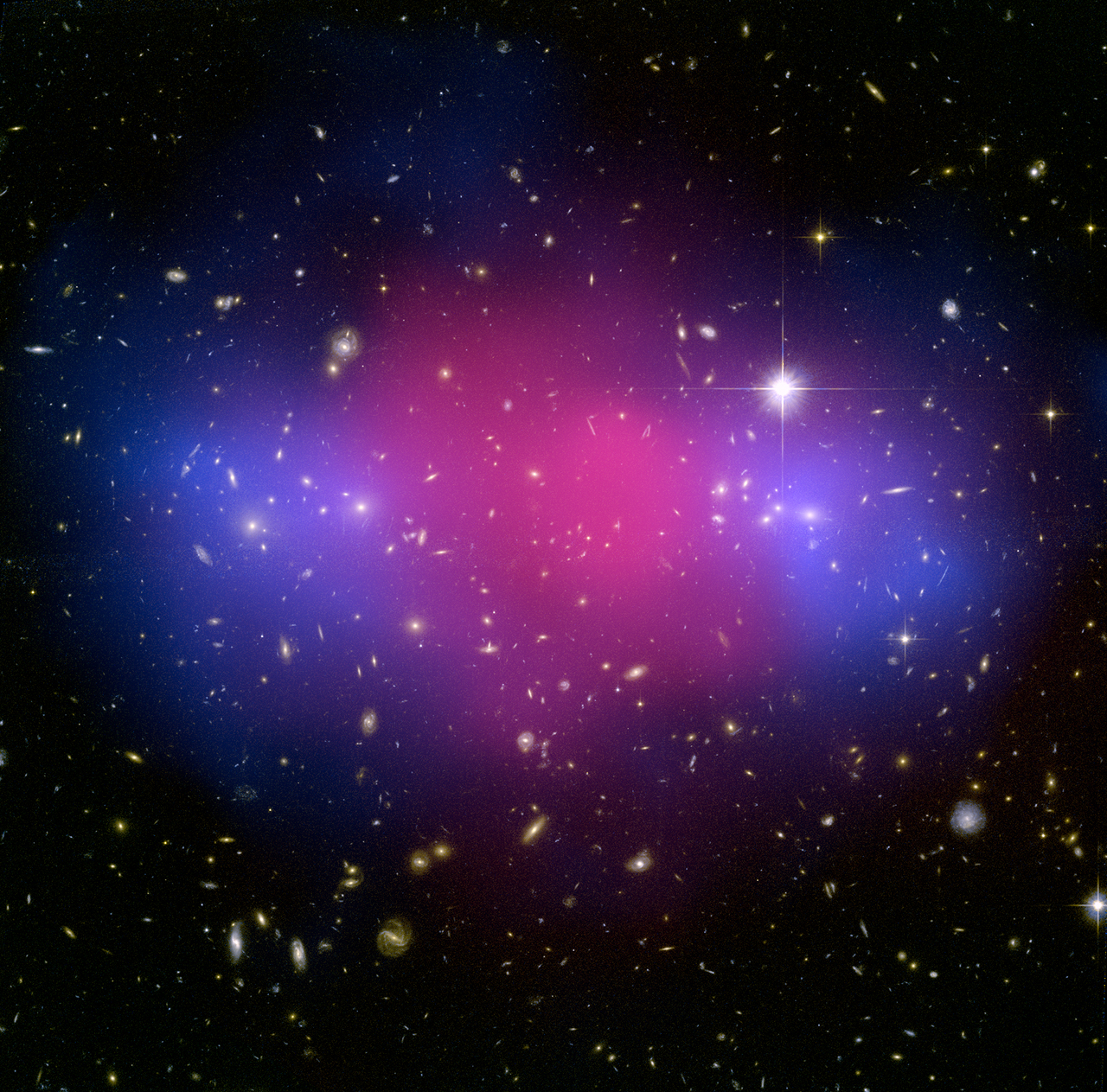
宇宙で最も大きな天体2つが衝突するとどうなるのか?誰も確信を持てずにいたが、その答えは謎の暗黒物質の性質の手がかりを与えている。MACSJ0025.4-1222の場合、2つの巨大な銀河団が数億年かけてゆっくりと衝突していることが発見され、その結果はハッブル宇宙望遠鏡による可視光とチャンドラ宇宙望遠鏡によるX線の両方で画像化された。上記の可視光画像が記録されると、新たに合体した銀河団による遠方の銀河の位置と重力レンズ効果による歪みから、天文学者は計算によって銀河団の暗黒物質に何が起こったのかを解明することができた。その結果、この巨大な衝突によって銀河団内の暗黒物質が通常の物質から部分的に分離したことが示され、以前の推測が裏付けられた。上記の合成画像では、暗黒物質は拡散した紫色で示され、X線で滑らかに表現された高温の通常の物質はピンク色で示されている。 MACSJ0025は数百個の銀河を含み、約300万光年にわたって広がり、くじら座の方向、約60億光年離れた場所に位置しています(赤方偏移0.59)。注:APOD編集者による無料のオンライン天文学講座
原文(English)
What happens when two of the largest objects in the universe collide? No one was quite sure, but the answer is giving clues to the nature of mysterious dark matter. In the case of MACSJ0025.4-1222, two huge clusters of galaxies have been found slowly colliding over hundreds of millions of years, and the result has been imaged by both the Hubble Space Telescope in visible light and the Chandra Space Telescope in X-ray light. Once the above visible image was recorded, the location and gravitational lens distortions of more distant galaxies by the newly combined galaxy cluster allowed astronomers to computationally determine what happened to the clusters' dark matter. The result indicates that this huge collision has caused the dark matter in the clusters to become partly separated from the normal matter, confirming earlier speculation. In the above combined image, dark matter is shown as the diffuse purple hue, while a smoothed depiction of the X-ray hot normal matter is shown in pink. MACSJ0025 contains hundreds of galaxies, spans about three million light years, and lies nearly six billion light years away (redshift 0.59) toward the constellation of Monster Whale (Cetus). Note: Free Astronomy Course Taught Online by an APOD Editor
\ この感動を宇宙仲間にシェア /
宇宙をXでシェア
© NASA / APOD