ハッブル宇宙望遠鏡が捉えた、Arp 147の二重リング銀河
The Double Ring Galaxies of Arp 147 from Hubble
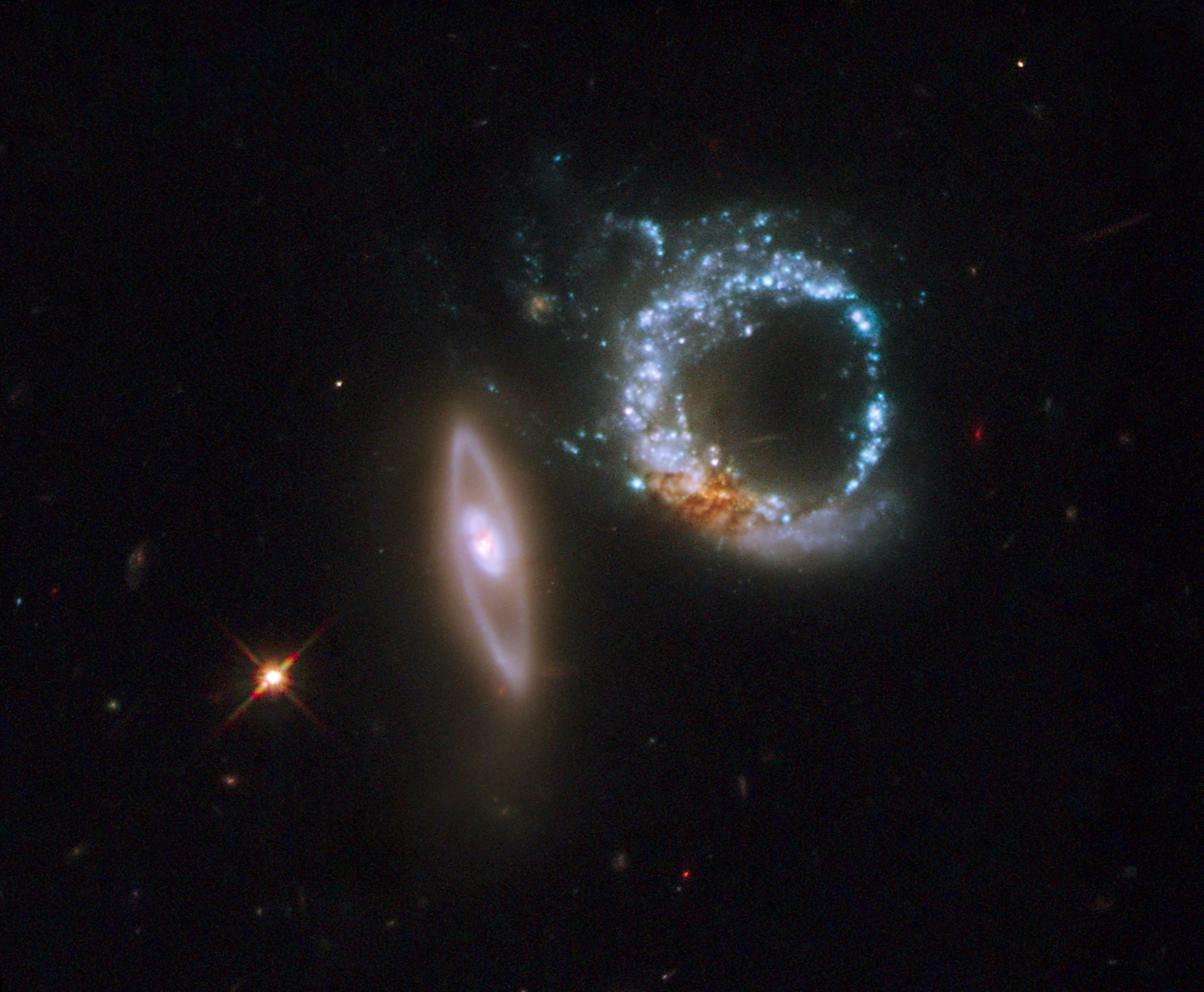
銀河がどうしてリング状になるのか?さらに奇妙なのは、どうして2つもリング状になるのか?右側に写っている青い銀河の縁には、新しく形成された極めて明るく巨大な星々で構成された、直径3万光年の巨大なリング状構造が見られる。この青い銀河は、Arp 147として知られる相互作用銀河系の一部であり、フレーム内のもう1つの銀河、左側の赤い銀河と最近衝突したため、リング状になっている。珍しいことに、この赤い銀河もほぼ真横から見ているにもかかわらず、リング状の帯が見られる。銀河が衝突すると、銀河同士がすり抜ける。個々の星が接触することはめったにない。星間ガスと塵の雲が凝縮し、衝突点から池の水面に広がる波紋のように星形成の波が広がる。上記の画像は、NASAのハッブル宇宙望遠鏡が先週撮影したもので、最近発生した技術的な問題の後、広視野惑星カメラ2の性能を実証するために撮影されたものです。
原文(English)
How could a galaxy become shaped like a ring? Even more strange: how could two? The rim of the blue galaxy pictured on the right shows an immense ring-like structure 30,000 light years in diameter composed of newly formed, extremely bright, massive stars. This blue galaxy is part of the interacting galaxy system known as Arp 147, and shows a ring because it has recently collided with the other galaxy in the frame, the red galaxy on the left. Unusually, even this red galaxy shows a ring like band, although it is seen nearly edge-on. When galaxies collide, they pass through each other -- their individual stars rarely come into contact. Clouds of interstellar gas and dust become condensed, causing a wave of star formation to move out from the impact point like a ripple across the surface of a pond. The above image was taken last week by NASA's Hubble Space Telescope to demonstrate the ability of its Wide Field Planetary Camera 2 after some recent technical difficulties.
\ この感動を宇宙仲間にシェア /
宇宙をXでシェア
© NASA / APOD