カニ星雲パルサー風星雲
Crab Pulsar Wind Nebula
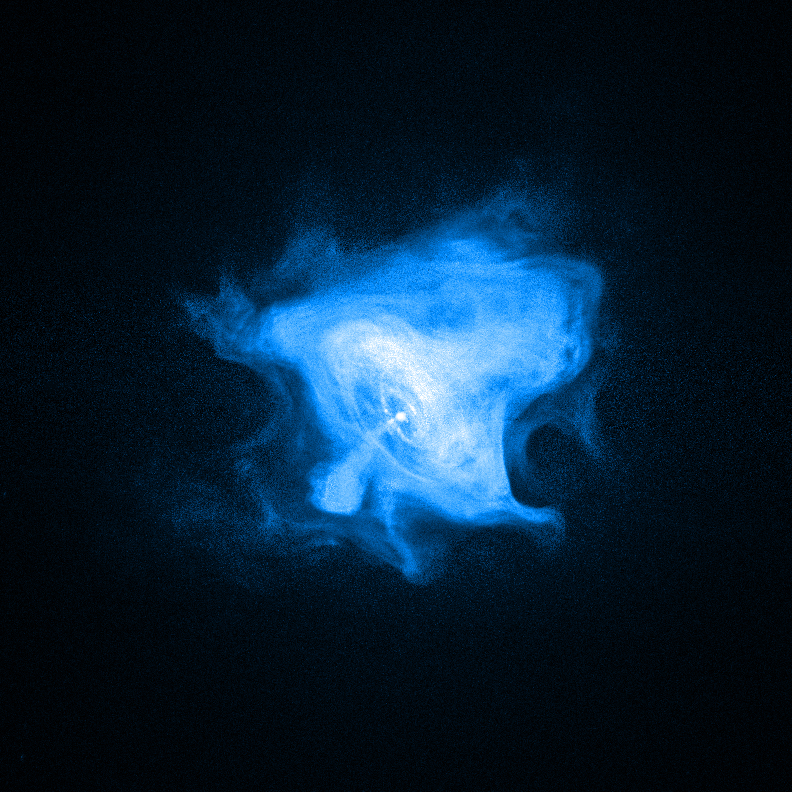
軌道上のチャンドラ天文台が撮影したこの驚くべき画像の中心には、都市ほどの大きさの磁化された中性子星、カニパルサーが写っている。この深宇宙X線画像は、カニパルサーのパルサー風星雲の複雑な境界を初めて鮮明に捉えたものである。宇宙のダイナモのように、パルサーはX線放射のエネルギー源となっている。パルサーのエネルギーは荷電粒子を加速させ、極から遠ざかる方向に不気味に輝くX線ジェットと、赤道方向への強烈な風を生み出す。荷電粒子が流れ出すにつれて興味深い境界が形成され、最終的にはパルサーの強力な磁場と相互作用してエネルギーを失う。太陽よりも質量が大きく、原子核と同じ密度を持つこの回転するパルサー自体は、巨大な星の崩壊した核である。恒星核の崩壊は、1054年に観測された超新星爆発を引き起こしました。このチャンドラX線天文台の画像は、かに星雲の推定距離6,000光年において、9光年弱の範囲を捉えています。注:APOD編集者が1月2日にニューヨークで講演します。
原文(English)
The Crab Pulsar, a city-sized, magnetized neutron star spinning 30 times a second, lies at the center of this remarkable image from the orbiting Chandra Observatory. The deep x-ray image gives the first clear view of the convoluted boundaries of the Crab's pulsar wind nebula. Like a cosmic dynamo the pulsar powers the x-ray emission. The pulsar's energy accelerates charged particles, producing eerie, glowing x-ray jets directed away from the poles and an intense wind in the equatorial direction. Intriguing edges are created as the charged particles stream away, eventually losing energy as they interact with the pulsar's strong magnetic field. With more mass than the Sun and the density of an atomic nucleus, the spinning pulsar itself is the collapsed core of a massive star. The stellar core collapse resulted in a supernova explosion that was witnessed in the year 1054. This Chandra image spans just under 9 light-years at the Crab's estimated distance of 6,000 light-years. Note : APOD Editor to Speak in New York on Jan. 2
\ この感動を宇宙仲間にシェア /
宇宙をXでシェア
© NASA / APOD