金環日食:炎の輪
Annular Eclipse: The Ring of Fire
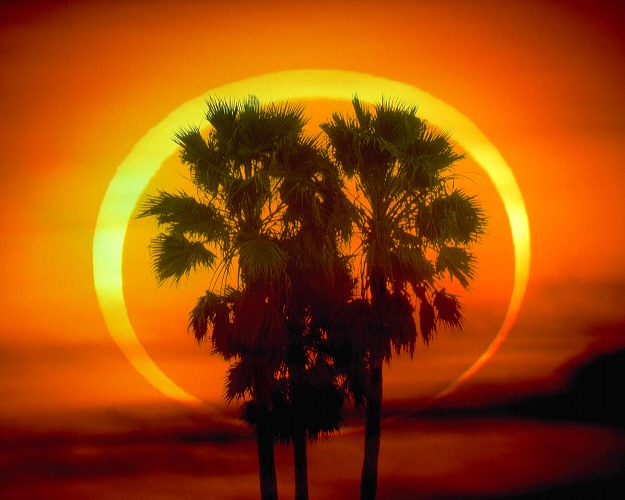
明日、幸運な数名が「火の輪」を見ることができるかもしれません。これは、月による金環日食の中央部分の名称です。この日食のピーク時には、太陽の中央が欠けているように見え、暗い月が明るい太陽に囲まれているように見えます。ただし、これは南インド洋を横断する経路からのみ見ることができます。人口の多い地域、南アフリカ、オーストラリアの一部からは、月の大部分が太陽をかじっているように見えるだけです。日食中であっても、太陽を直接見ないように注意してください。金環日食は、月が地球の周りを楕円軌道で公転しているときに、皆既日食ではなく起こります。次の金環日食は2010年1月に起こりますが、今年の7月には皆既日食が起こります。上の写真は、1992年1月にヤシの木の後ろで撮影された壮大な金環日食です。
原文(English)
Tomorrow, a few lucky people may see a "ring of fire." That's a name for the central view of an annular eclipse of the Sun by the Moon. At the peak of this eclipse, the middle of the Sun will appear to be missing and the dark Moon will appear to be surrounded by the bright Sun. This will only be visible, however, from a path that crosses the southern Indian Ocean. From more populated locations, southern Africa and parts of Australia, most of the Moon will only appear to take a bite out the Sun. Remember to never look directly at the Sun even during an eclipse. An annular eclipse occurs instead of a total eclipse when the Moon is on the far part of its elliptical orbit around the Earth. The next annular eclipse of the Sun will take place in 2010 January, although a total solar eclipse will occur this July. Pictured above, a spectacular annular eclipse was photographed behind palm trees on 1992 January.
\ この感動を宇宙仲間にシェア /
宇宙をXでシェア
© Dennis L. Mammana
(TWAN) / APOD