コメット・ルリン・テイルズ
Comet Lulin Tails
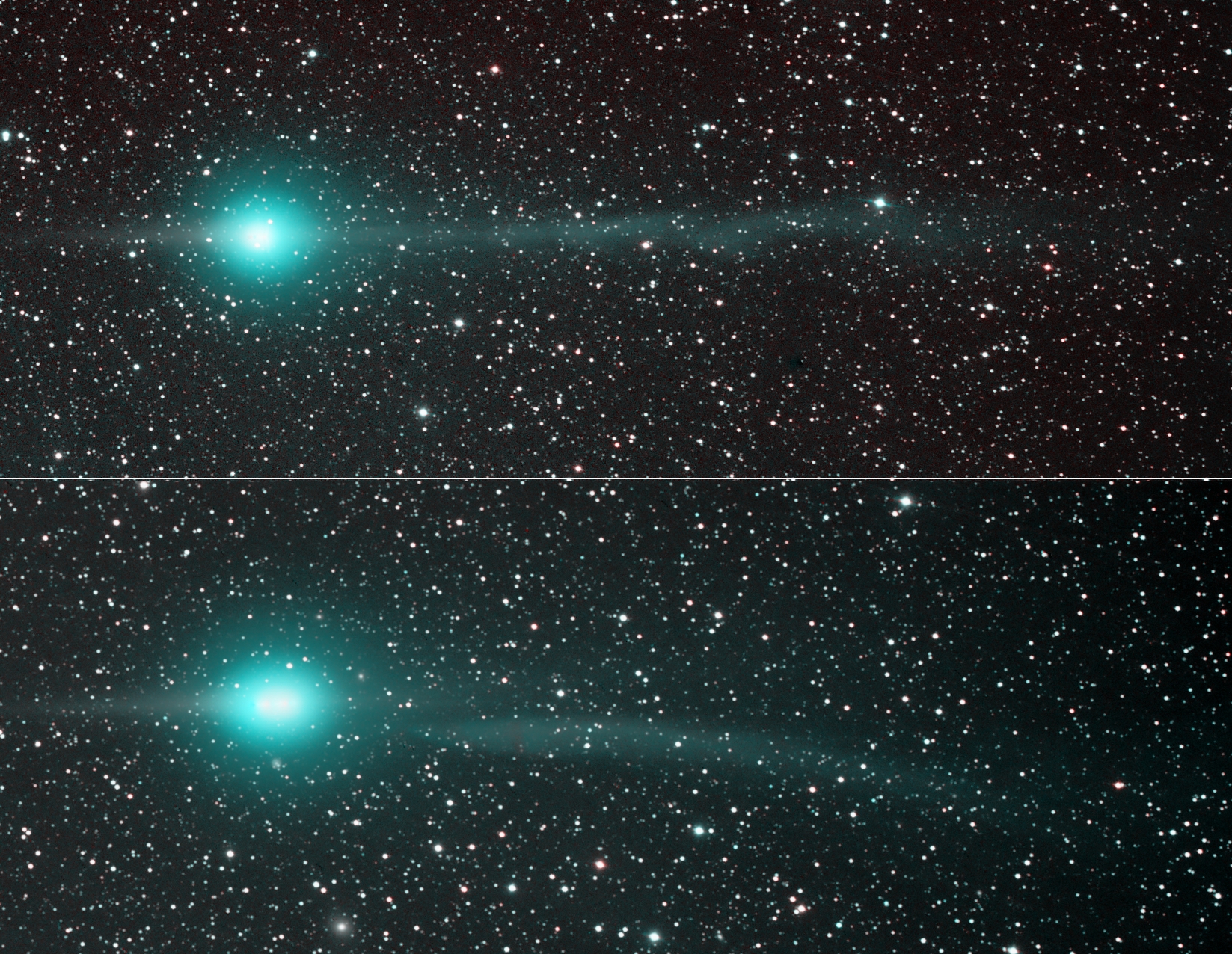
太陽系の内側を駆け抜けるルリン彗星は、双眼鏡や小型望遠鏡を使えば北半球と南半球の両方で容易に見ることができます。ルリン彗星の美しい緑がかったコマと尾の最近の変化は、1月31日(上)と2月4日に撮影された画像の2つのパネルの比較で紹介されています。暗いニューメキシコの空から撮影されたこれらの画像は、2度以上にわたっています。どちらの画像でも、彗星の左側には明らかな反尾が見られます。これは、ルリン彗星の軌道の後ろに引きずられる彗星の塵の尾が、地球からの視点ではほぼ真横から見える状態です。コマの右側、太陽から遠ざかる方向には、美しいイオンの尾が伸びています。驚くべきことに、下のパネルに写っているように、ルリン彗星のイオンの尾は2月4日に分離しました。おそらく太陽風の磁場によって揺さぶられ、引き裂かれたのでしょう。2007年には、NASAの衛星がエンケ彗星で同様の分離現象を記録しました。しかし、心配する必要はありません。彗星の尾は再生する可能性がある。
原文(English)
Sweeping through the inner solar system, Comet Lulin is easily visible in both northern and southern hemispheres with binoculars or a small telescope. Recent changes in Lulin's lovely greenish coma and tails are featured in this two panel comparison of images taken on January 31st (top) and February 4th. Taken from dark New Mexico Skies, the images span over 2 degrees. In both views the comet sports an apparent antitail at the left -- the comet's dust tail appearing almost edge on from an earth-based perspective as it trails behind in Lulin's orbit. Extending to the right of the coma, away from the Sun, is the beautiful ion tail. Remarkably, as captured in the bottom panel, Comet Lulin's ion tail became disconnected on February 4, likely buffeted and torn away by magnetic fields in the solar wind. In 2007 NASA satellites recorded a similar disconnection event for Comet Encke. Don't worry, though. Comet tails can grow back.
\ この感動を宇宙仲間にシェア /
宇宙をXでシェア
© Joseph Brimacombe / APOD