ガニメデ強化版
Ganymede Enhanced
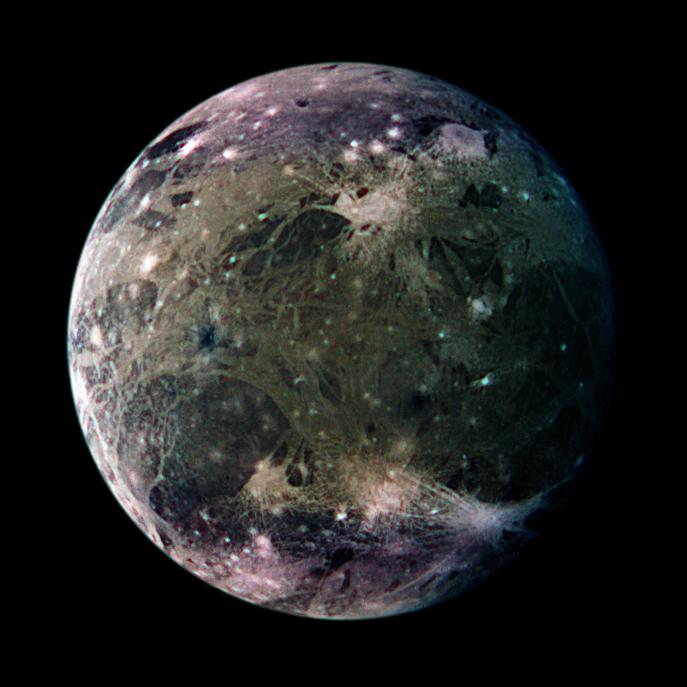
太陽系最大の衛星はどんな姿をしているのでしょうか?水星や冥王星よりも大きいガニメデの表面は、明るく若いクレーターが点在し、その下には溝や尾根が走る、より古く暗くクレーターの多い地形が広がっています。地球の月と同様に、ガニメデは常に同じ面を中心惑星、つまり木星に向けています。1995年から2003年にかけて木星を周回したガリレオ探査機が撮影したこの歴史的かつ詳細な画像モザイクでは、この惑星サイズの衛星の色が強調され、表面のコントラストが際立っています。上下に広がる紫色の陰影は、ガニメデの極域にある霜の粒子によるものと考えられます。将来、木星への探査ミッションが提案されており、生命を支える上で重要と考えられる元素が存在する可能性のある深海をエウロパやガニメデで探査することが期待されています。
原文(English)
What does the largest moon in the Solar System look like? Ganymede, larger than even Mercury and Pluto, has a surface speckled with bright young craters overlying a mixture of older, darker, more cratered terrain laced with grooves and ridges. Like Earth's Moon, Ganymede keeps the same face towards its central planet, in this case Jupiter. In this historic and detailed image mosaic taken by the Galileo spacecraft that orbited Jupiter from 1995 to 2003, the colors of this planet-sized moon have been enhanced to increase surface contrasts. The violet shades extending from the top and bottom are likely due to frost particles in Ganymede's polar regions. Possible future missions to Jupiter are being proposed that can search Europa and Ganymede for deep oceans that may harbor elements thought important for supporting life.
\ この感動を宇宙仲間にシェア /
宇宙をXでシェア
© NASA / APOD