NGC 2623:ハッブル宇宙望遠鏡が捉えた銀河の合体
NGC 2623: Galaxy Merger from Hubble
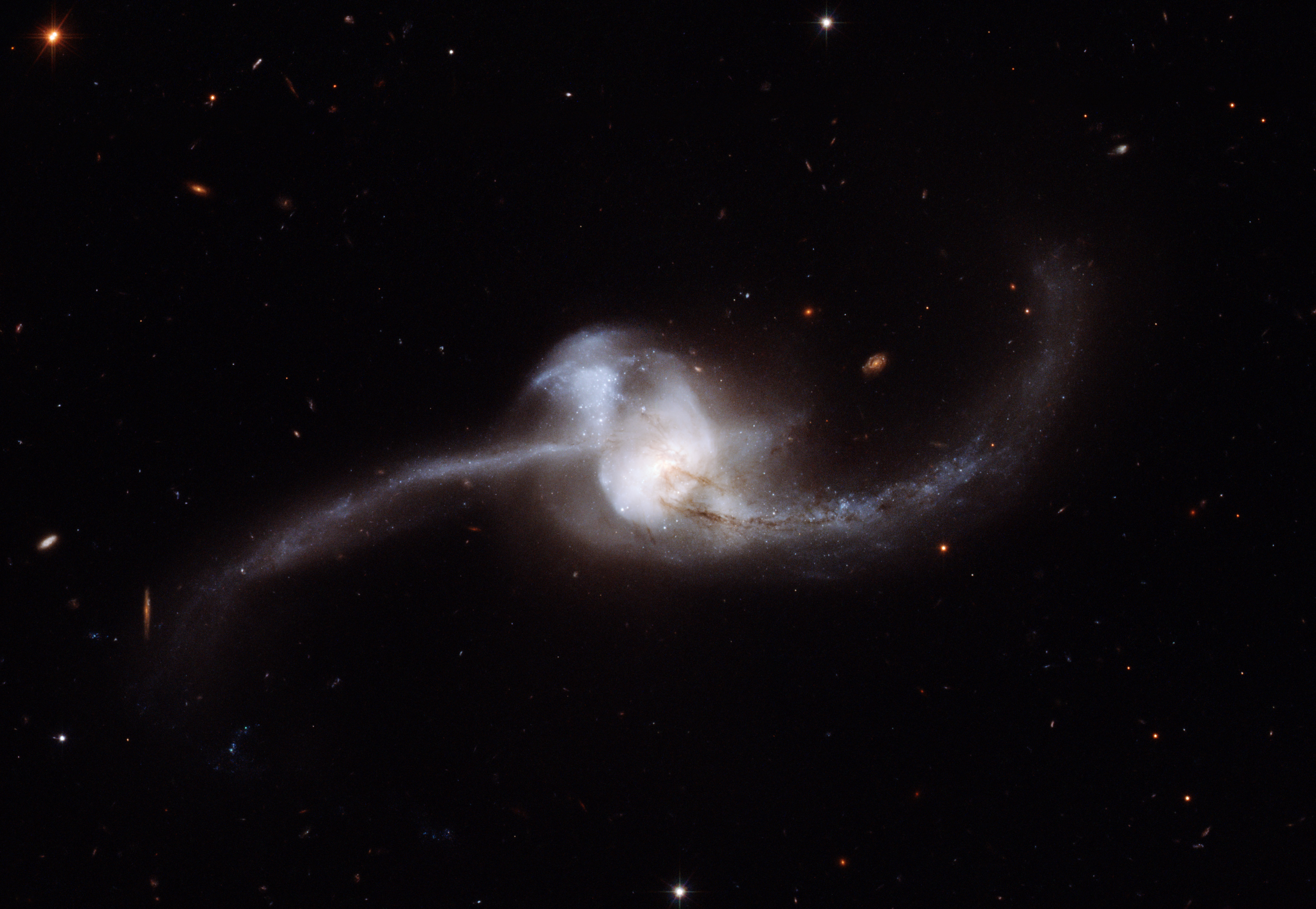
銀河が衝突すると、星はどこで形成されるのでしょうか?その解明のため、天文学者たちは2007年にハッブル宇宙望遠鏡で近傍の銀河合体NGC 2623を高解像度で撮影しました。このハッブル画像と、スピッツァー宇宙望遠鏡による赤外線画像、XMM-NewtonによるX線画像、GALEXによる紫外線画像のNGC 2623の分析から、元々は渦巻銀河だった2つの銀河が大きく巻き込まれ、その中心部が1つの活動銀河核(AGN)に合体したことが示唆されています。星形成は、上の画像の中心付近にあるこの中心部の周囲、両側に伸びた潮汐尾に沿って、そしておそらく意外なことに、明るい青い星の集団が見られる左上の中心部から離れた領域でも続いています。銀河の衝突は何億年もかかり、重力的に破壊的な通過を何度も繰り返すことがあります。 NGC 2623(別名Arp 243)は、約5万光年の広がりを持ち、かに座の方向へ約2億5000万光年離れた場所に位置しています。元の銀河を再構築し、銀河の合体がどのように起こるかを解明することは、しばしば困難であり、時には不可能ですが、一般的には宇宙がどのように進化してきたかを理解する上で重要です。
原文(English)
Where do stars form when galaxies collide? To help find out, astronomers imaged the nearby galaxy merger NGC 2623 in high resolution with the Hubble Space Telescope in 2007. Analysis of this Hubble image and images of NGC 2623 in infrared light by the Spitzer Space Telescope, in X-ray light by XMM-Newton, and in ultraviolet light by GALEX, indicate that two originally spiral galaxies appear now to be greatly convolved and that their cores have unified into one active galactic nucleus (AGN). Star formation continues around this core near the above image center, along the stretched out tidal tails visible on either side, and perhaps surprisingly, in an off-nuclear region on the upper left where clusters of bright blue stars appear. Galaxy collisions can take hundreds of millions of years and take several gravitationally destructive passes. NGC 2623, also known as Arp 243, spans about 50,000 light years and lies about 250 million light years away toward the constellation of the Crab (Cancer). Reconstructing the original galaxies and how galaxy mergers happen is often challenging, sometimes impossible, but generally important to understanding how our universe evolved.
\ この感動を宇宙仲間にシェア /
宇宙をXでシェア
© NASA / APOD