ロゼットのフィールド
Field of Rosette
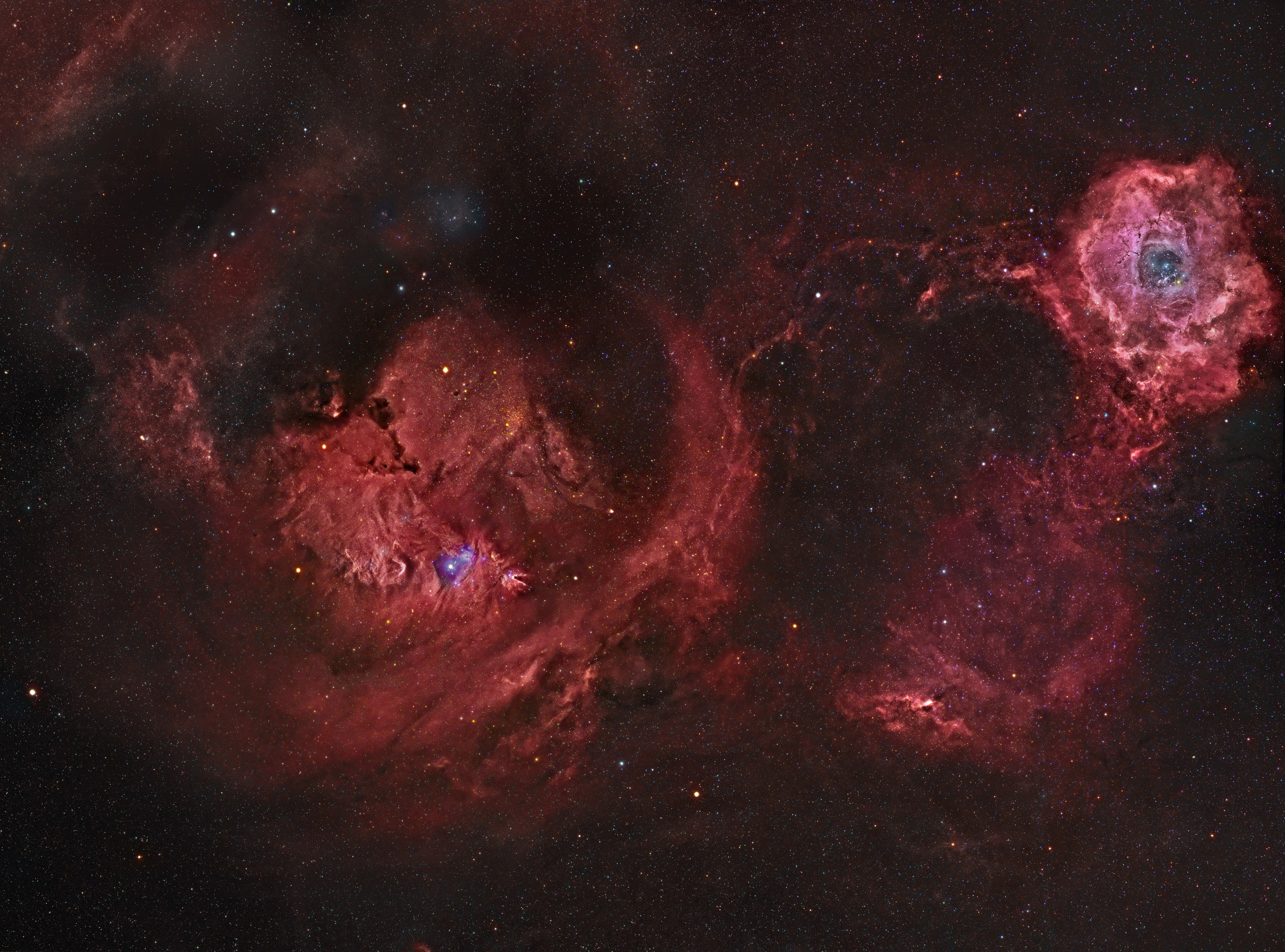
バラ星雲の周囲には何があるのか?この空の領域をよりよく捉えるために、右端にある有名な花のような輝線星雲が、最近、他のいくつかの空のハイライトを捉えた、深くドラマチックな広視野画像で撮影されました。NGC 2237 と指定されたバラ星雲の中心には、散開星団 NGC 2244 の明るい青い星々が集まっており、その風とエネルギーの高い光が星雲の中心から星を放出しています。バレンタインデーのシンボルである有名な花の下には、バラの茎のように見えるが数百光年にわたって伸びる塵とガスの柱があります。上の画像の中央の左下にある明るい青い星は S Monocerotis と呼ばれています。この星は、NGC 2264 とラベル付けされた散開星団の一部で、スノーフレーク星団として知られています。 S Monの右側には、円錐星雲と呼ばれる暗く尖った構造物があります。この星雲は、塵に覆われた巨大な星から流れ出る恒星風によって形成されたと考えられています。S Monの左側には、急速に進化するスノーフレーク星団によって形成された、激しい星雲であるフォックスファー星雲があります。バラ星雲領域は約5,000光年離れており、S Mon周辺の領域の約2倍の距離にあります。この領域全体は、一角獣座(いっかくじゅう座)の方向にある小型望遠鏡で見ることができます。注:天文学のオンライン講座を無料で受講できます
原文(English)
What surrounds the florid Rosette nebula? To better picture this area of the sky, the famous flowery emission nebula on the far right has been captured recently in a deep and dramatic wide field image that features several other sky highlights. Designated NGC 2237, the center of the Rosette nebula is populated by the bright blue stars of open cluster NGC 2244, whose winds and energetic light are evacuating the nebula's center. Below the famous flower, a symbol of Valentine's Day, is a column of dust and gas that appears like a rose's stem but extends hundreds of light years. Across the above image, the bright blue star just left and below the center is called S Monocerotis. The star is part of the open cluster of stars labelled NGC 2264 and known as the Snowflake cluster. To the right of S Mon is a dark pointy featured called the Cone nebula, a nebula likely shaped by winds flowing out a massive star obscured by dust. To the left of S Mon is the Fox Fur nebula, a tumultuous region created by the rapidly evolving Snowflake cluster. The Rosette region, at about 5,000 light years distant, is about twice as far away as the region surrounding S Mon. The entire field can be seen with a small telescope toward the constellation of the Unicorn (Monoceros). Note: Take an Astronomy Class Online for Free
\ この感動を宇宙仲間にシェア /
宇宙をXでシェア
© Rogelio Bernal Andreo
(Deep Sky Colors) / APOD