ベスタの接近衝
Vesta Near Opposition
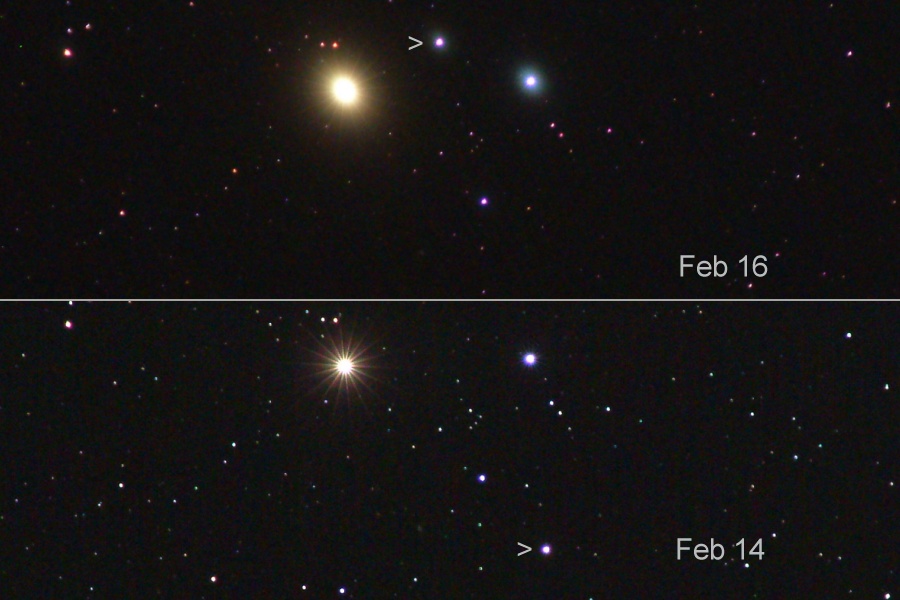
小惑星帯の4ベスタは現在最も明るく輝いています。この小さな天体は衝(空で太陽の反対側)に近く、地球に最も接近しています。しかし、最も明るい時でも、ベスタは肉眼で見つけるには暗すぎます。それでも、今後数日間は、明るい星ガンマ・レオニス(別名アルギエバ)と双眼鏡の視野を共有しているため、しし座で比較的簡単に見つけることができます。実際、2月16日、ベスタはガンマ・レオニスと、空で近い40レオニスの間を通過しました。ガンマ・レオニスはこの2つのパネルの中で最も明るい星で、2番目に明るい星である40レオニスはそのすぐ右にあります。マークされているように、ベスタはこの視野で3番目に明るい「星」です。ベスタは2月14日には40レオニスのはるか下から、2月16日にはフレームの上部近くまで位置を変え、ガンマ・レオニスと40レオニスの間の隙間を通り抜けます。もちろん、イオン推進式の探査機ドーンが2011年8月にベスタに到着すれば、小惑星の最高の近接画像が得られるようになるだろう。
原文(English)
Main belt asteroid 4 Vesta is at its brightest now. The small world is near opposition (opposite the Sun in the sky) and closest to Earth. But even at its brightest, Vesta is just too faint to spot with the naked-eye. Still, over the next few days it will be relatively easy to find in the constellation Leo, sharing a typical binocular field of view with bright star Gamma Leonis (aka Algieba). In fact on February 16 Vesta passed between Gamma Leonis and close neighbor on the sky 40 Leonis. Gamma Leonis is the brightest star in these two panels, while the second brightest star, 40 Leonis, is directy to its right. As marked, Vesta is the third brightest "star" in the field. Vesta shifts position between the two panels from well below 40 Leonis on Feb. 14 to near the top of the frame from Feb. 16, shooting the gap between the close Gamma/40 Leonis pair. Of course, premier close-up views of the asteroid will be possible after the ion-powered Dawn spacecraft arrives at Vesta in August of 2011.
\ この感動を宇宙仲間にシェア /
宇宙をXでシェア
© Jimmy Westlake / APOD