ギャラクシーグループ ヒクソン31
Galaxy Group Hickson 31
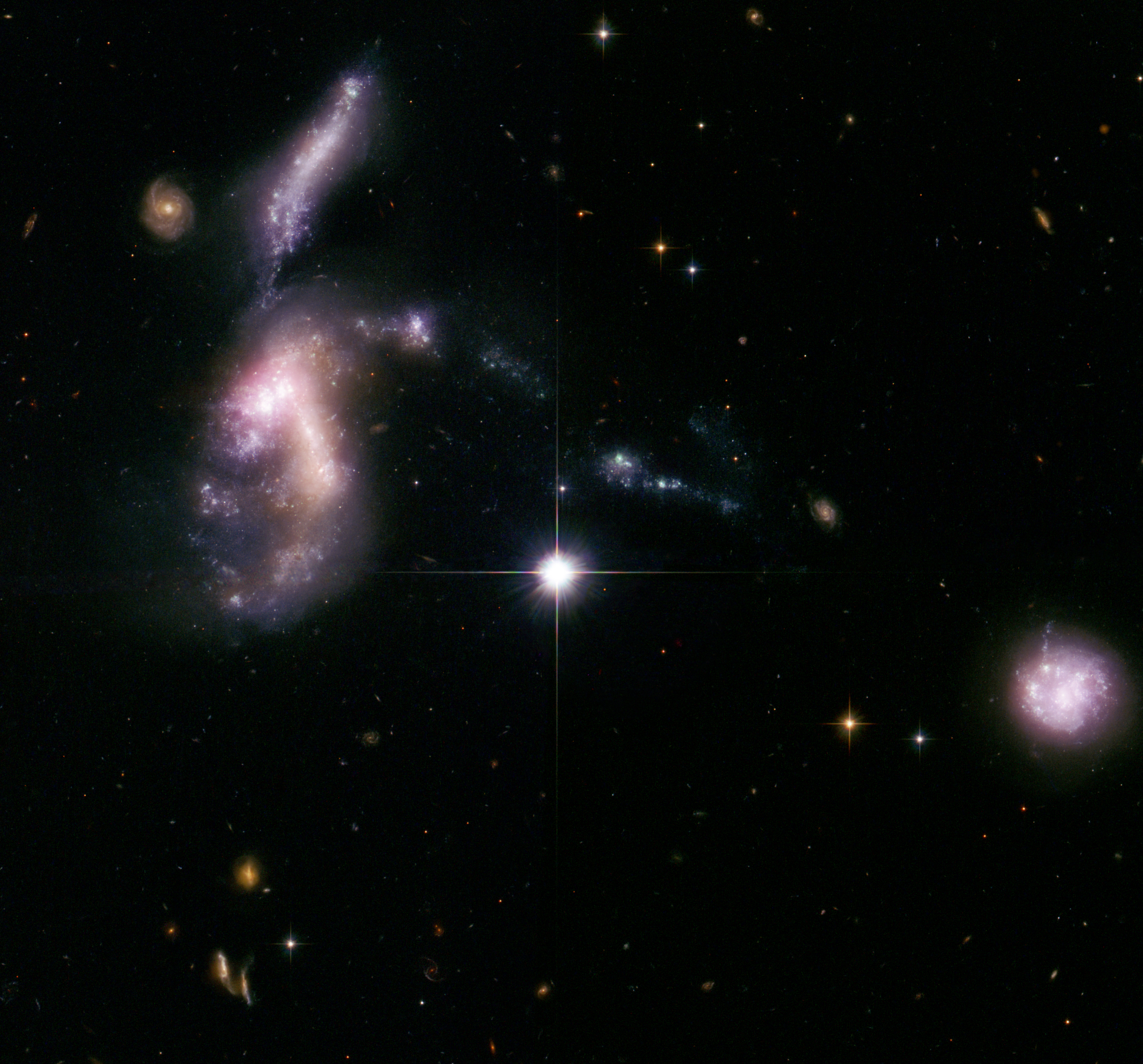
これらの銀河衝突の結果、一つの大きな楕円銀河が形成されるのだろうか?可能性は十分にあるが、それはあと10億年後のことだ。上の画像では、ヒクソンコンパクトグループ31に属するいくつかの矮小銀河がゆっくりと合体している様子が見られる。左端では2つの明るい銀河が衝突しており、その上にある細長い銀河は、珍しい星の橋でそれらと繋がっている。上の画像をさらに詳しく調べると、明るい2つの銀河が右端の渦巻銀河に向かって星のロープを引いていることがわかる。ヒクソンコンパクトグループ31のこれらの銀河は間違いなく互いにすれ違い、破壊し合い、何百万もの星が誕生して爆発し、何千もの星雲が誕生して消滅し、塵が収まって最終的な銀河が現れるのは約10億年後のことだろう。上記の画像は、スピッツァー宇宙望遠鏡による赤外線画像、GALEX宇宙望遠鏡による紫外線画像、ハッブル宇宙望遠鏡による可視光画像を合成したものです。ヒクソンコンパクト銀河群31は、約15万光年の範囲に広がり、エリダヌス座の方向に約1億5000万光年離れた場所に位置しています。
原文(English)
Will the result of these galactic collisions be one big elliptical galaxy? Quite possibly, but not for another billion years. Pictured above, several of the dwarf galaxies of in the Hickson Compact Group 31 are seen slowly merging. Two of the brighter galaxies are colliding on the far left, while an elongated galaxy above is connected to them by an unusual bridge of stars. Inspection of the above image further indicates that the bright duo trail a rope of stars pointing to the spiral galaxy on the far right. Most assuredly, the pictured galaxies of Hickson Compact Group 31 will pass through and destroy each other, millions of stars will form and explode, and thousands of nebula will form and dissipate before the dust settles and the final galaxy emerges about one billion years from now. The above image is a composite of images taken in infrared light by the Spitzer Space Telescope, ultraviolet light by the GALEX space telescope, and visible light by the Hubble Space Telescope. Hickson Compact Group 31 spans about 150 thousand light years and lies about 150 million light years away toward the constellation of Eridanus.
\ この感動を宇宙仲間にシェア /
宇宙をXでシェア
© NASA / APOD