カモメとアヒル
The Seagull and the Duck
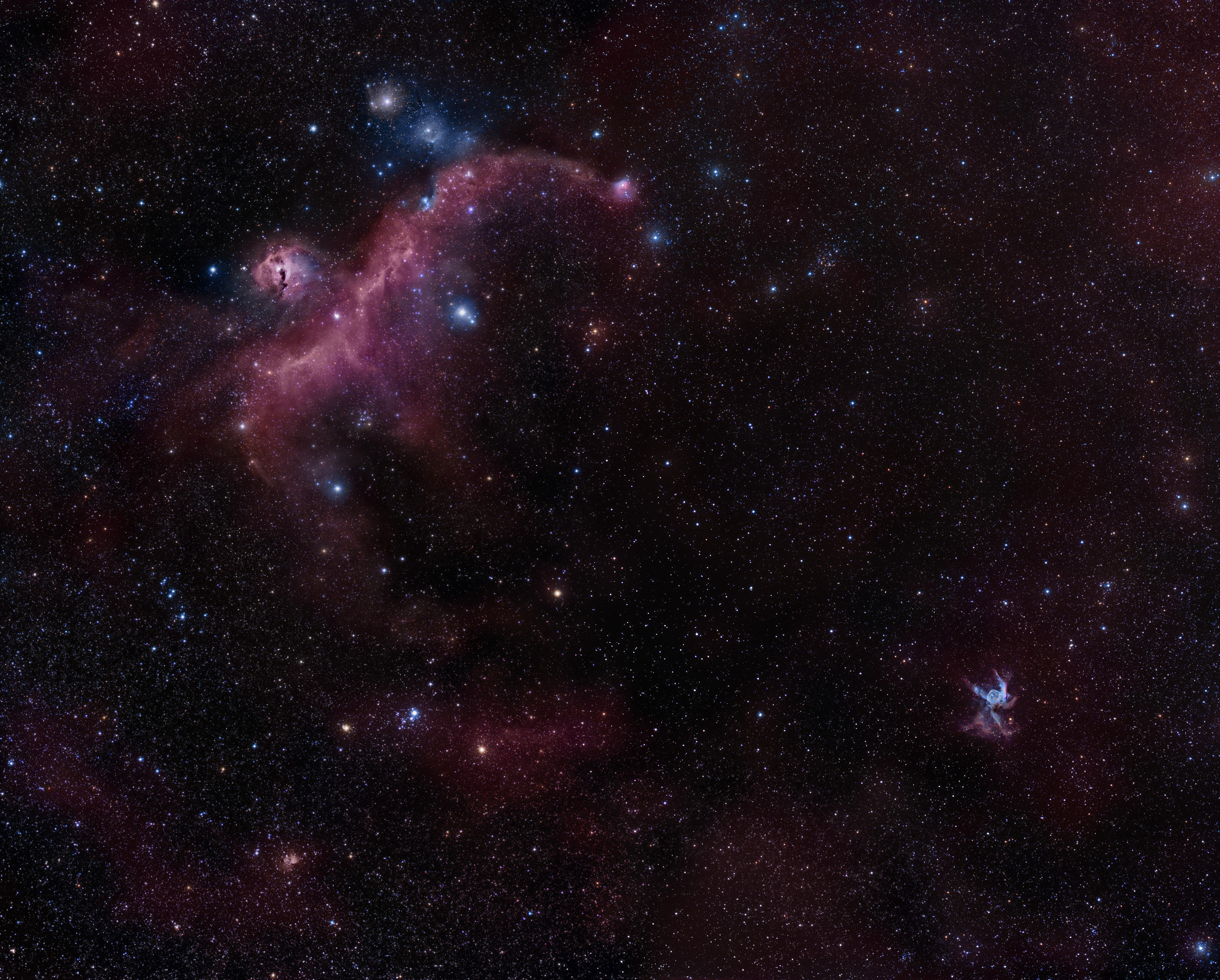
カモメとアヒルに似ていることから、これらの星雲は飛行を連想させる宇宙の雲の唯一のものではありません。しかし、どちらも地球の夜空を横切って約7度、おおいぬ座に向かって広がるこの広大な天体風景を翼を広げて飛んでいます。広大なカモメ(左上)は、カタログに掲載されている2つの主要な輝線星雲で構成されています。明るいNGC 2327が頭部を形成し、より拡散したIC 2177が翼と胴体を形成しています。驚くべきことに、カモメの翼幅は約250光年で、推定距離は3,800光年です。右下のアヒルははるかにコンパクトに見え、推定距離15,000光年で翼幅は約50光年です。中心付近にある極めて巨大で高温の恒星から吹き出す強烈な恒星風によって形成されたアヒル星雲は、NGC 2359としてカタログ化されている。もちろん、アヒルのずんぐりとした体と翼のような付属器官は、より劇的な通称「トールのヘルメット」としても知られている。
原文(English)
Seen as a seagull and a duck, these nebulae are not the only cosmic clouds to evoke images of flight. But both are winging their way across this broad celestial landscape, spanning almost 7 degrees across planet Earth's night sky toward the constellation Canis Major. The expansive Seagull (upper left) is itself composed of two major cataloged emission nebulae. Brighter NGC 2327 forms the head with the more diffuse IC 2177 as the wings and body. Impressively, the Seagull's wingspan would correspond to about 250 light-years at an estimated distance of 3,800 light-years. At the lower right, the Duck appears much more compact and would span only about 50 light-years given its 15,000 light-year distance estimate. Blown by energetic winds from an extremely massive, hot star near its center, the Duck nebula is cataloged as NGC 2359. Of course, the Duck's thick body and winged appendages also lend it a more dramatic popular moniker -- Thor's Helmet.
\ この感動を宇宙仲間にシェア /
宇宙をXでシェア
© Rogelio Bernal Andreo / APOD