北方のフクロウと南方のフクロウ
Northern and Southern Owls
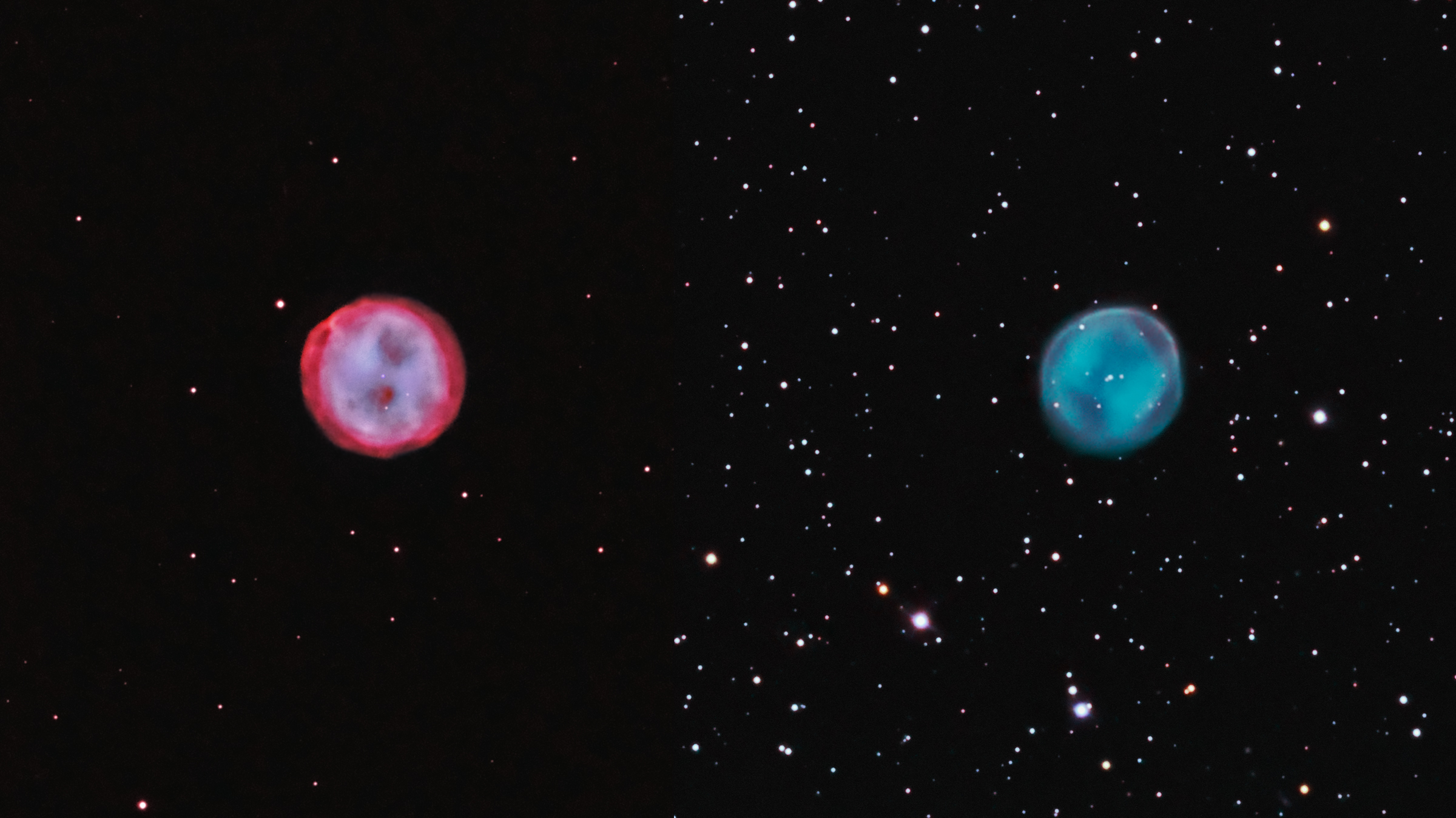
色鮮やかな望遠鏡で撮影されたこの興味深い惑星状星雲の比較画像では、2つの宇宙のフクロウが地球に向かって睨み返している。左側は北半球ではフクロウ星雲として知られるおおぐま座のM97。右側は、その視覚的な対応物であるうみへび座の南のフクロウ星雲で、カタログ番号はPLN 283+25.1である。どちらの星雲も驚くほど対称的で丸く、大きさも似ており、直径は約2光年、つまり海王星の軌道の直径の約2,000倍である。惑星状星雲は、太陽のような恒星の生涯の最終段階で生成される。これは、あと50億年で核燃料が尽きた太陽がたどる運命の一例である。どちらの画像も狭帯域フィルターと異なるカラーマッピングを使用して作成された。南のフクロウ星雲の画像には広帯域データも含まれており、周囲の星野が強調されている。
原文(English)
Captured in colorful telescopic portraits, two cosmic owls glare back toward planet Earth in this intriguing comparison of planetary nebulae. On the left is M97 in the constellation Ursa Major, also known in the northern hemisphere as the Owl Nebula. On the right is its visual counterpart, the southern Owl Nebula in the constellation Hydra, cataloged as PLN 283+25.1. Both nebulae are remarkably symmetric, round, and similar in size, some 2 light-years across or about 2,000 times the diameter of Neptune's orbit. Planetary nebulae are produced during a final phase in the life of a sun-like star, an example of the fate that awaits the Sun when it runs out of nuclear fuel in another 5 billion years. Both images were made using narrowband filters and different color mappings. The image of the southern Owl also includes broadband data, bringing out the surrounding star field.
\ この感動を宇宙仲間にシェア /
宇宙をXでシェア
© Don Goldman / APOD