M57:環状星雲
M57: The Ring Nebula
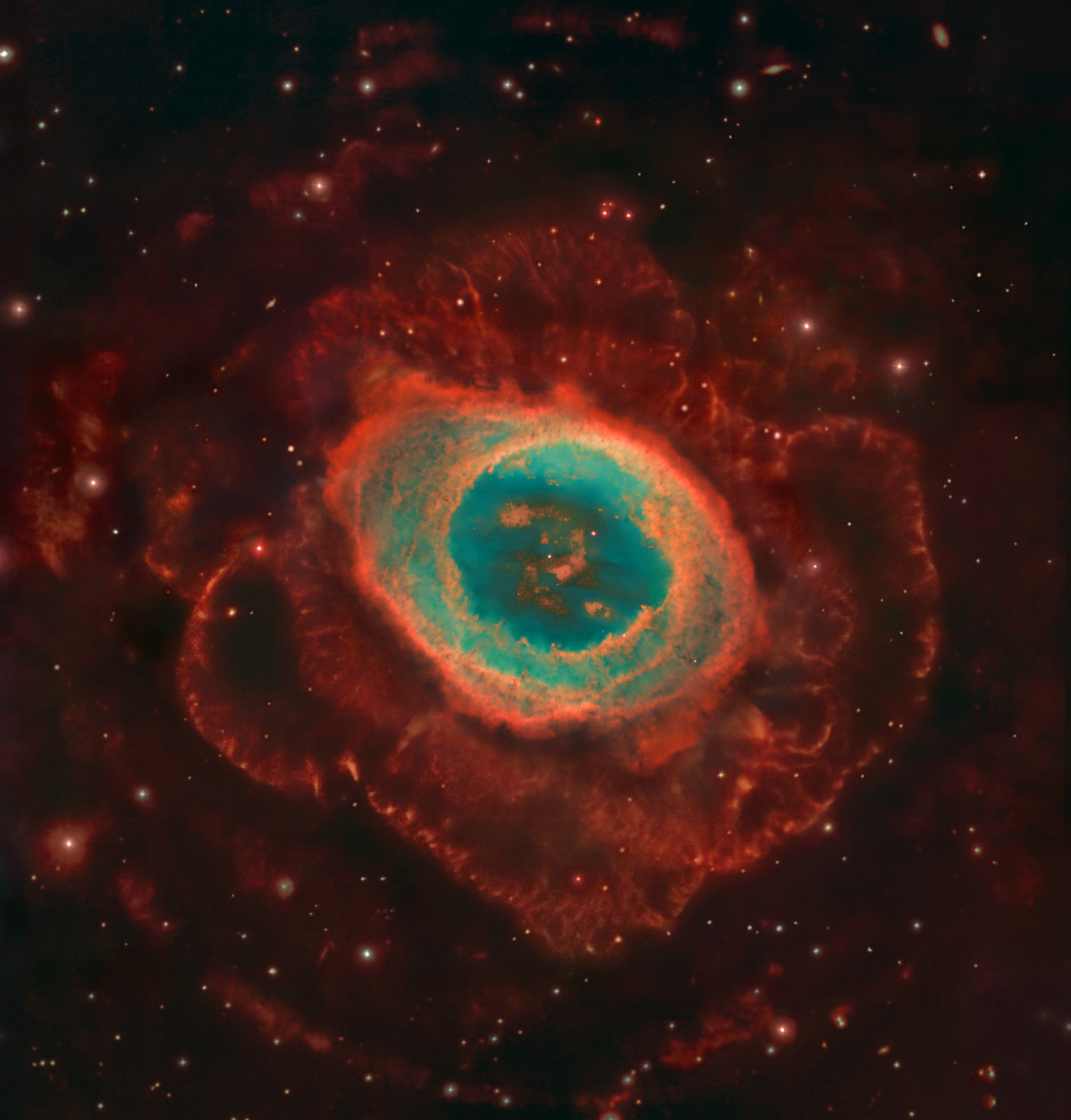
土星の環を除けば、環状星雲(M57)はおそらく最も有名な天体の帯でしょう。その典型的な外観は遠近法によるものと考えられています。地球から見ると、ほぼ樽型の輝くガス雲の中心を見下ろしていることになります。しかし、地上望遠鏡とハッブル宇宙望遠鏡の画像にすばる望遠鏡の狭帯域画像データを合成したこの興味深い画像では、環状星雲のよく知られた中心領域をはるかに超えて広がるループ状の構造が見られます。もちろん、このよく研究されている惑星状星雲の例では、輝く物質は惑星から来ているわけではありません。代わりに、ガス状の覆いは、星雲の中心にある、かつて太陽のような星だった死にゆく星から放出された外層を表しています。高温の中心星からの強烈な紫外線がガス中の原子を電離します。電離した酸素原子は特徴的な緑色の光を、電離した水素は目立つ赤い光を発します。環状星雲の中心環は、直径約1光年、地球からの距離は約2000光年です。今夜の流星群とともに、北天の星座であること座に輝いています。
原文(English)
cept for the rings of Saturn, the Ring Nebula (M57) is probably the most famous celestial band. Its classic appearance is understood to be due to perspective - our view from planet Earth looks down the center of a roughly barrel-shaped cloud of glowing gas. But expansive looping structures are seen to extend far beyond the Ring Nebula's familiar central regions in this intriguing composite of ground based and Hubble Space Telescope images with narrowband image data from Subaru. Of course, in this well-studied example of a planetary nebula, the glowing material does not come from planets. Instead, the gaseous shroud represents outer layers expelled from the dying, once sun-like star at the nebula's center. Intense ultraviolet light from the hot central star ionizes atoms in the gas. Ionized oxygen atoms produce the characteristic greenish glow and ionized hydrogen the prominent red emission. The central ring of the Ring Nebula is about one light-year across and 2,000 light-years away. To accompany tonight's shooting stars it shines in the northern constellation Lyra.
\ この感動を宇宙仲間にシェア /
宇宙をXでシェア
© NASA / APOD