ヒドラ銀河団
The Hydra Cluster of Galaxies
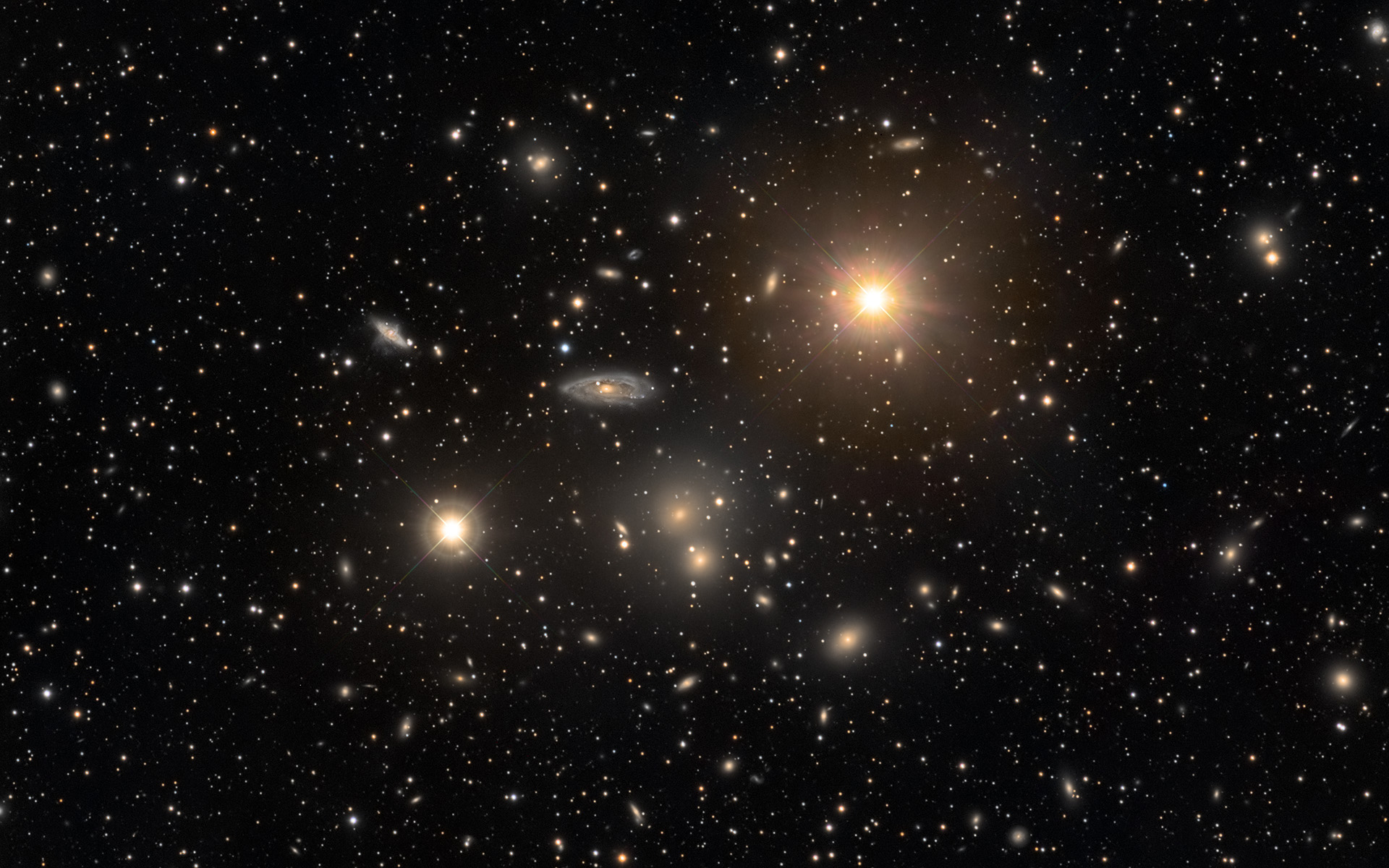
この宇宙のスナップショットの前景には、私たちの銀河系である天の川銀河内の2つの星が中心に据えられています。それらの星の向こうには、うみへび座銀河団の銀河が広がっています。実際、前景の尖った星は数百光年離れていますが、うみへび座銀河団の銀河は1億光年以上離れています。銀河団の中心付近にある3つの大きな銀河、2つの黄色い楕円銀河(NGC 3311、NGC 3309)と1つの目立つ青い渦巻銀河(NGC 3312)が支配的な銀河で、それぞれ直径は約15万光年です。NGC 3312のすぐ上と左には、NGC 3314としてカタログ化されている興味深い重なり合った銀河ペアがあります。アベル1060としても知られるうみへび座銀河団は、天の川銀河から2億光年以内にある3つの大きな銀河団の1つです。近傍宇宙では、銀河は重力によって束縛されて銀河団を形成し、それらの銀河団はさらに緩やかに束縛されて超銀河団を形成し、超銀河団はさらに大きなスケールで整列しているように見える。1億光年の距離では、この構造は直径約130万光年にも及ぶ。
原文(English)
Two stars within our own Milky Way galaxy anchor the foreground of this cosmic snapshot. Beyond them lie the galaxies of the Hydra Cluster. In fact, while the spiky foreground stars are hundreds of light-years distant, the Hydra Cluster galaxies are over 100 million light-years away. Three large galaxies near the cluster center, two yellow ellipticals (NGC 3311, NGC 3309) and one prominent blue spiral (NGC 3312), are the dominant galaxies, each about 150,000 light-years in diameter. An intriguing overlapping galaxy pair cataloged as NGC 3314 is just above and left of NGC 3312. Also known as Abell 1060, the Hydra galaxy cluster is one of three large galaxy clusters within 200 million light-years of the Milky Way. In the nearby universe, galaxies are gravitationally bound into clusters which themselves are loosely bound into superclusters that in turn are seen to align over even larger scales. At a distance of 100 million light-years this picture would be about 1.3 million light-years across.
\ この感動を宇宙仲間にシェア /
宇宙をXでシェア
© Angus Lau / APOD