太陽 vs. スーパームーン
Sun vs. Super Moon
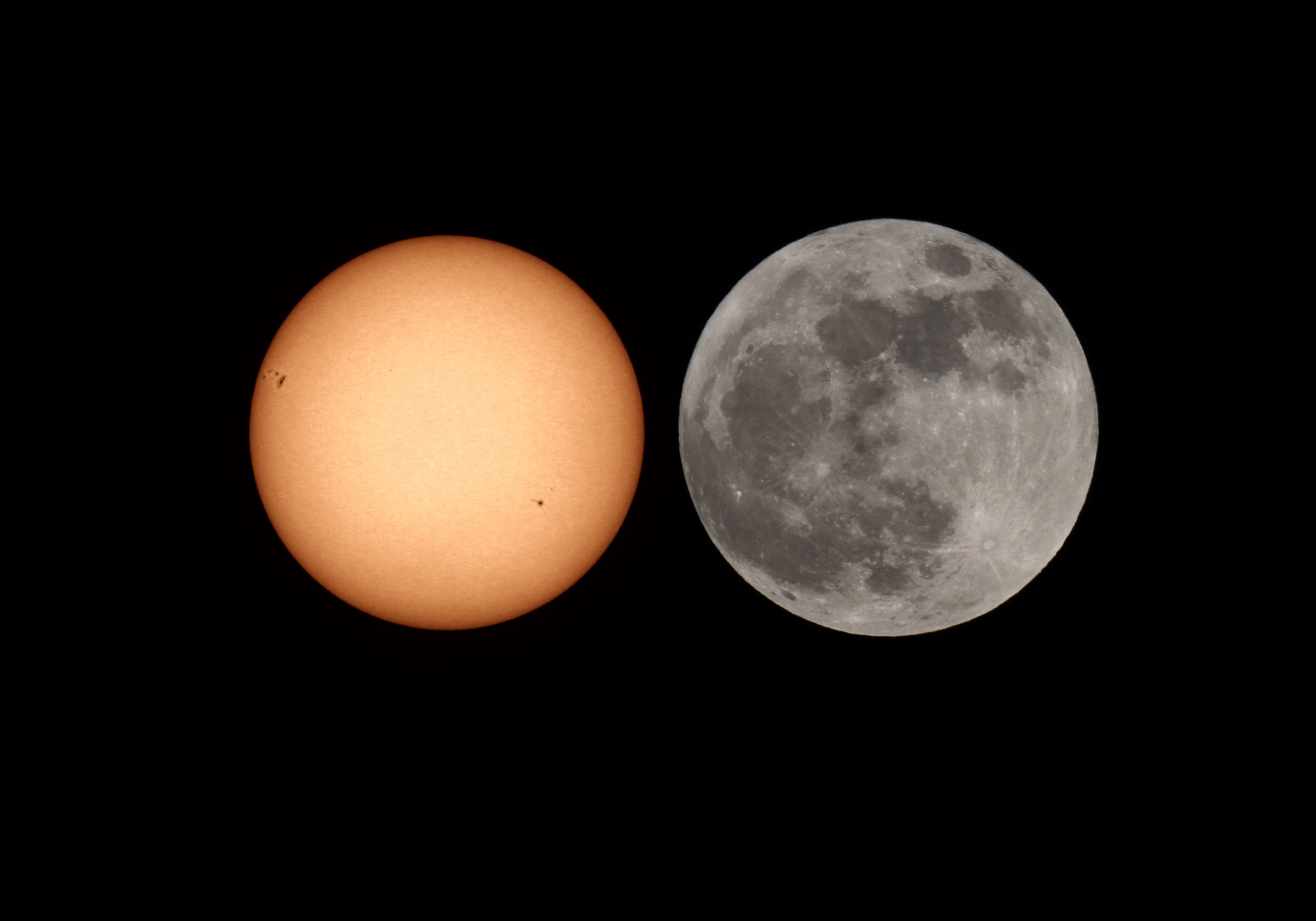
この巧妙な合成写真では、見かけの大きさを太陽と比較すると、スーパームーンがわずかに勝っています。この写真を作成するために、5月6日の満月を、翌日に太陽を撮影するのに使用したのと同じカメラと望遠鏡(濃密な太陽フィルター付き!)で撮影しました。もちろん、5月6日の月は近地点、つまり楕円軌道上で地球に最も近い地点にあり、2012年で最大の満月でした。2週間後の5月20日には、月は遠地点、つまり軌道上で最も遠い地点に近くなるため、その頃には見かけの大きさはほぼ最小になります。また、この日は新月でもあります。そして、5月20日にはアジア、太平洋、北アメリカの大部分で2012年最初の皆既日食が見られるため、新月を太陽と比較するのは驚くほど簡単でしょう。240~300キロメートル幅の帯に沿って、金環日食が起こります。遠地点付近では、小さくシルエットになった月が明るい太陽円盤の内側にちょうど収まるだろう。
原文(English)
The Super Moon wins, by just a little, when its apparent size is compared to the Sun in this ingenious composite picture. To make it, the Full Moon on May 6 was photographed with the same camera and telescope used to image the Sun (with a dense solar filter!) on the following day. Of course, on May 6 the Moon was at perigee, the closest point to Earth in its eliptical orbit, making it the largest Full Moon of 2012. Two weeks later, on May 20, the Moon will be near apogee, the most distant point in its orbit, so by then it will be nearly at its smallest apparent size. It will also be a dark New Moon on that date. And for some the New Moon will be surprisingly easy to compare to the Sun, because on May 20 the first solar eclipse of 2012 will be visible from much of Asia, the Pacific, and North America. Along a path 240 to 300 kilometers wide, the eclipse will be annular. Near apogee the smaller silhouetted Moon will fit just inside the bright solar disk.
\ この感動を宇宙仲間にシェア /
宇宙をXでシェア
© Charlie Szabototh / APOD