赤と青のさそり座
Scorpius in Red and Blue
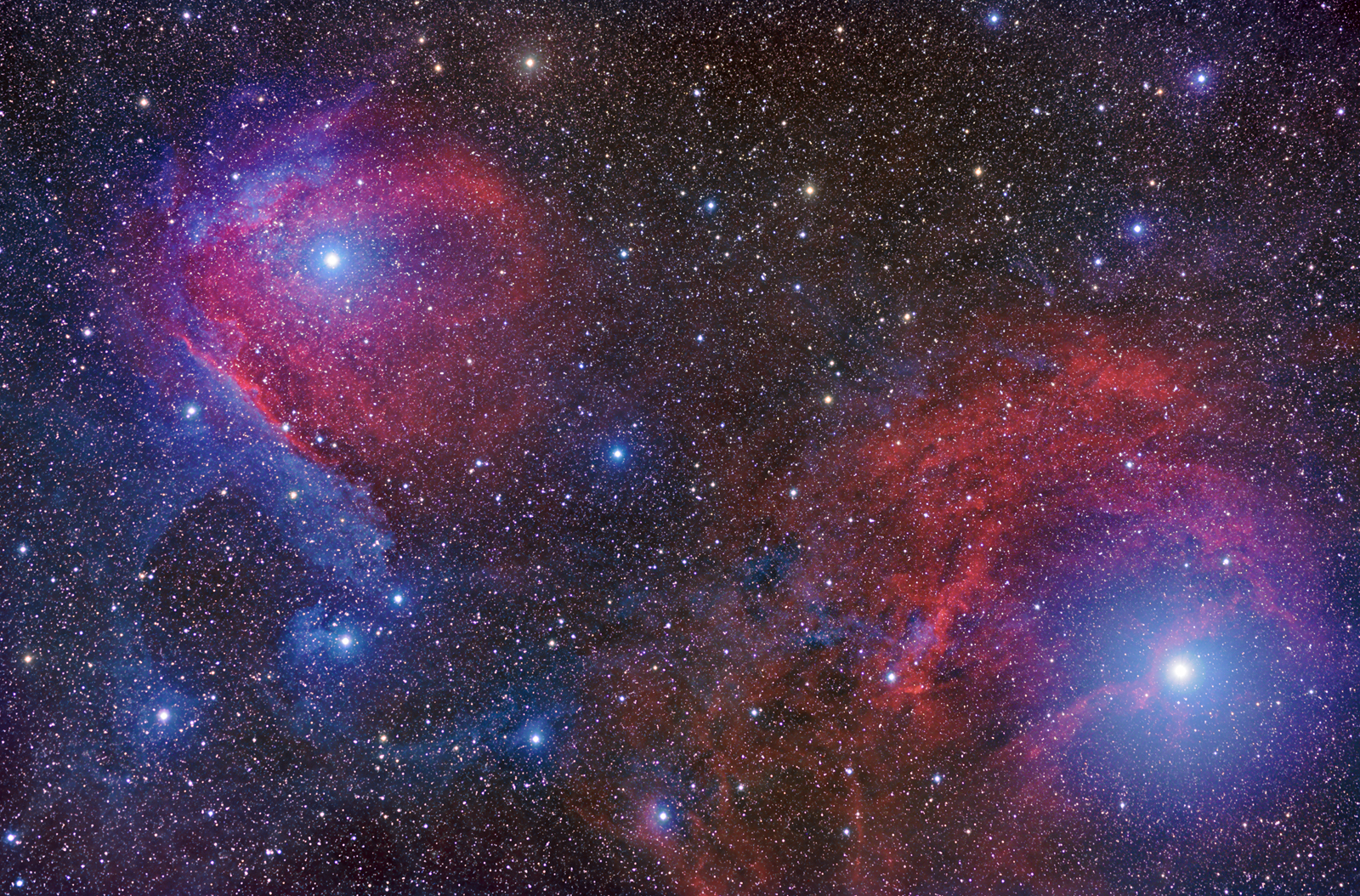
宇宙塵雲は背景の星の光を弱めますが、近くの星の光を反射します。明るい星は可視スペクトルの青色領域で強く放射する傾向があり、星間塵は赤色よりも青色の光を強く散乱するため、塵の反射星雲は青色になります。美しい例として、さそり座の頭部から望遠鏡で撮影したこの空の風景にある、明るく高温の星パイとデルタさそり座(左上と右下)の近くにある、かすかな青色の反射星雲が挙げられます。もちろん、対照的な赤い輝線星雲も、高温の星の高エネルギー放射によって引き起こされます。紫外線光子が星間雲の水素原子を電離し、電子が再結合する際に特徴的な赤い水素アルファ輝線を生成します。約600光年離れたこれらの星雲は、シャープレスカタログの第2版でSh2-1(左、反射星雲VdB 99を含む)とSh2-7として記載されています。その距離では、視野は約40光年ほどの広さになります。
原文(English)
Cosmic dust clouds dim the light of background stars. But they also reflect the light of stars nearby. Since bright stars tend to radiate strongly in the blue portion of the visible spectrum, and the interstellar dust scatters blue light more strongly than red, the dusty reflection nebulae tend to be blue. Lovely examples are the wispy blue reflection nebulae near bright, hot stars Pi and Delta Scorpii (upper left and lower right) in this telescopic skyscape from the head of the constellation Scorpius. Of course, the contrasting red emission nebulae are also caused by the hot stars' energetic radiation. Ultraviolet photons ionize hydrogen atoms in the interstellar clouds producing the characteristic red hydrogen alpha emission line as the electrons recombine. About 600 light-years away, the nebulae are found in the second version of the Sharpless Catalog as Sh2-1 (left, with reflection nebulae VdB 99) and Sh2-7. At that distance, this field of view is about 40 light-years across.
\ この感動を宇宙仲間にシェア /
宇宙をXでシェア
© John Davis / APOD