サッカレーの球体
Thackeray's Globules
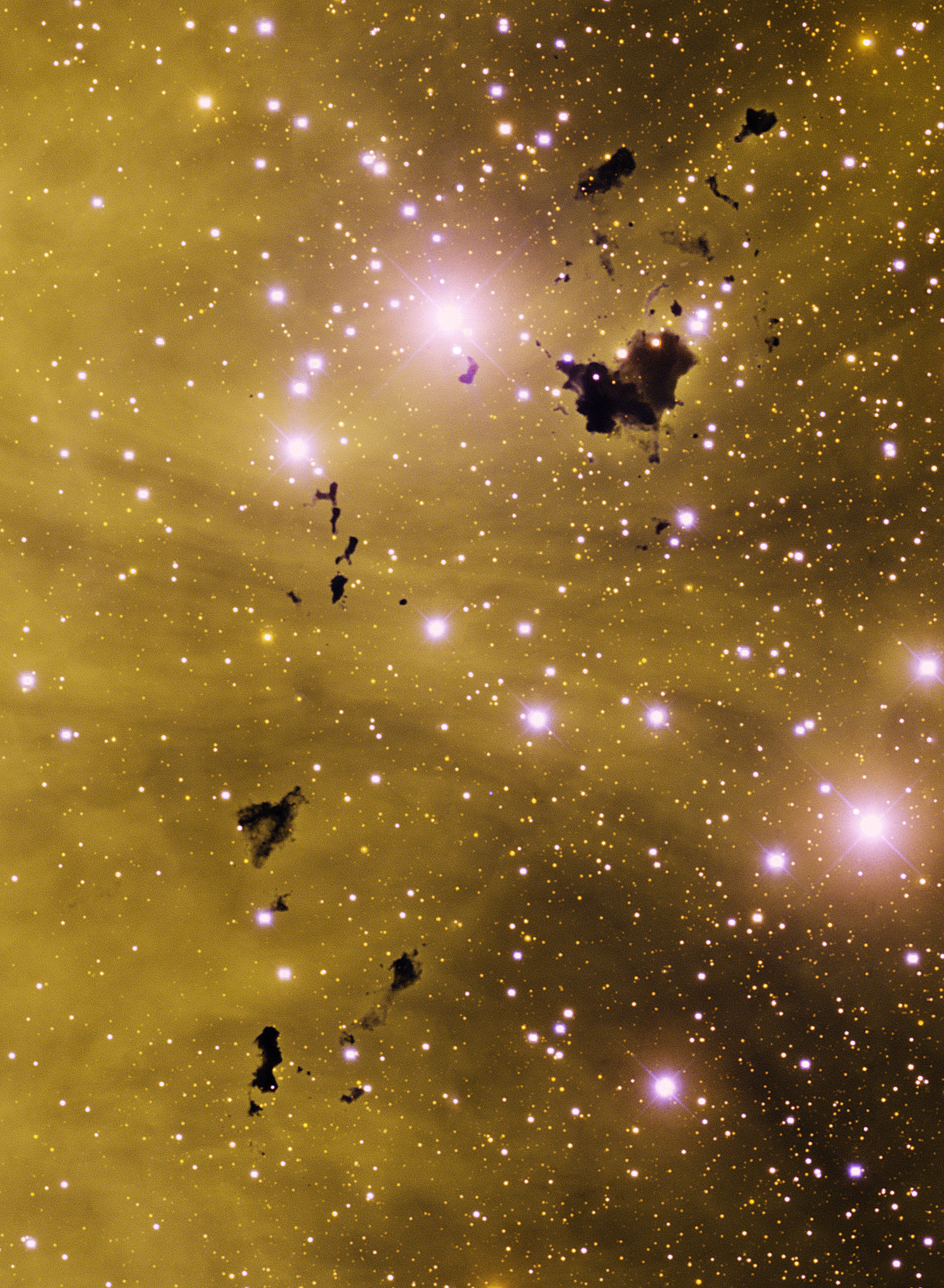
これらは、ベッドの下で見つけるよりも大きなホコリの塊です。星が豊富な領域と輝く水素ガスの中に位置するこれらの不透明な星間塵とガスの雲は、星を形成できるほど巨大です。これらの雲の故郷は、ケンタウルス座の方向に約5,900光年離れた明るい星形成領域であるIC 2944として知られています。これらの暗い球状天体のうち最大のものは、1950年に南アフリカの天文学者A. D. Thackerayによって初めて発見され、おそらく2つの別々の重なり合った雲で、それぞれが1光年以上の幅を持っています。他のデータとともに、チリのセロ・トロロにある4メートルのブランコ望遠鏡からの上記の代表的なカラー画像は、Thackerayの球状天体が、すでに明るい輝線星雲にエネルギーを与え加熱している若い高温の星からの強烈な紫外線放射の結果として、分裂して渦巻いていることを示しています。これらの暗黒球状天体や、他の星形成領域に関連していることが知られている同様の天体は、最終的にはその過酷な環境によって消散してしまう可能性があります。まるで熱いフライパンの中の宇宙のバターの塊のようです。天文学画像が3倍に:FacebookとGoogle PlusでAPODの素敵な投稿をフォローしてください。
原文(English)
These are larger dust bunnies than you will find under your bed. Situated in rich star fields and glowing hydrogen gas, these opaque clouds of interstellar dust and gas are so large they might be able to form stars. Their home is known as IC 2944, a bright stellar nursery located about 5,900 light years away toward the constellation of Centaurus. The largest of these dark globules, first spotted by South African astronomer A. D. Thackeray in 1950, is likely two separate but overlapping clouds, each more than one light-year wide. Along with other data, the above representative color image from the 4-m Blanco telescope at Cerro Tololo, Chile indicates that Thackeray's globules are fractured and churning as a result of intense ultraviolet radiation from young, hot stars already energizing and heating the bright emission nebula. These and similar dark globules known to be associated with other star forming regions may ultimately be dissipated by their hostile environment -- like cosmic lumps of butter in a hot frying pan. 3x the Astronomy Images: Follow cool APOD submissions on Facebook and Google Plus.
\ この感動を宇宙仲間にシェア /
宇宙をXでシェア
© T. Rector / APOD