天の川銀河のブラックホール
The Black Hole in the Milky Way
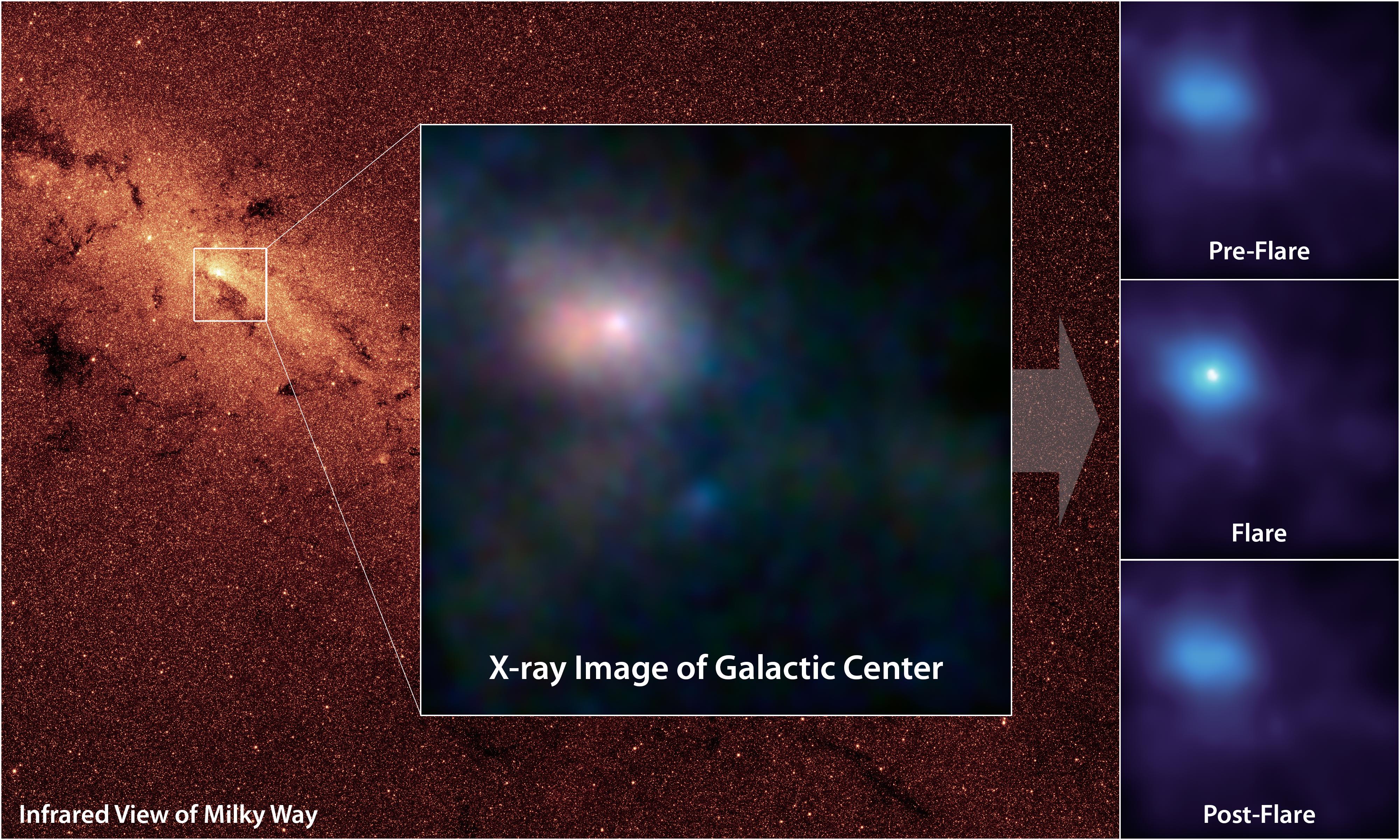
わずか27,000光年離れた天の川銀河の中心には、太陽の400万倍の質量を持つブラックホールが存在します。いて座A*(Aスターと発音)として親しまれている天の川銀河のブラックホールは、幸いにも遠方の活動銀河の中心にあるブラックホールに比べれば穏やかで、周囲の物質をはるかに静かに飲み込んでいます。しかし、時折、激しい噴火を起こすこともあります。数時間にわたる噴火の様子は、軌道上の核分光望遠鏡アレイ(NuSTAR)による一連の最先端X線画像に捉えられています。昨年6月13日に打ち上げられたNuSTARは、チャンドラやXMM観測所がアクセス可能なX線エネルギーよりも高いエネルギーで、いて座A*周辺領域を集中的に観測できる最初の観測装置です。2日間にわたるNuSTARの観測から得られたこの噴火の様子は、右端のパネルに示されています。 X線は、摂氏1億度を超える高温に加熱された物質が、銀河系の中心にあるブラックホールに落下する際に光速に近い速度まで加速されることで発生します。メインの挿入図は、約100光年にわたるX線画像です。この画像では、明るい白色の領域がブラックホールに最も近い高温の物質を表し、ピンクがかった雲は近くにある超新星残骸である可能性が高いことを示しています。
原文(English)
At the center of our Milky Way Galaxy, a mere 27,000 light-years away, lies a black hole with 4 million times the mass of the Sun. Fondly known as Sagittarius A* (pronounced A-star), the Milky Way's black hole is fortunately mild-mannered compared to the central black holes in distant active galaxies, much more calmly consuming material around it. From time to time it does flare-up, though. An outburst lasting several hours is captured in this series of premier X-ray images from the orbiting Nuclear Spectroscopic Telescope Array (NuSTAR). Launched last June 13, NuSTAR is the first to provide focused views of the area surrounding Sgr A* at X-ray energies higher than those accessible to Chandra and XMM observatories. Spanning two days of NuSTAR observations, the flare sequence is illustrated in the panels at the far right. X-rays are generated in material heated to over 100 million degrees Celsius, accelerated to nearly the speed of light as it falls into the Miky Way's central black hole. The main inset X-ray image spans about 100 light-years. In it, the bright white region represents the hottest material closest to the black hole, while the pinkish cloud likely belongs to a nearby supernova remnant.
\ この感動を宇宙仲間にシェア /
宇宙をXでシェア
© NASA / APOD