メトネ:土星の滑らかな卵の月
Methone: Smooth Egg Moon of Saturn
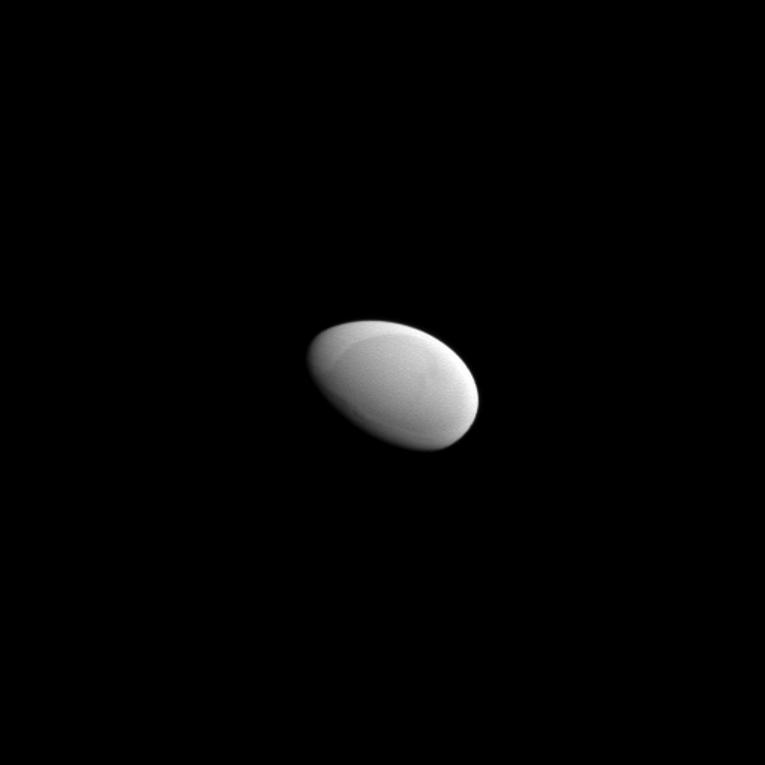
なぜこの衛星は滑らかな卵のような形をしているのでしょうか?探査機カッシーニは5月に土星の小さな衛星メトネへの史上初のフライバイを完了し、この衛星には明らかなクレーターがないことを発見しました。衝突によって形成されるクレーターは、これまで詳細に撮影されたすべての衛星、小惑星、彗星の核に見られてきました。地球やタイタンにもクレーターがあります。直径3キロメートルのこの衛星の滑らかさと卵のような形は、メトネの表面が移動できることが原因である可能性があります。これは、衛星が目に見えないほどの厚い瓦礫の層で覆われている場合に起こり得ることです。もしそうであれば、太陽系で最も類似した天体としては、土星の衛星テレスト、パンドラ、カリプソ、そして小惑星イトカワが挙げられます。これらはすべて、異常に滑らかな部分を示しています。ただし、メトネは完全に特徴がないわけではなく、表面の一部は他の部分よりも暗く見えます。メトネへのフライバイ観測は困難ではあるものの、この特異な衛星の性質や歴史への関心は今後も続くことは間違いないだろう。
原文(English)
Why is this moon shaped like a smooth egg? The robotic Cassini spacecraft completed the first flyby ever of Saturn's small moon Methone in May and discovered that the moon has no obvious craters. Craters, usually caused by impacts, have been seen on every moon, asteroid, and comet nucleus ever imaged in detail -- until now. Even the Earth and Titan have craters. The smoothness and egg-like shape of the 3-kilometer diameter moon might be caused by Methone's surface being able to shift -- something that might occur were the moon coated by a deep pile of sub-visual rubble. If so, the most similar objects in our Solar System would include Saturn's moons Telesto, Pandora, Calypso, as well as asteroid Itokawa, all of which show sections that are unusually smooth. Methone is not entirely featureless, though, as some surface sections appear darker than others. Although flybys of Methone are difficult, interest in the nature and history of this unusual moon is sure to continue.
\ この感動を宇宙仲間にシェア /
宇宙をXでシェア
© NASA / APOD