白鳥座の雲
Clouds in Cygnus
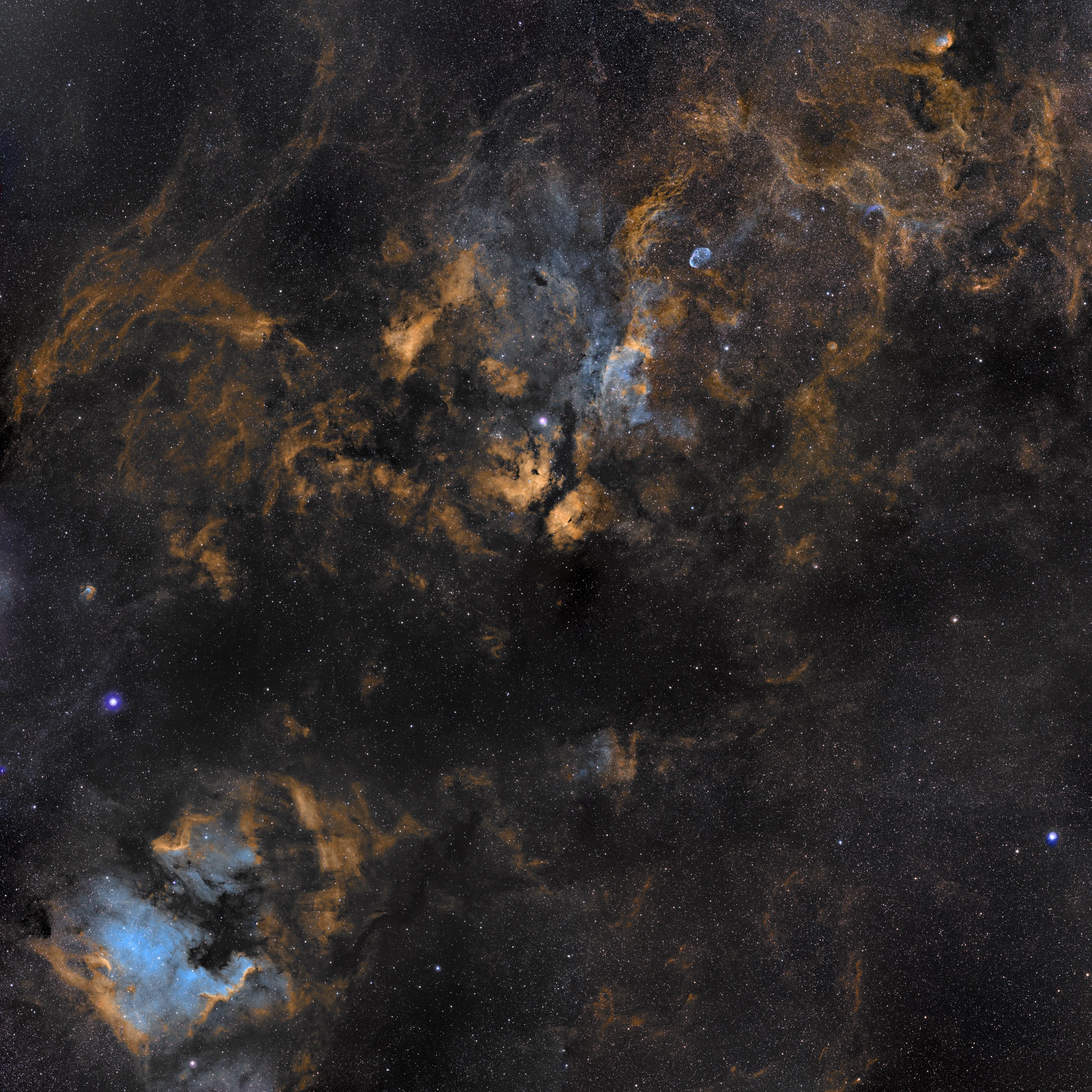
宇宙のガスと塵の雲が、はくちょう座の高所にある12×12度の視野を覆う壮大なモザイクを漂っています。ハッブルパレットで表現された広帯域と狭帯域の画像データを組み合わせたこの共同制作のスカイスケープは、左端近くの中央下部に明るく高温の超巨星デネブによって中心に据えられています。はくちょう座のアルファ星であるデネブは、北十字星群の頂点に位置し、ここでは北の石炭袋として知られる暗い空洞の隣に見えます。デネブの下には、北アメリカ星雲とペリカン星雲(NGC 7000とIC 5070)が認識できます。もう一つの超巨星サドル(はくちょう座γ星)は、蝶星雲の明るい翼のすぐ上の視野の中央付近にあります。右上に線を伸ばすと、よりコンパクトな三日月星雲に出会い、最後にフレームの上部近くにチューリップ星雲があります。これらの複雑な星雲のほとんどは、約2,000光年離れた場所にあります。それらは太陽とともに、天の川銀河のオリオン腕に位置している。
原文(English)
Cosmic clouds of gas and dust drift across this magnificent mosaic covering a 12x12 degree field within the high flying constellation Cygnus. The collaborative skyscape, a combination of broad and narrow band image data presented in the Hubble palette, is anchored by bright, hot, supergiant star Deneb, below center near the left edge. Alpha star of Cygnus, Deneb, is the top of the Northern Cross asterism and is seen here next to the dark void known as the Northern Coal Sack. Below Deneb are the recognizable North America and Pelican nebulae (NGC 7000 and IC 5070). Another supergiant star, Sadr (Gamma Cygni) is near the center of the field just above the bright wings of the Butterfly Nebula. A line continuing up and right will encounter the more compact Crescent Nebula and finally the Tulip Nebula near the top of the frame. Most of these complex nebulosities are located about 2,000 light-years away. Along with the Sun, they lie in the Orion spiral arm of our Milky Way galaxy.
\ この感動を宇宙仲間にシェア /
宇宙をXでシェア
© Bob Caton / APOD